
Career Change Quiz
How the Scales are Structured
Who Usually Takes This Test?
See How You Compare
Below is a preview of how scores are typically distributed across each scale.
Example Questions From the Test
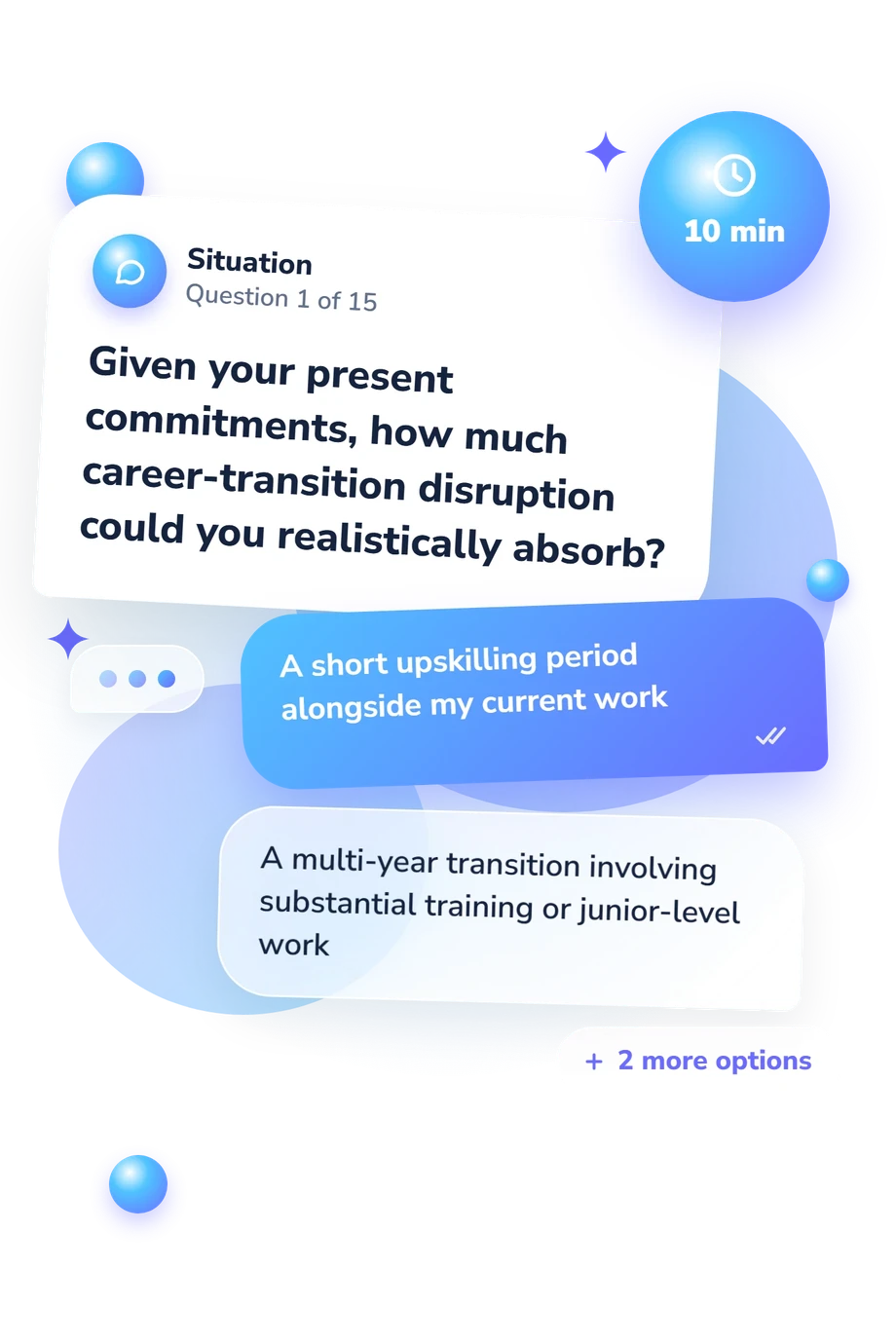
- A short upskilling period alongside my current work
- A multi-year transition involving substantial training or junior-level work
- A focused six-to-twelve-month period of study, saving, or reduced hours
- Very little; continuity of role and income is my current priority
- Create a realistic entry plan and begin meeting its training requirements
- Arrange a small experiment, such as a class, project, or job-shadowing day
- Search for a related position that still relies heavily on my current background
- Keep it as an interest while focusing my search within my established field
- The freedom and energy needed to rebuild from the beginning
- My reputation and relationships in the field
- My core strengths, even if I use them in another industry
- The specialized knowledge I have accumulated
Career Change Quiz - Description and methodology of the test
People considering a professional transition can use this career change quiz to compare continuity, a bridge into another field, and a more substantial restart. It is intended for people who want to reflect on fit, resources, learning demands, and acceptable disruption before choosing a direction. For people considering later transitions, the career change at 50 quiz can be useful when experience, financial commitments, and retraining time shape the decision.
What This Assessment Explores
Questions examine disruption tolerance, learning demands, beginner status, and whether strengths can travel. They also distinguish workplace frustration from dissatisfaction with the work itself.
When timing shapes a decision, the career change at 40 quiz can clarify whether the desired move is occupational, environmental, or skill-based.
These routes are:
- Adjacent Career Move (0-15) shows continuity with selected change: Distant Fit (0-5) favors broader change, Possible Fit (6-10) permits a partial shift, and Strong Fit (11-15) favors continuity.
- Full Career Reinvention (0-15) shows openness to new identity and learning: Distant Fit (0-5) favors continuity, Possible Fit (6-10) calls for testing, and Strong Fit (11-15) favors a restart.
- Transferable-Skills Pivot (0-15) shows interest in carrying strengths into another field: Distant Fit (0-5) favors continuity or a clean restart, Possible Fit (6-10) supports a bridge, and Strong Fit (11-15) favors transfer.
Methodology and Scientific Basis
Each prompt presents four response options covering continuity, retraining, experimentation, and professional change. You choose the response closest to your priorities, creating a self-report profile rather than a single overall score.
Answers form three route scores; higher values indicate stronger fit, while scores within one point can suggest a blend. Because no per-answer key, normative sample, reliability estimate, or standardization procedure is stated, the bands are comparative labels rather than validated cutoffs.
Conceptually, the questionnaire is consistent with the Career Transitions Inventory (Heppner et al., 1994), which addresses career-change resources; it is not an adaptation of that instrument. Otto et al. (2010) and Medici et al. (2020) add perspectives on occupational mobility.
Used for early reflection, a free career-change quiz can precede research into training, finances, job-shadowing, or bridge roles. Compare options with actual demands and small experiments.
For someone using a mid-life career-change quiz, the profile can frame continuity and disruption without treating age as destiny. Responses can shift with current stress, selective presentation, and limited self-awareness, so use the result as a starting point for practical judgment.
- Heppner, Mary J., Karen D. Multon, and Joseph A. Johnston. (1994). Assessing Psychological Resources during Career Change: Development of the Career Transitions Inventory. Journal of Vocational Behavior, 44(1), 55-74. 10.1006/jvbe.1994.1004
- Otto, Kathleen, Dorothea E. Dette-Hagenmeyer, and Claudia Dalbert. (2010). Occupational Mobility in Members of the Labor Force: Explaining the Willingness to Change Occupations. Journal of Career Development, 36(3), 262-288. 10.1177/0894845309345842
- Medici, Guri, Cécile Tschopp, Gudela Grote, and Andreas Hirschi. (2020). Grass roots of occupational change: Understanding mobility in vocational careers. Journal of Vocational Behavior, 122, 103480. 10.1016/j.jvb.2020.103480
Updated: