
DNA Test Online Quiz
How the Scales are Structured
Who Usually Takes This Test?
See How You Compare
Below is a preview of how scores are typically distributed across each scale.
Example Questions From the Test
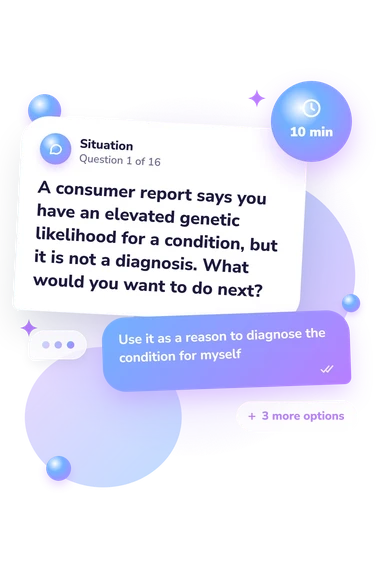
- Use it as a reason to diagnose the condition for myself
- Note it as interesting information without making decisions from it
- Read about its limits and raise it at a future routine appointment
- Seek appropriate clinical or genetic-counseling guidance before acting on it
- Comfortable; I can consider genetics alongside family history, environment, and medical guidance
- Somewhat comfortable if the report clearly explains its limits
- Only mildly comfortable; I mainly want simple recreational information
- Uncomfortable; I need a different type of test with a non-health purpose
- It is my main reason for considering a test
- It is one useful feature among several
- I am mildly curious but would not choose a test for it
- I would prefer a test that does not center on relative matching
DNA Test Online Quiz - Description and methodology of the test
People deciding what they want from consumer genetic testing can use an ancestry quiz to clarify priorities before choosing a service. The DNA Test Online Quiz turns that reflection into a profile rather than a laboratory finding. It can help organize genetic testing goals when someone is weighing origins, relationship evidence, health information, or genealogy. The strongest profile, or a blended result when scores are close, offers a starting point.
What This Assessment Explores
This assessment explores which genetic information feels most relevant, not a DNA result itself. Questions cover origins, family stories, matching, kinship, probabilistic health reports, consent, and uncertainty. A DNA ancestry test may suggest one place, but this result describes whether origins, relationships, health insights, or genealogy fit the visitor’s current purpose.
The four result dimensions are:
- Ancestry Origins Testing (0-12) measures regional interest: Secondary interest (0-4), Meaningful interest (5-8), Strong affinity (9-12).
- Biological Relationship Testing (0-12) measures focused kinship interest: Secondary interest (0-4), Meaningful interest (5-8), Strong affinity (9-12).
- Genetic Health Insights (0-12) measures probabilistic health-information interest: Secondary interest (0-4), Meaningful interest (5-8), Strong affinity (9-12).
- Relative Matching and Genealogy (0-12) measures matching and family-tree interest: Secondary interest (0-4), Meaningful interest (5-8), Strong affinity (9-12).
The highest score is the strongest affinity; scores within one point form a blended result.
Methodology and Scientific Basis
Each item presents four response options. Scenarios cover changing ancestry estimates, unexpected relatives, consent, legal sample handling, and probabilistic health findings, capturing both preferred information and readiness to interpret it cautiously. A relationship DNA test is framed as a focused question requiring relevant people’s participation; matching and genealogy involve boundaries.
Response patterns produce four scores. The catalogue compares them rather than giving one total: the highest shows strongest affinity, and scores within one point form a blended result. Since each answer’s point contribution is not specified, the bands are interpretive ranges, not validated probabilities, diagnostic cutoffs, or population norms.
The themes are conceptually consistent with Hazel et al. (2021), which studied prospective users’ attitudes to ancestry and biological-relationship information. Roberts et al. (2017) examined motivations, decisions, and perceived usefulness in direct-to-consumer testing. This questionnaire is not an adaptation of either instrument, so the studies support relevance, not its scoring or validity.
Self-report results may shift with current priorities, expectations, and self-knowledge. Health-related findings need cautious interpretation and professional confirmation when consequential; the quiz cannot diagnose or rule out disease.
- Hazel JW, Hammack-Aviran C, Brelsford KM, Malin BA, Beskow LM, Clayton EW. Direct-to-consumer genetic testing: Prospective users' attitudes toward information about ancestry and biological relationships. PLOS ONE. 2021;16(11):e0260340. 10.1371/journal.pone.0260340
- Roberts JS, Gornick MC, Carere DA, Uhlmann WR, Ruffin MT, Green RC. Direct-to-Consumer Genetic Testing: User Motivations, Decision Making, and Perceived Utility of Results. Public Health Genomics. 2017;20(1):36-45. 10.1159/000455006