
Random Trivia Quiz
How the Scales are Structured
Who Usually Takes This Test?
See How You Compare
Below is a preview of how scores are typically distributed across each scale.
Example Questions From the Test
- Humans first landed on the Moon.
- The first successful powered airplane flight took place.
- The Berlin Wall fell.
- The United Nations was founded.
- Pollination
- Germination
- Transpiration
- Phototropism
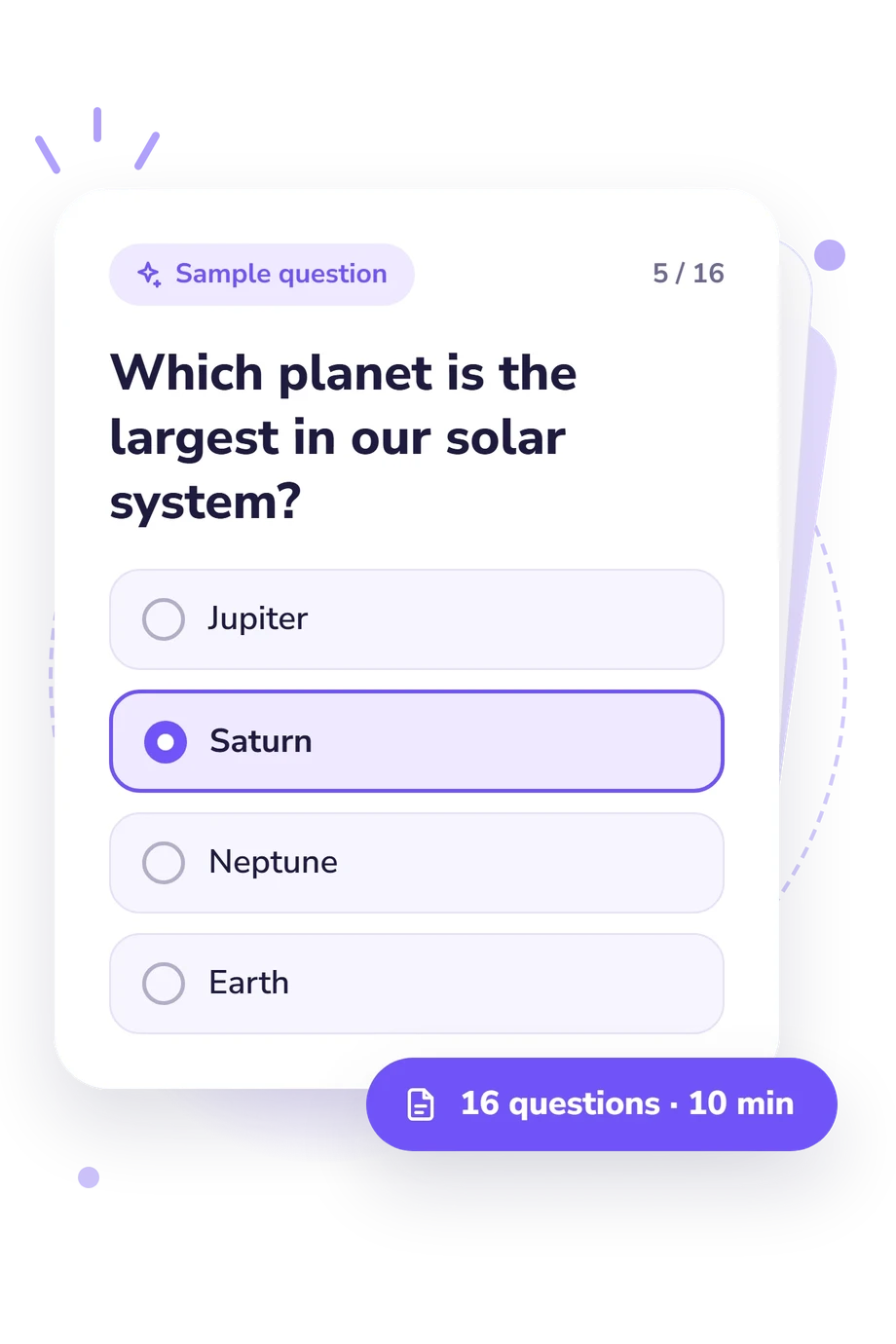
- Jupiter
- Saturn
- Neptune
- Earth
Random Trivia Quiz - Description and methodology of the test
Readers who enjoy broad factual challenges can use the random trivia quiz to see how they perform on its particular set of questions. It measures knowledge recall and simple application across subjects, so the result describes performance on this sample. As an online activity, it suits independent self-checks and informal play; friends can also take a trivia quiz online together. It fits a personal check or shared challenge.
What This Assessment Explores
Instead of focusing on one school subject, the assessment samples general knowledge across science, history, language, art, literature, government, chemistry, and everyday reasoning. Items ask you to explain, order, calculate, identify, or recall, so the result reflects both factual familiarity and simple application. It suits anyone seeking a broad self-check or a way to choose topics for further study. Varied subjects keep this fun trivia quiz broad and engaging.
The displayed Random Trivia Knowledge scale (0-16) has these bands:
- Curious Starter (0-6) indicates some recognized ideas and topics left to explore.
- Developing Generalist (7-12) indicates a useful base with noticeable gaps.
- Trivia Standout (13-16) indicates broad, reliable knowledge across varied topics, while still reflecting this sample rather than all general knowledge.
It can be used as a group quiz, with bands offering an easy shared result for this sample.
Methodology and Scientific Basis
Each question has a short stem and four answer choices; one response is best supported by fact or straightforward reasoning. The format tests recognition or application, not generated answers. The quiz draws on trivia from several domains and uses the same four-choice format throughout; an incorrect response may reflect unfamiliarity, wording, or a momentary lapse.
Results appear as one displayed knowledge score; item-to-point allocation or weighting is not documented, so it is not a calibrated estimate of every area of knowledge. The Lynn et al. (2002) general knowledge test provides a conceptual comparison for treating knowledge as measurable across domains. Rolfhus and Ackerman (1999) distinguish knowledge from intelligence and related traits, while Goecke et al. (2022) support multiple-choice formats for assessing fact knowledge. These studies do not validate this online questionnaire itself.
Interpret the bands descriptively rather than as population norms. Performance can vary with education, cultural exposure, language, attention, current context, and self-selection; a short sample cannot represent all general knowledge. The score is most useful as a snapshot for reflection and topic exploration.
- Lynn, Richard, Paul Irwing, and Thomas Cammock. 2002. "Sex differences in general knowledge." Intelligence 30(1): 27-39. 10.1016/S0160-2896(01)00064-2
- Rolfhus, Eric L., and Phillip L. Ackerman. 1999. "Assessing individual differences in knowledge: Knowledge, intelligence, and related traits." Journal of Educational Psychology 91(3): 511-526. 10.1037/0022-0663.91.3.511
- Goecke, Benjamin, Marlena Staab, Catherine Schittenhelm, and Oliver Wilhelm. 2022. "Stop Worrying about Multiple-Choice: Fact Knowledge Does Not Change with Response Format." Journal of Intelligence 10(4): 102. 10.3390/jintelligence10040102
Updated: