
Financial Planning Quiz
How the Scales are Structured
Who Usually Takes This Test?
See How You Compare
Below is a preview of how scores are typically distributed across each scale.
Example Questions From the Test
- The cash earns a higher return automatically
- The cash generally buys fewer goods and services
- The cash becomes legally protected from market changes
- The cash balance decreases by the inflation rate
- Become better with money in the future
- Spend less whenever it feels practical
- Save $3,000 for moving costs within 12 months
- Save as much as possible for something important
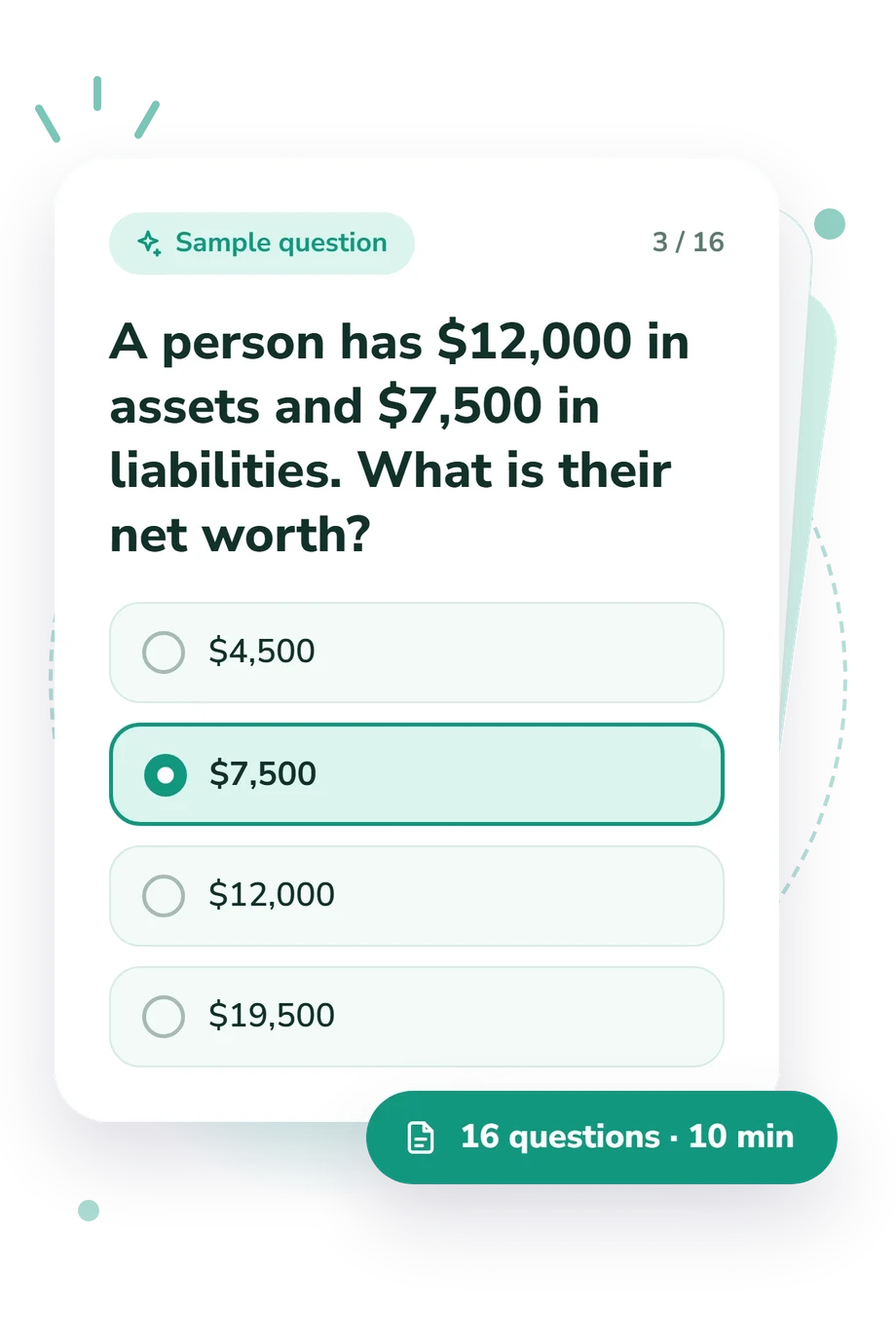
- $4,500
- $7,500
- $12,000
- $19,500
Financial Planning Quiz - Description and methodology of the test
People who want to make more deliberate choices about saving, borrowing, protection, and investing can use this financial planning quiz to check their understanding and recognition of practical financial-planning principles in everyday situations. Designed as an educational personal finance quiz for self-directed learners, it provides a clear snapshot of the breadth of practical knowledge shown across these planning topics and highlights areas for review.
What This Assessment Explores
The questionnaire examines financial planning knowledge through everyday choices rather than wealth or income. It asks whether respondents recognize relationships among concepts, compare trade-offs, and select reasonable actions when circumstances change.
Financial Planning Knowledge is scored 0-16: Foundation to build (0-6), Developing knowledge (7-12), and Strong knowledge (13-16). This score describes the breadth of concepts recognized across the tested planning areas.
The main topic groups are:
- Budgeting and goals measure recognition of budgeting principles, expense planning, and specific, measurable goals.
- Borrowing and credit indicate understanding of interest costs, grace periods, and repayment priorities.
- Insurance and protection reflect recognition of premiums, deductibles, and coverage trade-offs.
- Saving and investing cover emergency reserves, compound interest, diversification, time horizon, and rebalancing.
Through its result, this money management quiz helps learners prioritize practical topics for further study.
Methodology and Scientific Basis
Each item presents a short financial situation with four answer choices. The questionnaire reports an overall knowledge score, but its displayed description gives no separate weights or partial-credit rules; point values should not be inferred from the range. Interpret the result as sampled knowledge: its band reflects breadth across tested planning areas, while individual answers indicate topics for review.
The finance quiz uses scenario-based multiple-choice questions to test applied planning knowledge and is conceptually consistent with the Financial Education Outcome Instrument described by Skimmyhorn and colleagues in 2016. It also aligns with the OECD/INFE measurement framework and Remund’s definition of financial literacy as understanding and using financial knowledge in practical decisions. These sources support the sampled construct; they do not make this online questionnaire an adaptation, validated translation, or standardized administration of those instruments.
Performance can vary with answer accuracy, attention, current knowledge, terminology familiarity, and situational context. The financial quiz result can guide learning and reflection; it is an educational summary, not individualized financial advice or a measure of wealth or future outcomes.
- William L. Skimmyhorn, Evan R. Davies, David Mun, and Brian Mitchell (2016). Assessing financial education methods: Principles vs. rules-of-thumb approaches. The Journal of Economic Education, 47(3), 193-210. 10.1080/00220485.2016.1179145
- OECD (2022). OECD/INFE Toolkit for Measuring Financial Literacy and Financial Inclusion 2022. OECD Publishing, Paris. 10.1787/cbc4114f-en
- David L. Remund (2010). Financial literacy explicated: The case for a clearer definition in an increasingly complex economy. Journal of Consumer Affairs, 44(2), 276-295. 10.1111/j.1745-6606.2010.01169.x
Updated: