
Airplane Quiz
How the Scales are Structured
Who Usually Takes This Test?
See How You Compare
Below is a preview of how scores are typically distributed across each scale.
Example Questions From the Test
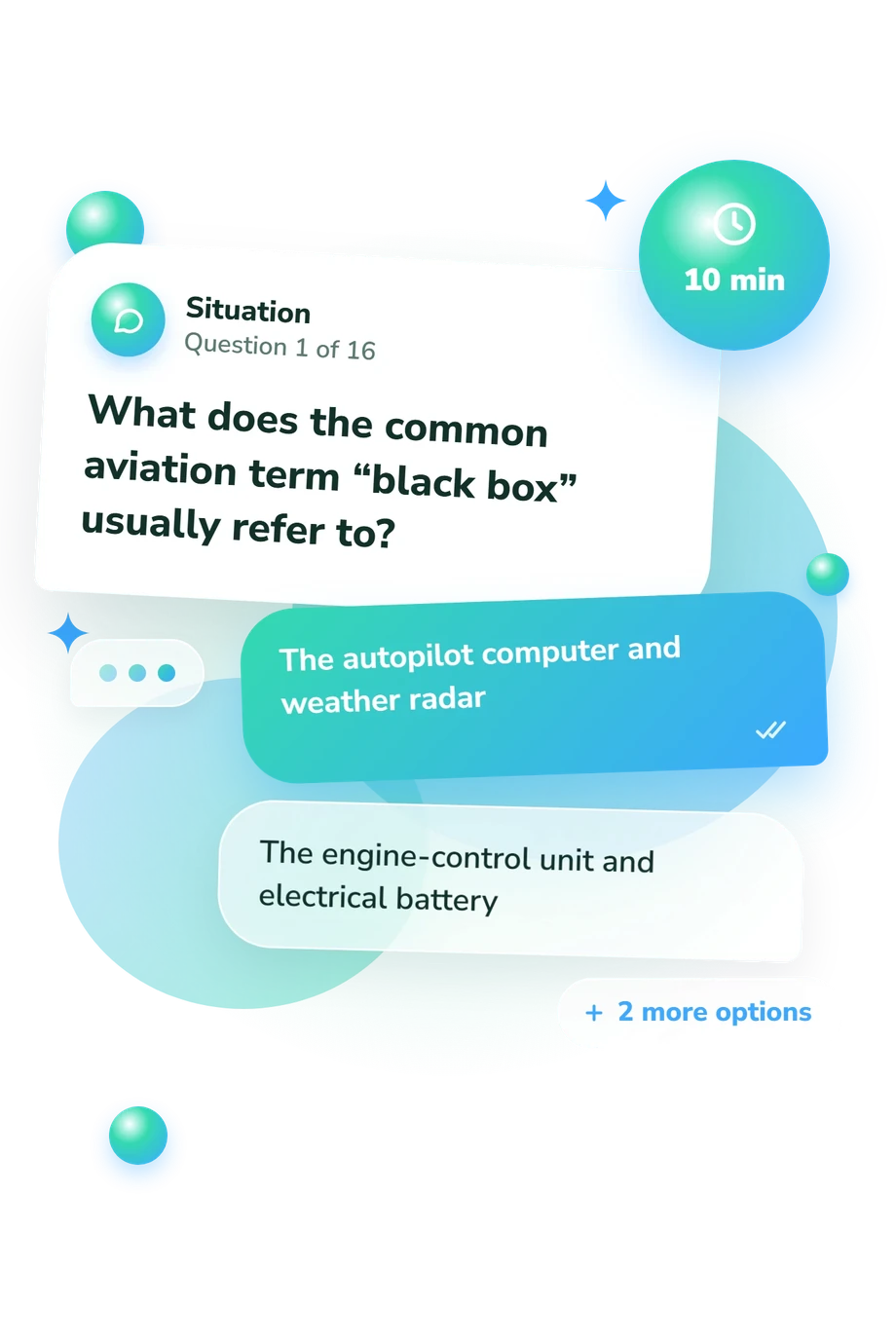
- The autopilot computer and weather radar
- The engine-control unit and electrical battery
- The transponder and emergency locator transmitter
- The flight data recorder and cockpit voice recorder
- They reduce drag so the airplane can approach faster
- They reduce both lift and drag to steepen the descent
- They increase thrust without changing wing performance
- They increase lift and drag, permitting flight at a lower speed
- Magnetic compass
- Attitude indicator
- Airspeed indicator
- Engine tachometer
Airplane Quiz - Description and methodology of the test
People who want to strengthen their aviation basics can use this airplane quiz to check how confidently they handle core concepts and practical decisions. It suits curious learners, student pilots, aviation enthusiasts, and anyone seeking a focused way to test their understanding through a plane quiz. The result provides a single banded knowledge summary, showing overall performance and indicating where further study may be useful.
What This Assessment Explores
As an aviation knowledge quiz, this assessment examines practical understanding rather than personal preference or flying style. Its items move across foundational concepts and short operational scenarios, asking the respondent to identify standard equipment, control effects, aerodynamic forces, emergency priorities, runway markings, performance factors, and wake-turbulence precautions. That scope suits people refreshing core aviation theory because it tests both remembered principles and their application to practical situations.
The result is organized into these interpretations:
- Airplane Knowledge (0-16) summarizes performance across general airplane principles and operations.
- Foundational (0-6) indicates recognition of some aviation ideas while core forces, controls, and procedures may need review.
- Developing (7-12) indicates a useful base and the ability to apply many concepts, with some technical or operational gaps.
- Strong (13-16) indicates broad, accurate knowledge across factual and scenario-based questions.
Methodology and Evidence Base
Each prompt uses multiple choice, with one best answer among four options. Items test recognition and application: a respondent may connect a blocked pitot tube with airspeed information, relate bank angle to vertical lift, or prioritize control after engine failure. The aircraft quiz checks practical reasoning as well as factual recall.
Content selection is conceptually consistent with the FAA's Pilot's Handbook (2023): its coverage of flight principles, controls, systems, performance, and operations matches the knowledge tested here. The FAA's 2021 Flying Handbook covers stalls, gliding, takeoff, landing, and emergency-control principles represented by several scenarios. Novacek's 2017 paper addresses confidence-based aviation assessment rather than validating this questionnaire; together, these sources provide subject-matter context, so the bands summarize performance on this question set rather than comparison with a reference population.
The score is a snapshot of performance on these questions. The questionnaire turns responses into a displayed total and band, while guessing, attention, and current study exposure can affect the result. Use the outcome to choose review topics and track learning.
- Federal Aviation Administration. Pilot's Handbook of Aeronautical Knowledge, FAA-H-8083-25C. Washington, DC: U.S. Department of Transportation, 2023.
- Federal Aviation Administration. Airplane Flying Handbook, FAA-H-8083-3C. Washington, DC: U.S. Department of Transportation, 2021.
- Paul E. Illman and Gene Gailey. The Pilot's Handbook of Aeronautical Knowledge, Fifth Edition. New York: McGraw-Hill Professional, 2013.
- Paul F. Novacek. Exploration of a Confidence-Based Assessment Tool within an Aviation Training Program. Journal of Aviation/Aerospace Education & Research, 26(1), 65-88, 2017. 10.15394/jaaer.2017.1717
Updated: