
Am I Anemic Quiz
How the Scales are Structured
Who Usually Takes This Test?
See How You Compare
Below is a preview of how scores are typically distributed across each scale.
Example Questions From the Test
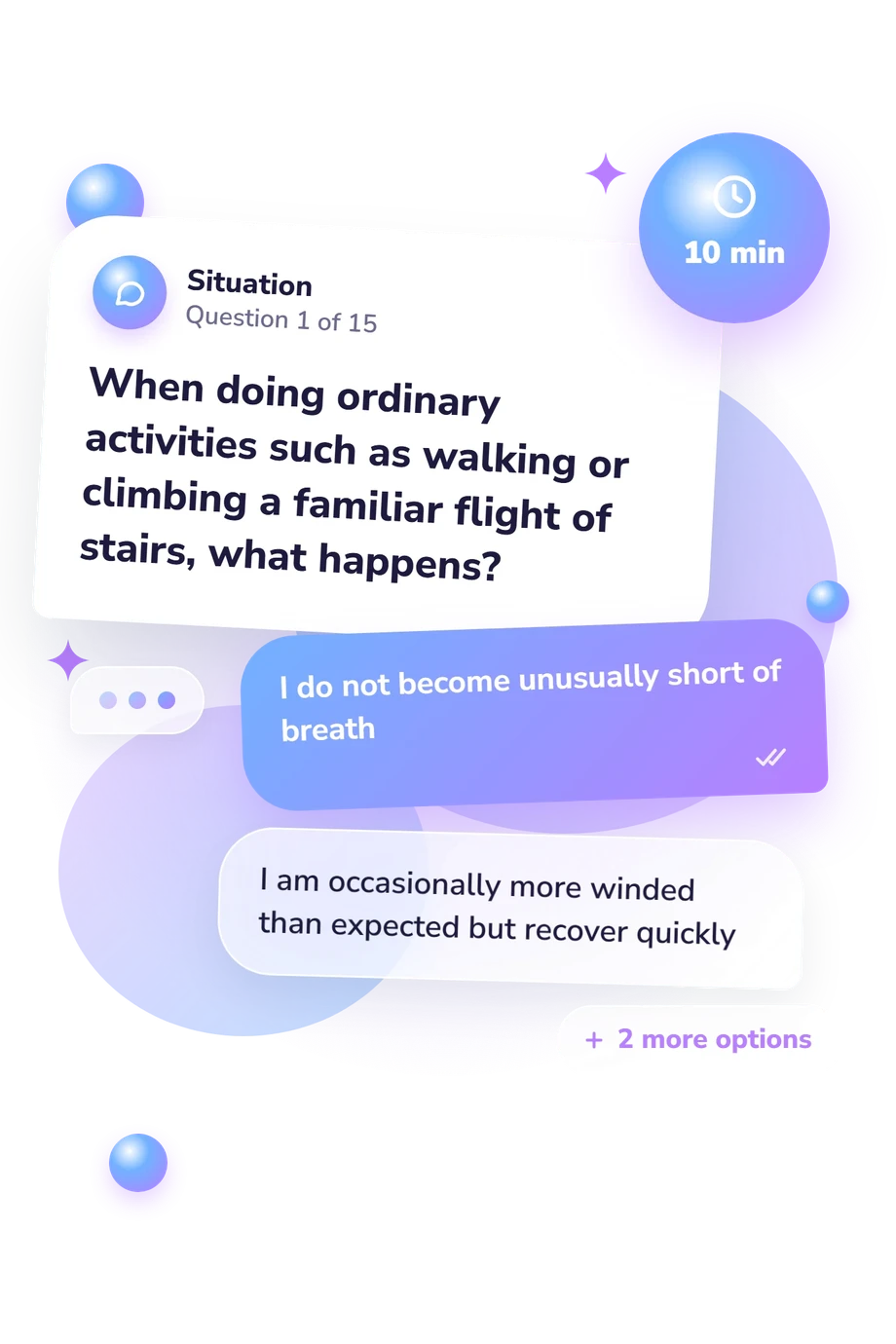
- I do not become unusually short of breath
- I am occasionally more winded than expected but recover quickly
- I often need to slow down or pause to catch my breath
- Breathlessness regularly makes me stop or avoid these activities
- I have had neither dizziness nor fainting
- I felt briefly lightheaded but was not close to fainting
- I nearly fainted or needed support to remain upright
- I fainted, collapsed, or was difficult to rouse
- I have not noticed unusual tiredness
- I noticed it on a few days, without changing my routine
- It sometimes slowed me down or made me rest earlier than usual
- It occurred most days or regularly limited normal activities
Am I Anemic Quiz - Description and methodology of the test
For people deciding whether recent experiences warrant attention, the Am I Anemic Quiz offers a structured way to prepare for a healthcare conversation. People wondering whether they have anemia can use this questionnaire as a do i have anemia quiz to weigh symptoms alongside dietary intake or food access, without treating an answer as proof of a cause.
What This Assessment Explores
The questionnaire is intended for people making sense of experiences that can accompany anaemia or iron-related problems, including tiredness, breathlessness, dizziness, bleeding, dietary intake, pregnancy, recent birth, digestive conditions, and blood donation.
As an anemia quiz, it helps distinguish symptoms from circumstances relevant to discussing iron status and urgent signals. The three result domains are:
- Anaemia-Associated Symptoms (0-15) summarizes reported symptoms; its bands are No indicators endorsed (0), Worth monitoring (1-2), and Clinical discussion indicated (3-15).
- Iron Loss and Intake Context (0-15) identifies circumstances relevant to iron discussion; its bands are No listed context endorsed (0), Context to note (1-2), and Assessment worth arranging (3-15).
- Urgent Warning Signs (0-15) flags experiences needing quicker attention; its bands are No warning signs endorsed (0), Prompt review warranted (1-2), and Urgent action indicated (3-15).
Methodology and Scientific Basis
Each item offers four ordered choices, moving from minimal experience toward more frequent, severe, or urgent descriptions. The questionnaire does not specify an item-weighting or laboratory-conversion rule, so its bands are action prompts rather than haemoglobin or iron measurements.
The evidence is thematic rather than validating this online questionnaire. Weckmann et al. (2023) supports caution because symptoms commonly attributed to anaemia are not specific alone. Hirosawa et al. (2022) keeps iron deficiency without anaemia distinct from anaemia; Bryant et al. (2013) supports asking about pica and blood-donation history, and Snook et al. (2021) supports attention to bleeding and appropriate investigation.
For readers considering a do i have low iron quiz, this questionnaire is conceptually consistent with those sources, not a validated adaptation of them. Those studies do not establish its reliability, validity, norms, or clinical cutoffs. Its results organize circumstances relevant to discussing iron status without proving deficiency.
Memory, current context, and self-awareness can affect answers, so the questionnaire is an unvalidated self-report reflection, and any red-flag response should take priority over the total.
- Weckmann G, Kiel S, Chenot J-F, Angelow A. Association of Anemia with Clinical Symptoms Commonly Attributed to Anemia-Analysis of Two Population-Based Cohorts. Journal of Clinical Medicine. 2023;12(3):921. 10.3390/jcm12030921
- Hirosawa T, Hayashi A, Harada Y, Shimizu T. The Clinical and Biological Manifestations in Women with Iron Deficiency Without Anemia Compared to Iron Deficiency Anemia in a General Internal Medicine Setting: A Retrospective Cohort Study. International Journal of General Medicine. 2022;15:6765-6773. 10.2147/IJGM.S376405
- Bryant BJ, Yau YY, Arceo SM, Hopkins JA, Leitman SF. Ascertainment of Iron Deficiency and Depletion in Blood Donors through Screening Questions for Pica and Restless Legs Syndrome. Transfusion. 2013;53(8):1637-1644. 10.1111/trf.12061
- Snook J, Bhala N, Beales ILP, Cannings D, Kightley C, Logan RP, Pritchard DMP, Sidhu R, Surgenor S, Thomas W, Verma AM, Goddard AF. British Society of Gastroenterology guidelines for the management of iron deficiency anaemia in adults. Gut. 2021;70(11):2030-2051. 10.1136/gutjnl-2021-325210
Updated: