
Greek Alphabet Quiz
How the Scales are Structured
Who Usually Takes This Test?
See How You Compare
Below is a preview of how scores are typically distributed across each scale.
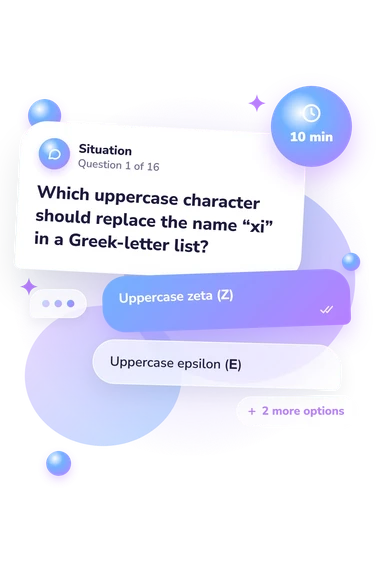
Example Questions From the Test
- Uppercase zeta (Ζ)
- Uppercase epsilon (Ε)
- Uppercase chi (Χ)
- Uppercase xi (Ξ)
- Lowercase psi (ψ)
- Lowercase theta (θ)
- Lowercase chi (χ)
- Lowercase phi (φ)
- Sigma
- Nu
- Tau
- Pi
Greek Alphabet Quiz - Description and methodology of the test
For learners beginning to read Greek, the greek alphabet quiz provides a focused check of symbol recognition rather than a broad language examination. It suits students, travelers, educators, and anyone refreshing foundational knowledge before working with Greek text, notation, or historical references. The result from this quiz can show whether mistakes arise from letter shapes, case pairs, sequence, or easily confused characters, making it useful for Greek alphabet practice.
What This Assessment Explores
This assessment focuses on alphabet knowledge rather than speaking, grammar, or translation. Items connect names with uppercase and lowercase forms, fill sequence gaps, test standard order, and distinguish final sigma from ordinary lowercase sigma. Its format makes it a greek letters quiz for reviewing visual recall.
The result reflects four closely related areas:
- Letter identity shows whether names such as xi, phi, theta, and omega match symbols.
- Case conversion indicates whether uppercase and lowercase pairs are recognized.
- Alphabetical sequencing reveals whether neighboring letters and the 24-letter order are remembered.
- Position-sensitive usage tests recognition of final sigma as a word-final form.
The Greek Alphabet Knowledge scale runs from 0 to 16. Foundations (0-6) calls for review of the alphabet and case pairs; Developing (7-12) reflects gaps in forms or ordering; Strong (13-16) indicates consistently accurate command of names, forms, and order.
Methodology and Scientific Basis
Each item presents a recognition or ordering task with four choices. Distractors use neighboring letters, similar symbols, mismatched cases, or letters from elsewhere. Final sigma is treated as a Modern Greek word-final form, consistent with grammar descriptions.
Scoring is direct: one point goes to each correct answer, so the total summarizes the tasks without weighting one topic more heavily. Sequence items turn the assessment into a quiz on the Greek alphabet in order, while case and symbol items test recognition of forms relevant to reading and writing.
The questionnaire therefore summarizes performance on these recognition tasks, rather than claiming to assess broader language ability. Modern Greek grammar references describe the conventions behind uppercase and lowercase forms and final sigma. The questionnaire is conceptually consistent with those descriptions, not an adaptation; they do not establish its reliability, norms, clinical cutoffs, or validity.
Interpret the result as a learning snapshot: prior exposure, guessing, visual presentation, and attention can affect performance. A high score does not measure pronunciation, vocabulary, fluency, or comprehension; missed pairs and sequences can guide review.
- Papanastasiou, E. C. (2022). A Greek Alphabet Guide for Research Methodology, Measurement, and Statistics. Frontiers in Education, 7, 831344. DOI 10.3389/feduc.2022.831344
- Manolitsis, G., Grigorakis, I., & Georgiou, G. K. (2017). The Longitudinal Contribution of Early Morphological Awareness Skills to Reading Fluency and Comprehension in Greek. Frontiers in Psychology, 8, 1793. DOI 10.3389/fpsyg.2017.01793
- Holton, D., Mackridge, P., & Philippaki-Warburton, I. (2004). Greek: An Essential Grammar of the Modern Language. London: Routledge. ISBN 0415232104