
Fibromyalgia Quiz
How the Scales are Structured
Who Usually Takes This Test?
See How You Compare
Below is a preview of how scores are typically distributed across each scale.
Example Questions From the Test
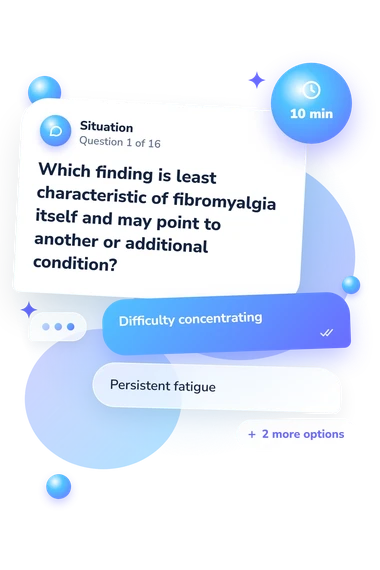
- Difficulty concentrating
- Persistent fatigue
- Visible, progressively damaged and inflamed joints
- Widespread tenderness
- To confirm fibromyalgia through a single definitive marker
- To calculate an exact fibromyalgia severity level
- To locate fibromyalgia bacteria in the bloodstream
- To investigate other conditions that can cause similar symptoms
- Problems with concentration, memory, or mental clarity
- A temporary loss of eyesight during a pain flare
- A fever caused by inflammation of the brain
- Drowsiness that occurs only as a medication side effect
Fibromyalgia Quiz - Description and methodology of the test
For readers who want to understand the condition before discussing symptoms with a clinician, this fibromyalgia quiz offers a focused way to review essential knowledge. It is useful for people living with unexplained pain, supporting someone who has been diagnosed, or preparing questions for an appointment. As a fibromyalgia knowledge test, it highlights concepts worth clarifying rather than estimating whether a person has the disorder.
What This Assessment Explores
The questionnaire checks whether a respondent recognizes the pattern commonly associated with fibromyalgia, including widespread pain, fatigue, disrupted sleep, cognitive difficulty, and altered pain processing. It also distinguishes typical features from findings that may suggest another condition. As a fibromyalgia symptoms quiz, it teaches symptom patterns rather than determining whether one person has the disorder.
Further items examine clinical assessment, pacing, gradual activity, sleep support, individualized management, and responses to urgent symptoms such as chest pressure or breathing difficulty. The result is a knowledge profile, not a symptom-severity estimate.
The catalogue reports one educational scale, Fibromyalgia Knowledge: 0-16, with these bands:
- Foundation to build (0-6) indicates that core features, assessment, or management principles need review.
- Developing knowledge (7-12) indicates that many essentials are understood, although some concepts need clarification.
- Strong knowledge (13-16) indicates a well-rounded grasp of current fundamentals.
Methodology and Scientific Basis
All 16 questions use selected-response options, combining factual items with short clinical scenarios about symptoms, assessment, pacing, exercise, sleep, and management. Choosing the best answer produces an aggregate knowledge result across these domains rather than a measure of current pain or fatigue.
The structure is conceptually consistent with the Fibromyalgia Knowledge Questionnaire (FKQ), a published knowledge instrument, but this online questionnaire is not the FKQ itself or a validated adaptation. Its educational score is identified as unvalidated, so no diagnostic cutoff or clinical conclusion should be inferred from it.
The content also aligns with major clinical sources: Clauw’s review explains altered pain and sensory processing; the 2016 criteria emphasize symptom pattern and duration while considering other causes; and EULAR recommendations support individualized combinations of education, activity, sleep care, psychological approaches, and medication.
A fibromyalgia self-assessment can show which topics to revisit before an appointment, yet answers depend on attention, memory, interpretation, and current knowledge. The result cannot determine the cause of symptoms or treatment needs. New or severe chest pain, major weakness, or breathing difficulty warrants prompt medical attention.
- Suda AL, Jennings F, Bueno VC, Natour J. Development and validation of Fibromyalgia Knowledge Questionnaire: FKQ. Rheumatology International. 2012;32(3):655-662. 10.1007/s00296-010-1627-7
- Clauw DJ. Fibromyalgia: A Clinical Review. JAMA. 2014;311(15):1547-1555. 10.1001/jama.2014.3266
- Wolfe F, Clauw DJ, Fitzcharles MA, Goldenberg DL, Hauser W, Katz RL, Mease PJ, Russell AS, Russell IJ, Walitt B. 2016 Revisions to the 2010/2011 fibromyalgia diagnostic criteria. Seminars in Arthritis and Rheumatism. 2016;46(3):319-329. 10.1016/j.semarthrit.2016.08.012
- Macfarlane GJ, Kronisch C, Atzeni F, Hauser W, Choy EH, Amris K, Branco J, Dincer F, Leino-Arjas P, Longley K, McCarthy G, Makri S, Perrot S, Sarzi-Puttini P, Taylor A, Jones GT. EULAR revised recommendations for the management of fibromyalgia. Annals of the Rheumatic Diseases. 2017;76(2):318-328. 10.1136/annrheumdis-2016-209724