
Algebra Quiz
How the Scales are Structured
Who Usually Takes This Test?
See How You Compare
Below is a preview of how scores are typically distributed across each scale.
Example Questions From the Test
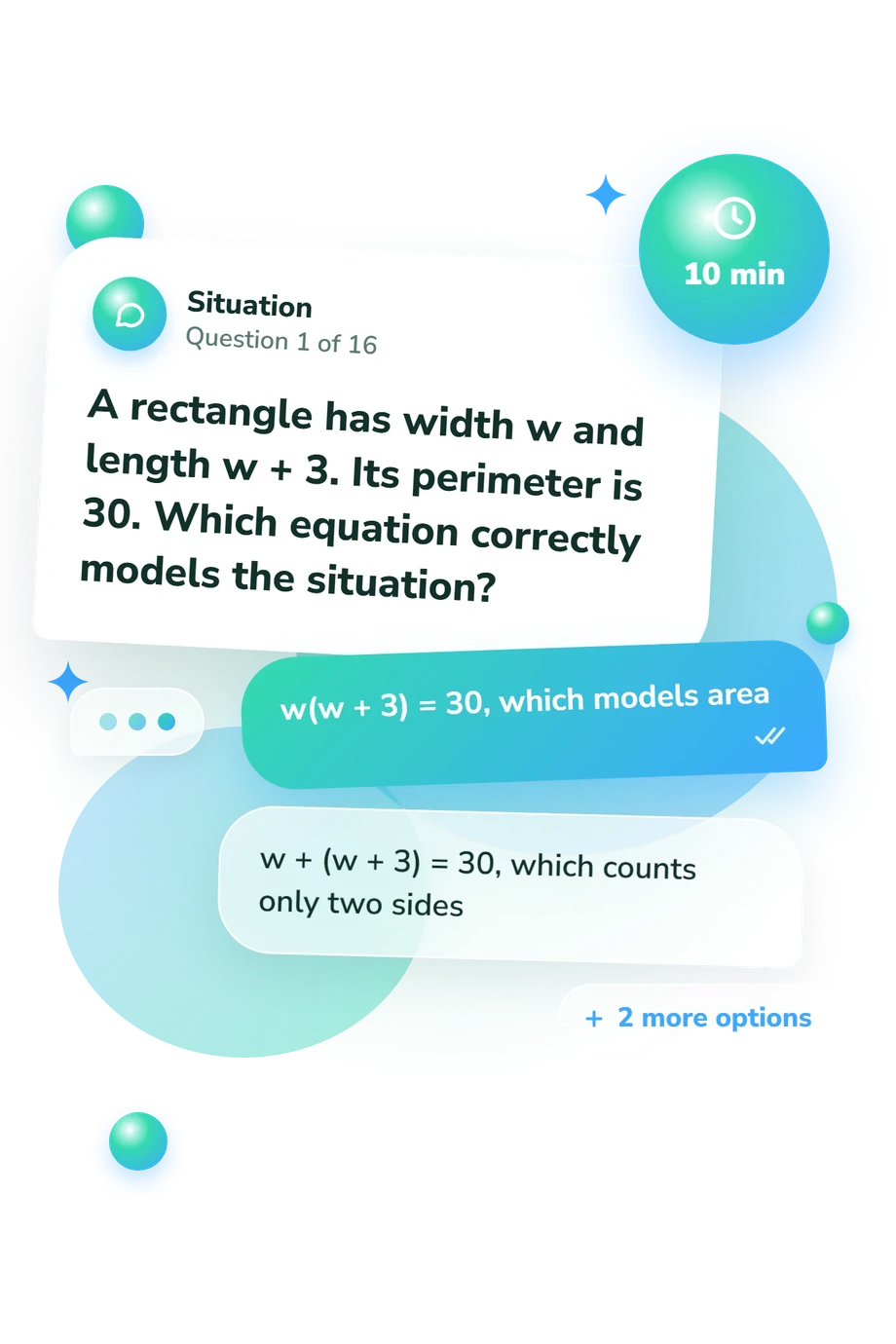
- w(w + 3) = 30, which models area
- w + (w + 3) = 30, which counts only two sides
- 2w + 2(w + 3) = 30, which counts all four sides
- 2w(w + 3) = 30, which doubles the area expression
- 4m + 2
- 4 + 2m
- 6m
- 2(m + 4)
- x − 3, the factor that was canceled
- x + 3, the uncanceled factor
- x² − 6, obtained by subtracting the constants
- The constant 1, obtained by canceling the entire numerator
Algebra Quiz - Description and methodology of the test
Students who want a clear snapshot of their working knowledge can use this assessment to review how they reason through common algebra tasks. The algebra quiz suits learners checking readiness for further practice, teachers seeking a compact discussion starter, and anyone returning to foundational mathematics. As a basic quiz on algebra, it emphasizes accurate application and points toward concepts that may deserve another look.
What This Assessment Explores
The questions test translation between situations, expressions, equations, and graphs, along with factoring, distribution, substitution, coefficients, exponents, sequences, inequalities, slope, systems, and like terms. This suits learners reviewing foundations or using an algebra practice quiz to target weak spots.
Algebra Knowledge (0-16) summarizes correct answers on this set. Foundations to review (0-6) calls for key-rule review; Developing knowledge (7-12) shows core ideas with practice still useful; Strong knowledge (13-16) reflects accurate application of most tested concepts.
The main topic groups show what different parts of the result represent:
- Expressions and equations show how you model situations and solve unknowns.
- Factors and exponents show how you simplify structure and work with powers.
- Inequalities and sequences show how you track patterns and reverse a sign when required.
- Lines and systems show how you calculate slope, intercepts, and linked solutions.
Methodology and Scientific Basis
Each item presents four choices, including alternatives that reflect common algebraic errors. You select the mathematically supported response rather than write a derivation; the format is a quiz on algebra with answers selected from defined options. The score summarizes correct responses from this set.
The content is conceptually consistent with Walick and Burns (2017), whose work emphasizes analyzing algebra problem-solving demands. Peralta et al. (2020) provides a psychometric perspective on algebra-readiness measures, while Carlson, Oehrtman, and Engelke (2010) support attention to conceptual reasoning rather than memorized procedures. The questionnaire is not presented as an adaptation of these instruments.
Interpretation is descriptive: the bands indicate performance on this question set, not a formal placement result or published norm. An algebra math quiz can show which concepts deserve review, but it cannot display every algebra skill or explain why an answer was missed.
Performance may vary with instruction, notation familiarity, attention, guessing, and the respondent’s current understanding. Use the pattern of missed topics to choose focused practice and revisit the underlying rule or representation.
- Walick, Christopher M., and Matthew K. Burns. (2017). A Proposed Algebra Assessment for Use in a Problem-Analysis Framework. Assessment for Effective Intervention, 42(3), 150-159. 10.1177/1534508417690000
- Peralta, Yadira, Nidhi Kohli, April Strom, Irene Duranczyk, Vilma Mesa, and Laura Watkins. (2020). A Psychometric Analysis of the Algebra and Precalculus Concept Readiness Assessment for Community Colleges. Journal of Psychoeducational Assessment, 38(3), 321-336. 10.1177/0734282919846019
- Carlson, Marilyn, Michael Oehrtman, and Nicole Engelke. (2010). The Precalculus Concept Assessment: A Tool for Assessing Students’ Reasoning Abilities and Understandings. Cognition and Instruction, 28(2), 113-145. 10.1080/07370001003676587
Updated: