
Siblings or Dating Quiz
How the Scales are Structured
Who Usually Takes This Test?
See How You Compare
Below is a preview of how scores are typically distributed across each scale.
Example Questions From the Test
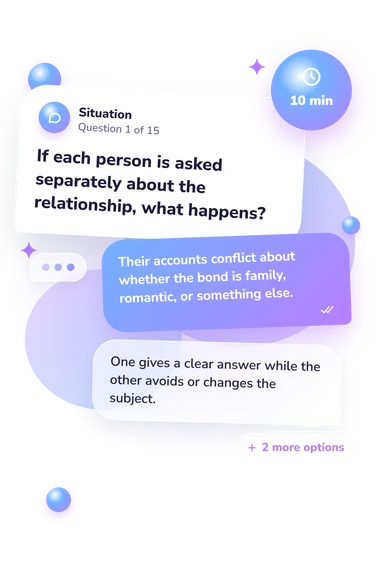
- Their accounts conflict about whether the bond is family, romantic, or something else.
- One gives a clear answer while the other avoids or changes the subject.
- Their answers generally align but leave some details unstated.
- Their answers match and clearly define the relationship.
- Many specific memories involving the same childhood home, caregivers, or family routines.
- A long shared history that feels family-like, although they did not share the same household.
- They know each other’s childhood stories but did not experience them together.
- Their shared memories mainly begin around the time they met as adults or potential partners.
- They act couple-like in one setting but strongly reject that interpretation in another.
- Their closeness shifts enough that observers could reasonably read it in different ways.
- Their behavior is mostly consistent, with a few context-dependent differences.
- Their behavior and stated relationship remain consistent across settings.
Siblings or Dating Quiz - Description and methodology of the test
When labels, behavior, and family history point in different directions, it can be difficult to know how to describe a pair’s connection. The siblings or dating quiz gives readers a structured way to examine those clues from inside or outside the relationship, while keeping uncertainty visible. A relationship ambiguity test can show where clarification may help.
What This Assessment Explores
The questionnaire distinguishes romantic, family, and unresolved interpretations through labels, history, behavior, affection, responsibilities, boundaries, and plans. This siblings-or-dating quiz has four choices, from conflicting cues to clear descriptions; appearance is one cue. It examines:
- Romantic or Dating Bond (0-15) reflects labels, boundaries, couple plans, and direct conversations: Limited dating evidence (0-5), Emerging romantic signals (6-10), or Strong dating affinity (11-15).
- Sibling or Family Bond (0-15) reflects explicit labels, shared family history, and ongoing family roles: Limited sibling evidence (0-5), Some family signals (6-10), or Strong sibling affinity (11-15), without establishing biological or legal kinship.
- Unclear or Mixed Signals (0-15) reflects inconsistent labels, incomplete information, shifting behavior, or unresolved expectations: Mostly defined context (0-5), Noticeable uncertainty (6-10), or Strong mixed signals (11-15).
The highest score shows strongest affinity; scores within one point blend, while those involved define the relationship.
Methodology and Scientific Basis
Each item presents a relationship situation with four choices, ranging from conflicting or indirect evidence to clear, mutually recognized descriptions. Topics include labels, shared history, public and private behavior, boundaries, affection, family responsibilities, expectations, and future plans. This treats appearance as one cue alongside reported relationship evidence.
This siblings-or-dating test compares dating, family, and mixed-signal evidence in a three-part profile. The displayed bands organize selected evidence, but the scoring rule does not state how many points each answer contributes; point values cannot be inferred from score ranges.
Its conceptual frame is consistent with the Network of Relationships Inventory (Furman & Buhrmester, 2009), which examines relationship qualities through behavioral systems, and with Furman and Buhrmester’s 1985 research on sibling relationships. The uncertainty dimension is consistent with Knobloch and Solomon’s 1999 account of incomplete information and changing expectations. These sources provide conceptual context; this questionnaire is not a standardized adaptation of them.
Because the result depends on what respondents know, remember, and report, context and observer bias can shape it. Read it as a self-reflection profile, using clarification when signals remain mixed.
- Furman, W., & Buhrmester, D. (2009). The Network of Relationships Inventory: Behavioral Systems Version. International Journal of Behavioral Development, 33(5), 470-478. 10.1177/0165025409342634
- Furman, W., & Buhrmester, D. (1985). Children's Perceptions of the Qualities of Sibling Relationships. Child Development, 56(2), 448-461. 10.2307/1129733
- Knobloch, L. K., & Solomon, D. H. (1999). Measuring the Sources and Content of Relational Uncertainty. Communication Studies, 50(4), 261-278. 10.1080/10510979909388499