
Functional Group Quiz
How the Scales are Structured
Who Usually Takes This Test?
See How You Compare
Below is a preview of how scores are typically distributed across each scale.
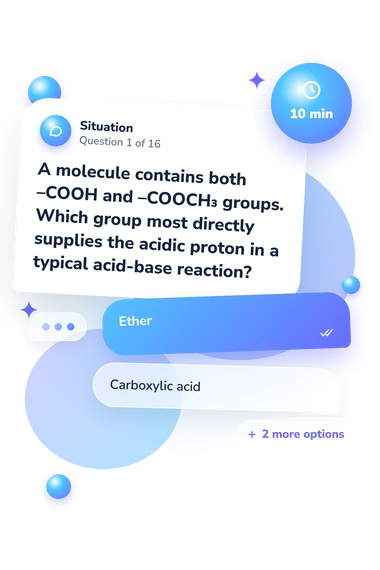
Example Questions From the Test
- Alkyl chloride
- Carboxylic acid
- Aldehyde
- Acid chloride
- Amide
- Amine
- Imine
- Nitrile
- Primary amine
- Secondary amine
- Amide
- Imine
Functional Group Quiz - Description and methodology of the test
Students revising reaction patterns, nomenclature, or introductory biochemistry can use this functional groups organic chemistry quiz to check whether familiar structures are identified and classified accurately. The functional group quiz offers a focused knowledge check for learners who want a clearer picture of how well they apply distinctions among common organic structures. Its result summarizes performance across common organic structures rather than judging overall chemistry ability.
What This Assessment Measures
Questions use displayed formulas, condensed structures, general patterns, and brief reaction descriptions. Four choices require one classification, testing recognition of defining bonds and distinctions between related groups.
This questionnaire works as a functional group naming quiz: its identification and naming items show how well the respondent connects labels with structural cues. The result uses one knowledge scale:
- Functional Group Knowledge (0-16) shows how accurately the respondent identifies and applies the tested classifications. Foundations to Review (0-6) marks core distinctions for review; Developing Knowledge (7-12) reflects many correct identifications with some weaker areas; Strong Knowledge (13-16) indicates confident performance across the tested groups.
The item themes cover carbonyl chemistry, nitrogen-containing functional groups, oxygen functionality, and unsaturated or aromatic structures; reviewing these areas may be useful. The single result indicates a broad level of knowledge across the tested material, not overall organic chemistry mastery.
Methodology and Evidence Base
Each item presents a formula, structural pattern, or brief transformation followed by four answer options. In this organic functional groups quiz, each correct selection earns one point, so the total reflects criterion-based classification performance rather than a personality or clinical measure.
The content is conceptually consistent with Orchin et al. (2005), which classifies organic compounds through characteristic functional groups. IUPAC recommendations provide a framework for consistent nomenclature and preferred names. Ertl (2017) describes a computational approach to formal structural pattern recognition; it is background for the kinds of patterns named in these items, not evidence for this questionnaire's validity, scoring, or interpretation.
Questions about alcohols and phenols, amides and amines, or aldehydes and ketones require careful attention to the structural cue and the requested distinction.
Interpret the result as a snapshot of performance under this format. Guessing, recent coursework, memorization, and the limited selection of structures can affect it. No norm group is stated for this questionnaire, so the band should guide review priorities rather than serve as a comprehensive estimate of chemical competence.
- Orchin, Milton, Roger S. Macomber, Allan R. Pinhas, and R. Marshall Wilson. “Functional Groups: Classes of Organic Compounds.” In The Vocabulary and Concepts of Organic Chemistry, 2nd ed., 139-220. John Wiley & Sons, 2005. 10.1002/0471713740.ch6
- Favre, Henri A., and Warren H. Powell, eds. Nomenclature of Organic Chemistry: IUPAC Recommendations and Preferred Names 2013. Royal Society of Chemistry, 2014. 10.1039/9781849733069
- Ertl, Peter. “An Algorithm to Identify Functional Groups in Organic Molecules.” Journal of Cheminformatics 9 (2017): 36. 10.1186/s13321-017-0225-z