
Interview Quiz
How the Scales are Structured
Who Usually Takes This Test?
See How You Compare
Below is a preview of how scores are typically distributed across each scale.
Example Questions From the Test
- Because the read and write quorums must overlap when R + W is greater than N
- Because every write is sent to exactly the same single replica
- Because asynchronous networks always deliver writes in timestamp order
- Because three replicas eliminate the possibility of node failure
- Increase the client timeout for every payment request
- Place payment requests on a higher-priority network connection
- Associate the operation with an idempotency key and reuse its recorded result
- Create a new transaction identifier for every retry attempt
- Replicating the complete dataset to read-only followers
- Sharding the data by a suitable partition key
- Adding a local in-memory cache to the existing server
- Archiving the database transaction log more frequently
Interview Quiz - Description and methodology of the test
People preparing for technical interviews can use this interview quiz to check how confidently they reason about common system design decisions. It is intended for learners who want a structured snapshot of practical understanding rather than a personality profile. For learners seeking technical interview preparation, it offers a focused starting point for reviewing architectural concepts before a technical discussion.
What This Assessment Measures
The questionnaire examines how learners handle growth, failure, latency, consistency, and trade-offs in system design. It suits people preparing for technical discussions who want to connect technologies with architectural decisions.
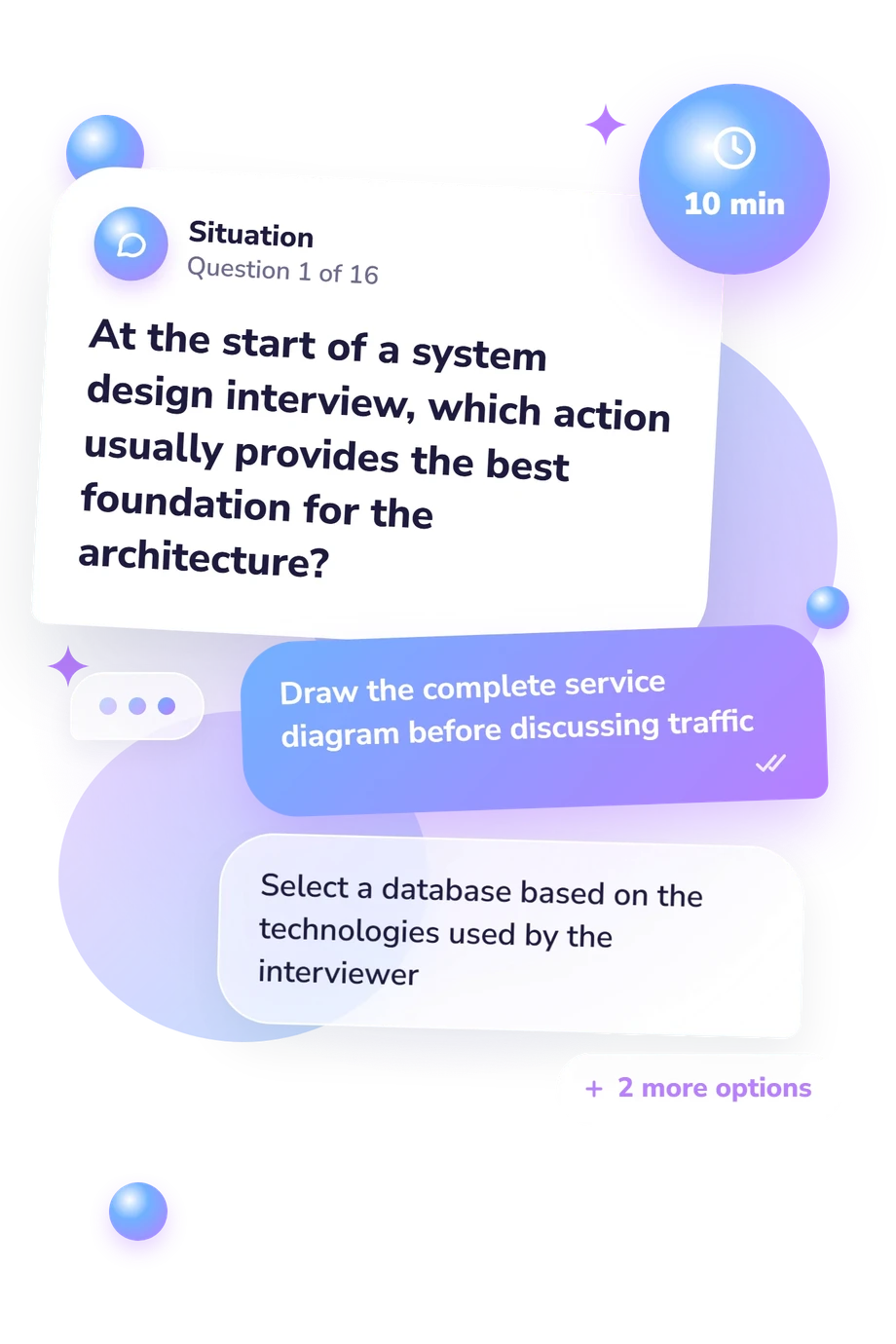
The questionnaire uses scenario-based questions: each presents a systems problem with four answer choices, testing recognition of a sound response rather than extended diagramming. The thematic groups are:
- Requirements and architecture show how you clarify use cases, scale, and quality needs.
- Data and consistency measure reasoning about sharding, replication, quorums, indexes, and idempotency.
- Reliability and resilience show recognition of graceful degradation, queues, outbox coordination, and availability.
- Performance and traffic management cover tail latency, caching, rate limiting, and CDNs.
System Design Knowledge (0-16) reports Foundations to build (0-6), Developing knowledge (7-12), or Strong knowledge (13-16). These bands move from fundamentals needing review, through developing application, to solid command of common principles.
Methodology and Evidence Base
The format is single-best-answer: each scenario has four alternatives, so the result reflects responses to applied system design problems. It reports one performance profile; the questionnaire does not state weighting or partial-credit rules, and it presents three descriptive bands for interpreting the score.
Its coverage is conceptually consistent with Xu's discussion of requirements, scalability, storage, reliability, and practical trade-offs in system-design learning. Kleppmann's work provides a wider distributed-systems frame for replication, consistency, partitioning, queues, and data processing.
Quorum reasoning also aligns with the Dynamo paper by DeCandia and colleagues, while availability, graceful degradation, monitoring, and latency reflect Beyer and colleagues' work. These works support the subject matter, but this questionnaire is not a reproduction or adaptation of any one source.
The result supports interview preparation: revisit fundamentals after a lower band, practise trade-offs in the middle band, and explain designs aloud when strong. As a self-report questionnaire, it depends on interview-focused knowledge and recent study; familiarity with interview conventions can affect answers, so the score does not establish production experience or predict hiring outcomes.
- Xu, Alex. System Design Interview: An Insider's Guide, Volume 1. Byte Code LLC, 2020. ISBN 9798664653403.
- Kleppmann, Martin. Designing Data-Intensive Applications: The Big Ideas Behind Reliable, Scalable, and Maintainable Systems. O'Reilly Media, 2017. ISBN 9781491903063.
- DeCandia, Giuseppe, Deniz Hastorun, Madan Jampani, Gunavardhan Kakulapati, Avinash Lakshman, Alex Pilchin, Swaminathan Sivasubramanian, Peter Vosshall, and Werner Vogels. Dynamo: Amazon's highly available key-value store. Proceedings of the 21st ACM SIGOPS Symposium on Operating Systems Principles, 2007, pp. 205-220. 10.1145/1294261.1294281.
- Beyer, Betsy, Chris Jones, Jennifer Petoff, and Niall Richard Murphy, editors. Site Reliability Engineering: How Google Runs Production Systems. O'Reilly Media, 2016. ISBN 9781491929117.
Updated: