
Goddess Quiz
How the Scales are Structured
Who Usually Takes This Test?
See How You Compare
Below is a preview of how scores are typically distributed across each scale.
Example Questions From the Test
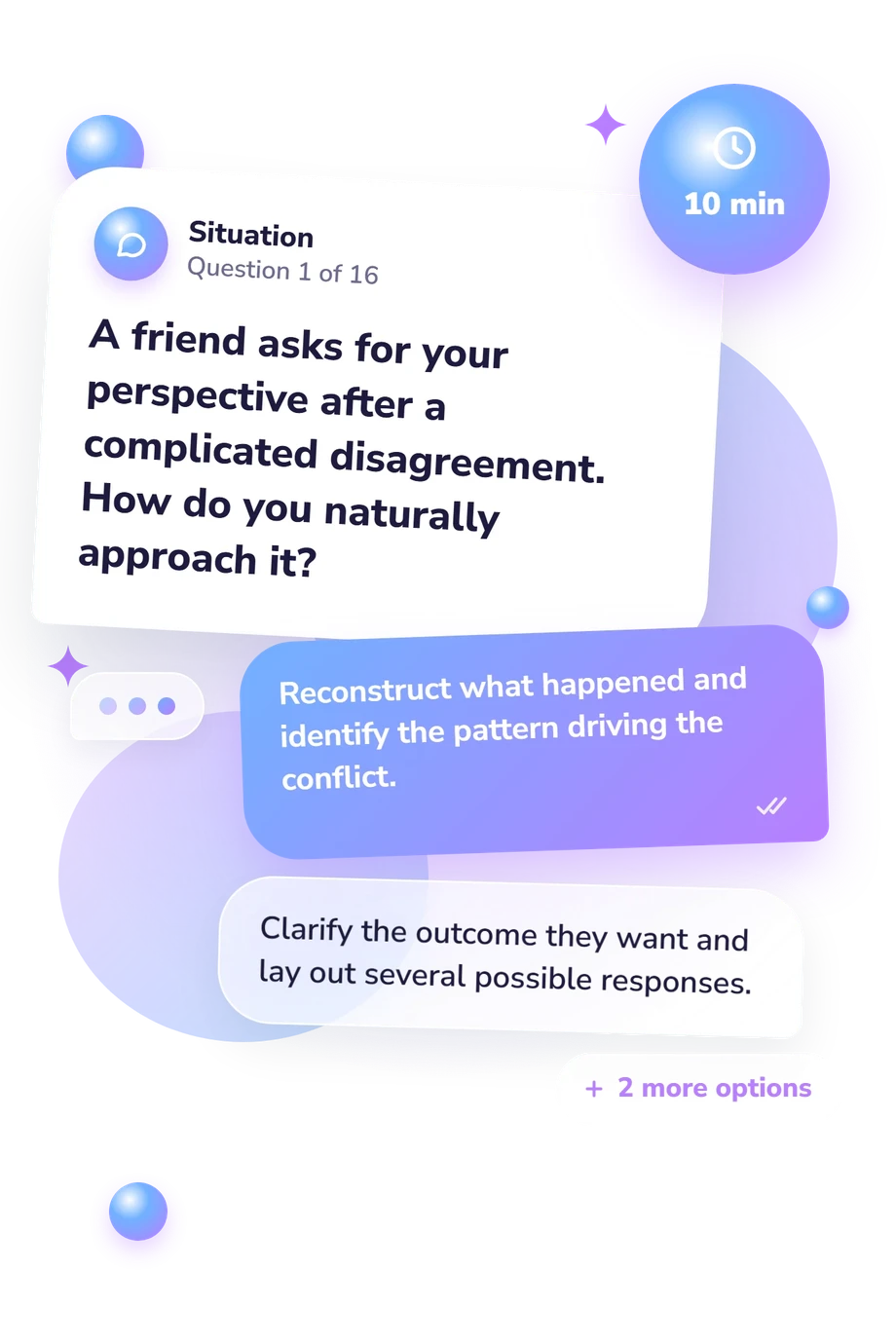
- Reconstruct what happened and identify the pattern driving the conflict.
- Clarify the outcome they want and lay out several possible responses.
- Share a similar experience that might offer another perspective.
- Give them space to express the feelings before discussing solutions.
- Desire, beauty, attraction, and the power of being seen.
- The private bonds and emotions connecting two people.
- Technical mastery and the satisfaction of a well-made form.
- Solitude, open landscapes, and freedom from social expectations.
- “Your judgment stays sharp when a situation becomes complicated.”
- “You turn knowledge into something skillful and useful.”
- “You bring an energizing presence wherever you go.”
- “You make people feel comfortable and cared for.”
Goddess Quiz - Description and methodology of the test
Readers who want a playful way to reflect on recurring strengths, preferences, and ways of relating may find the goddess quiz a useful starting point. As a what greek goddess am i quiz, it uses Greek mythic figures as symbolic reference points rather than fixed personality diagnoses. The result shows which qualities resonate most and whether the profile is focused or blended.
What This Assessment Explores
Four profiles organize choices around connection, autonomy, wisdom, and care. Scenarios about disagreement, solitude, group roles, support, creativity, and relationships connect mythic themes with recognizable preferences.
The what goddess am i quiz invites reflection, not literal identity claims.
Four affinities show distinct emphases:
- Aphrodite Affinity (0-12) measures beauty, desire, pleasure, and interpersonal magnetism; Faint 0-4, Emerging 5-8, and Strong 9-12 show the bands.
- Artemis Affinity (0-12) measures independence, wilderness, purposeful action, and protection; Faint 0-4, Emerging 5-8, and Strong 9-12 show the bands.
- Athena Affinity (0-12) measures wisdom, craft, analysis, and measured counsel; Faint 0-4, Emerging 5-8, and Strong 9-12 show the bands.
- Demeter Affinity (0-12) measures nourishment, patient growth, provisioning, and enduring bonds; Faint 0-4, Emerging 5-8, and Strong 9-12 show the bands.
Methodology and Evidence Base
Each item presents a short scenario and four response options, asking which reaction, priority, or contribution feels most natural. Choices move among analysis, autonomy, expressive connection, practical skill, care, and exploration. This structure makes the result a pattern of preferences rather than a score for one isolated trait.
The scoring aggregates responses into four affinity totals. The highest total represents the strongest affinity, while totals within one point indicate a blended result. A which greek goddess are you quiz outcome can therefore show a leading theme without implying that the other dimensions are absent.
The questionnaire’s conceptual reference is the Hudson Archetypal Goddess Scale (Hudson, 2004), alongside Bolen (1984) and Bolen and Clausson (1995), whose Jungian archetypal work connects goddess figures with recurring psychological roles. The present questionnaire is conceptually consistent with that framework; it is not the published HAGS or a validated adaptation of it.
Because responses depend on self-perception, current mood, and situational context, and the online scoring is not presented with population norms, reliability estimates, or clinical cutoffs, the profile is best used as a focused prompt for reflection and further self-observation.
- Hudson, Peggy Alexander. (2004). Measurement of the Dominant Goddess Archetypes: Development of the Hudson Archetypal Goddess Scale (HAGS). Doctoral dissertation, Oklahoma State University.
- Bolen, Jean Shinoda. (1984). Goddesses in Everywoman: A New Psychology of Women. San Francisco, CA: Harper & Row.
- Bolen, Jean Shinoda, and JoAnn Clausson. (1995). Women's Psychology, Goddess Archetypes, and Patriarchy: A Jungian Analyst, Feminist Activist, Visionary Feminist Foremother. Women & Therapy, 17(1-2), 71-85. 10.1300/J015v17n01_08.
Updated: