
What Should I Do with My Life Quiz
How the Scales are Structured
Who Usually Takes This Test?
See How You Compare
Below is a preview of how scores are typically distributed across each scale.
Example Questions From the Test
- I commit to deliberate practice and track improvement over months
- I take a short structured course and complete a defined project
- I learn the parts I need as situations arise
- I sample it briefly before moving on to other subjects
- Listening closely and helping them discover what matters to them
- Talking through practical options and sharing relevant experience
- Giving them space now and checking in after they have decided
- Respecting their independence unless they request my involvement
- Try a small version quickly so I can learn through experience
- Research the main uncertainties and then run a bounded trial
- Wait until stronger evidence clarifies whether it is worthwhile
- Decline it so I can protect commitments I have already chosen
What Should I Do with My Life Quiz - Description and methodology of the test
People weighing a change in study, work, or direction can use the What Should I Do with My Life Quiz to clarify preferences. The result does not name one ideal occupation; it helps you compare possible directions in this what to do with my life quiz, showing which activities feel engaging and how those motives combine. It helps you compare a course, role, or experiment without prescribing one route.
What This Assessment Explores
Situations involving planning, routines, uncertainty, learning, creativity, community, and work reveal what kinds of effort feel worthwhile. Anyone using this how to know what you want in life quiz can notice recurring preferences in the profile rather than chase one title.
The four dimensions are:
- Build Expertise (0-12) shows your affinity for sustained practice, problem-solving, and dependable results.
- Create and Express (0-12) shows how strongly original ideas, design, performance, or communication energize you.
- Explore and Adapt (0-12) shows your attraction to novelty, changing conditions, and experimentation.
- Help and Connect (0-12) shows your present affinity for mentoring, support, teaching, and community contribution.
Each score is shown as Secondary direction (0-4), Meaningful ingredient (5-8), or Leading direction (9-12). The highest score marks the strongest affinity; any other profile within one point of it joins a blended result.
Methodology and Scientific Basis
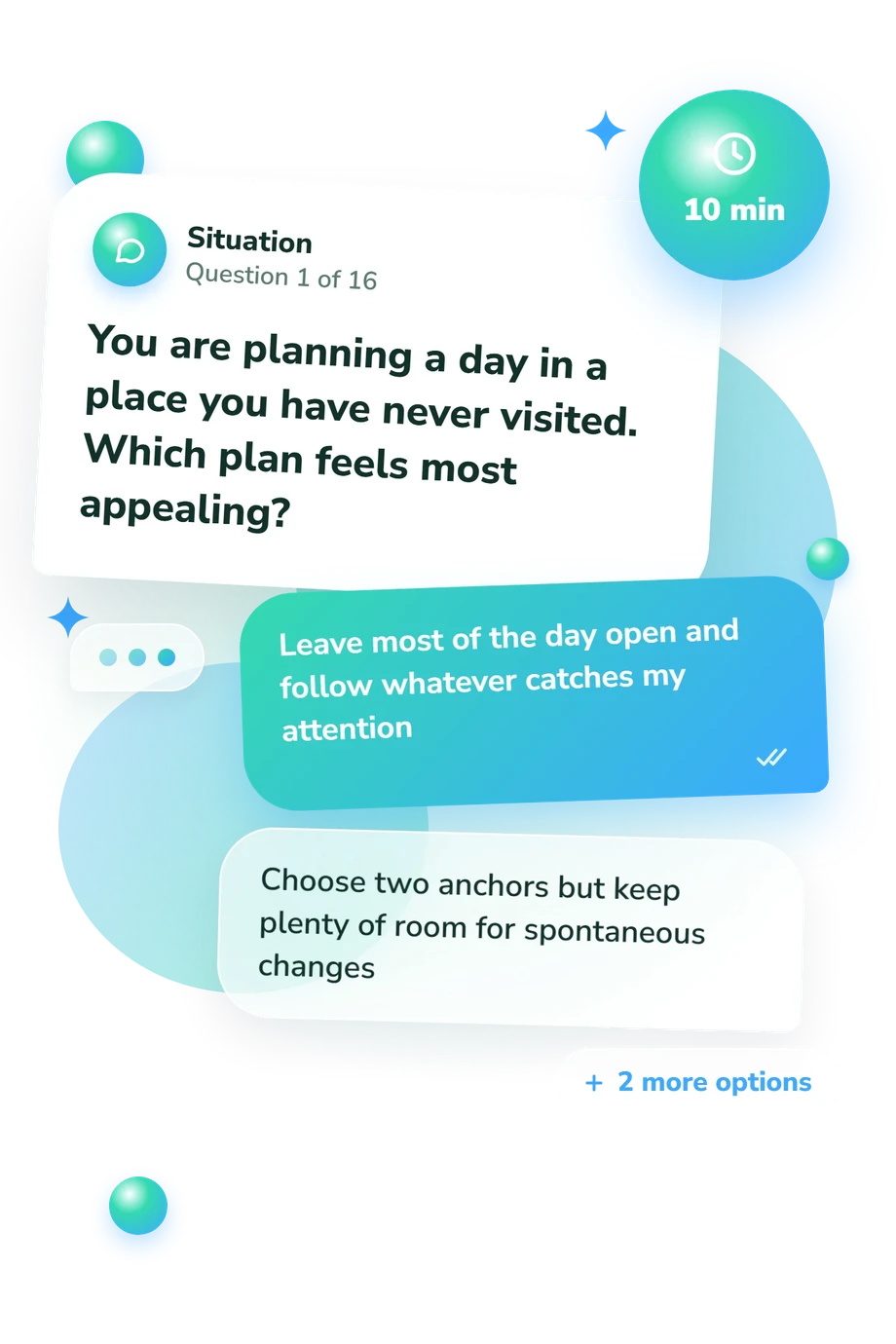
Each item presents a situation with four response choices. Selecting the option that feels most natural makes the format a preference profile rather than a knowledge test or job-title selector. For someone using the what do i want to do with my life quiz, the format offers a structured way to compare motives.
Scoring is profile-based: the four dimensions receive displayed scores, with the highest showing strongest current affinity; any other profile within one point of the highest score joins it in a blended profile. Because no item-by-item point rule is published, weights should not be inferred.
Super’s Work Values Inventory is a conceptual parallel, not this questionnaire’s source instrument. Robinson and Betz’s psychometric study concerns a revised inventory; this online profile is not a direct adaptation or standardized administration, and no population norms are supplied.
Deci and Ryan’s self-determination theory and Steger and colleagues’ meaning-in-life research are interpretive parallels, not validation of this four-scale model; competence, autonomy, relatedness, and purpose may help contextualize its motives. The free questionnaire is a self-report snapshot: mood, self-awareness, and circumstances may affect results. Use it to generate options and test them in real settings, not narrow your future to one label.
- Super, Donald E. (1970). Work Values Inventory: Manual. Boston, MA: Houghton Mifflin.
- Robinson, Carrie H., & Betz, Nancy E. (2008). A Psychometric Evaluation of Super's Work Values Inventory-Revised. Journal of Career Assessment, 16(4), 456-473. 10.1177/1069072708318903
- Deci, Edward L., & Ryan, Richard M. (2000). The "What" and "Why" of Goal Pursuits: Human Needs and the Self-Determination of Behavior. Psychological Inquiry, 11(4), 227-268. 10.1207/S15327965PLI1104_01
- Steger, Michael F., Frazier, Patricia A., Kaler, Matthew, & Oishi, Shigehiro. (2006). The Meaning in Life Questionnaire: Assessing the Presence of and Search for Meaning in Life. Journal of Counseling Psychology, 53(1), 80-93. 10.1037/0022-0167.53.1.80
Updated: