
Tissue Identification Quiz
How the Scales are Structured
Who Usually Takes This Test?
See How You Compare
Below is a preview of how scores are typically distributed across each scale.
Example Questions From the Test
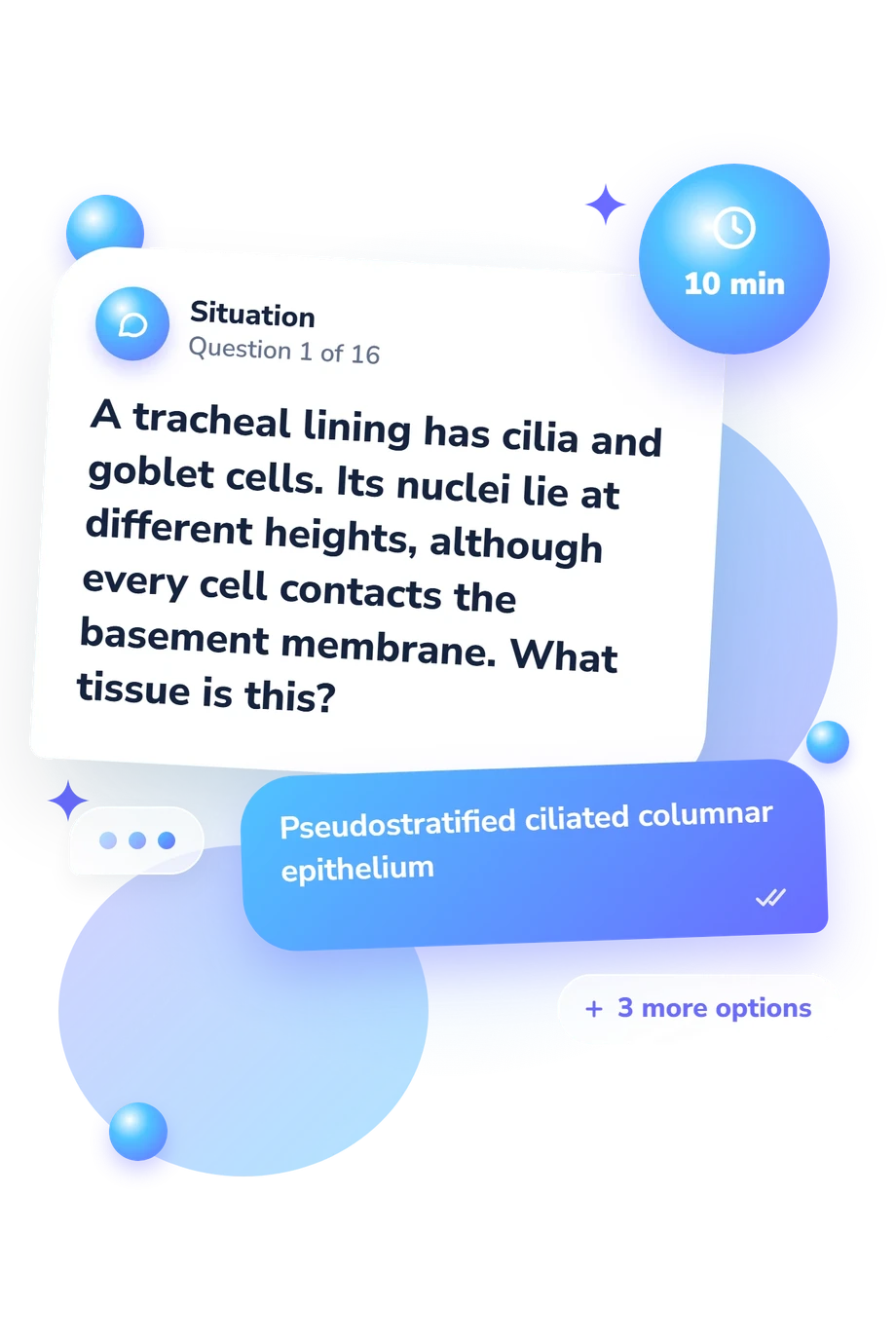
- Pseudostratified ciliated columnar epithelium
- Simple columnar epithelium
- Stratified columnar epithelium
- Transitional epithelium
- Dense irregular connective tissue
- Elastic connective tissue
- Areolar connective tissue
- Dense regular connective tissue
- Simple columnar epithelium
- Stratified squamous epithelium
- Transitional epithelium
- Pseudostratified ciliated columnar epithelium
Tissue Identification Quiz - Description and methodology of the test
Students revising introductory histology and readers who want to choose their next study priorities can use the tissue identification quiz as a focused knowledge check. The short tissue quiz helps reveal which areas deserve another pass and whether the learner is ready for finer distinctions. That result offers a clear starting point for planning further study without replacing hands-on practice.
What This Assessment Measures
Four primary tissue classes are examined, so the exercise serves as a quiz on tissue types for learners reviewing basic histology. Written clues connect cellular form with location and function, including layers, nuclei, matrix, fibers, striations, lacunae, cilia, and goblet cells.
The result reflects recognition from descriptions rather than slide-handling skill. The identifying tissues quiz asks learners to connect each scenario's structural pattern to its best-fitting tissue name.
The four content groups are:
- Epithelial tissue is organized into layers and specialized surfaces.
- Connective tissue is distinguished by matrix, fibers, and cell arrangement.
- Muscle tissue is recognized through striations, nuclei, and branching.
- Nervous tissue is marked by cell bodies, processes, and support cells.
Tissue Identification Knowledge: 0-16 summarizes how accurately tissues were identified from written histology clues. Foundations to review is 0-6; Developing recognition is 7-12; Strong identification knowledge is 13-16. It does not assess laboratory or clinical competence.
Methodology and Evidence Base
Each prompt presents a written histology scenario followed by four answer choices. The task requires learned terminology and recall alongside applying structural clues to distinguish similar tissues. In the identifying tissue types quiz, a decisive clue may be epithelial layering, connective-tissue matrix, muscle appearance, or neural processes.
The result summarizes how accurately you identified tissues from written histology clues. It is best used to select topics for further study.
These distinctions are consistent with Ross and Pawlina (2020), while Mescher (2021) provides a parallel foundational account. The work by Vemu, Basta, and Cole (2019) offers a related example of critical-thinking prompts in tissue identification. This quiz is a separate educational questionnaire that shares that study's use of tissue-identification prompts but is not an adaptation or validation of it. The result is presented as an educational score, with no stated norms or reliability information. Results can vary with prior coursework, terminology familiarity, and interpretation of written clues, all of which can shape performance.
- Ross MH, Pawlina W. Histology: A Text and Atlas: With Correlated Cell and Molecular Biology. 8th ed. Philadelphia, PA: Wolters Kluwer Health; 2020. ISBN 9781496383426.
- Mescher AL. Junqueira's Basic Histology: Text and Atlas. 16th ed. New York, NY: McGraw Hill; 2021. ISBN 9781260462982.
- Vemu S, Basta H, Cole DC. Histology Personal Trainer: Identifying Tissue Types Using Critical Thinking and Metacognition Prompts. Journal of Microbiology & Biology Education. 2019;20(2):1791. 10.1128/jmbe.v20i2.1791.
Updated: