
Room Aesthetic Quiz
How the Scales are Structured
Who Usually Takes This Test?
See How You Compare
Below is a preview of how scores are typically distributed across each scale.
Example Questions From the Test
- A full vignette where books, art, and keepsakes overlap
- Matching trays that organize the collection into neat groups
- A rotating display of a few carefully coordinated objects
- A nearly clear surface with one purposeful object
- A weathered wooden stool with visible age and a useful shape
- A sleek chrome lamp with a geometric shade
- A bold woven wall hanging in saturated colors
- A mirrored tray with faceted handles
- Raw wood, handmade pottery, and woven fibers
- Aged pine, floral china, and softly tarnished brass
- Pale wood, matte ceramic, and one clear glass object
- Lacquer, smoked glass, polished metal, and a velvet-lined box
Room Aesthetic Quiz - Description and methodology of the test
People choosing furnishings, colors, finishes, and decorative details can use this questionnaire to clarify the visual direction they naturally prefer. The room aesthetic quiz turns everyday bedroom decisions into a four-style profile rather than requiring design expertise. For someone planning a refresh, a quiz about bedroom aesthetics can compare personal instincts and offer a practical starting point when several looks feel appealing.
What This Assessment Explores
Decorating choices reveal the visual language that feels natural. The bedroom style quiz suits people exploring taste before furnishing or redecorating; it maps attraction rather than judging quality.
The four result scales are:
- Bohemian Eclectic (0-12) shows affinity for layered textiles, mixed eras, plants, and collected pattern: Curated Consistency (0-4), Creative Mix (5-8), or Bohemian Affinity (9-12).
- Cozy Cottagecore (0-12) measures florals, weathered wood, handmade details, and nostalgic softness: Contemporary Leaning (0-4), Cottage Touches (5-8), or Cottagecore Affinity (9-12).
- Minimalist Calm (0-12) reflects clean lines, quiet palettes, breathing room, and edited displays: Expressive Alternative (0-4), Selective Simplicity (5-8), or Minimalist Affinity (9-12).
- Modern Glam (0-12) captures symmetry, shine, plush fabrics, and statement lighting: Understated Preference (0-4), Refined Accents (5-8), or Modern Glam Affinity (9-12).
Scores within one point of the highest indicate a blend rather than one label.
Methodology and Scientific Basis
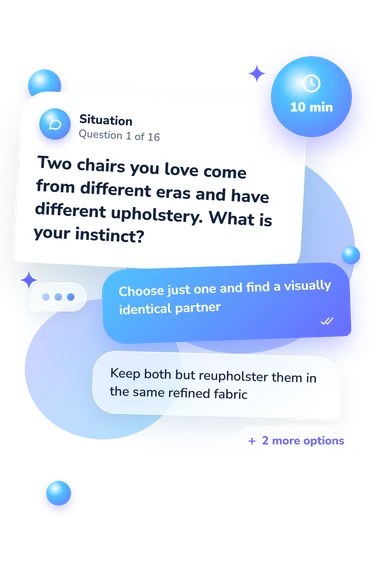
Each item presents a decorating situation with four answer choices. Options contrast coordinated objects, layered finds, restrained furniture, and polished accents. The bedroom quiz converts selections into four style scores rather than one total, allowing more than one strong direction.
Each displayed band shows how strongly the catalogue’s description matches your choices. If you are wondering what your bedroom style is, the profile turns those preferences into a pattern rather than a single label.
Conceptually, the format is consistent with Pohlmann et al. (2025), whose interactive room-design work links visual choices with form and style preferences. Yoon et al. (2010) supports studying furniture choices through alternatives, while Chan (2000) offers a broader account of measuring style through preference patterns. These sources support the comparative method; they do not make this questionnaire a published adaptation.
As a structured self-report reflection tool, it can shift with current projects, mood, budget, living space, and design familiarity. It has no stated population norms or clinical cutoffs, so results describe fit with the catalogue’s definitions, not a diagnosis. Honest, situation-specific choices improve the profile.
- Pohlmann, Kira, Noah Lichtlein, Fariba Mostajeran, Nour Tawil, and Simone Kühn. (2025). Interactive room design as a tool for understanding form and style preferences. Scientific Reports, 15(1), Article 35578. 10.1038/s41598-025-23543-5
- Yoon, So-Yeon, Hyunjoo Oh, and Ji Young Cho. (2010). Understanding Furniture Design Choices Using a 3D Virtual Showroom. Journal of Interior Design, 35(3), 33-50. 10.1111/j.1939-1668.2010.01041.x
- Chan, Chiu-Shui. (2000). Can style be measured? Design Studies, 21(3), 277-291. 10.1016/S0142-694X(99)00011-3