
Tarot Card Quiz
How the Scales are Structured
Who Usually Takes This Test?
See How You Compare
Below is a preview of how scores are typically distributed across each scale.
Example Questions From the Test
- Expecting less next time may prevent another disappointment.
- I can rest before deciding what the setback means.
- A revised plan can still produce a worthwhile result.
- This ending may reveal a possibility I could not see before.
- Pause until the proper resources become available.
- Outsource the part that requires the missing equipment.
- Learn the standard method with guidance from someone experienced.
- Repurpose the tools I have and test an unconventional method.
- Join a lively event that changes the energy.
- Complete practical chores that restore order.
- Share quiet, low-pressure time with someone close.
- Be alone with space to read, walk, write, or think.
Tarot Card Quiz - Description and methodology of the test
People drawn to symbolic reflection can use this tarot card quiz to consider how they approach uncertainty, solitude, initiative, hope, and emotional steadiness. It suits readers who want a structured prompt for self-observation, using the what tarot card am I quiz question as a starting point; mood and circumstances may shape the profile. The result highlights current affinities, and close scores can form a blend.
What This Assessment Explores
The cards in this tarot quiz reflect current tendencies, not predictions. Situations cover setbacks, emotions, opportunities, solitude, planning, creativity, change. The highest displayed score marks the strongest current affinity; scores within one point form a blend.
The scales are:
- Strength (0-12) reflects courageous steadiness, emotional composure, firmness with care; Background archetype (0-4), Developing steadiness (5-8), Strong resonance (9-12).
- The Fool (0-12) reflects openness to beginnings, experimentation, movement beyond familiar routines; Background archetype (0-4), Emerging invitation (5-8), Strong resonance (9-12).
- The Hermit (0-12) reflects inward listening, intentional solitude, clarity beyond noise; Background archetype (0-4), Reflective pull (5-8), Strong resonance (9-12).
- The Magician (0-12) reflects initiative, resourcefulness, turning tools into action; Background archetype (0-4), Gathering power (5-8), Strong resonance (9-12).
- The Star (0-12) reflects renewal, future-facing hope, reconnecting with possibility after disappointment; Background archetype (0-4), Returning light (5-8), Strong resonance (9-12).
Methodology and Evidence Base
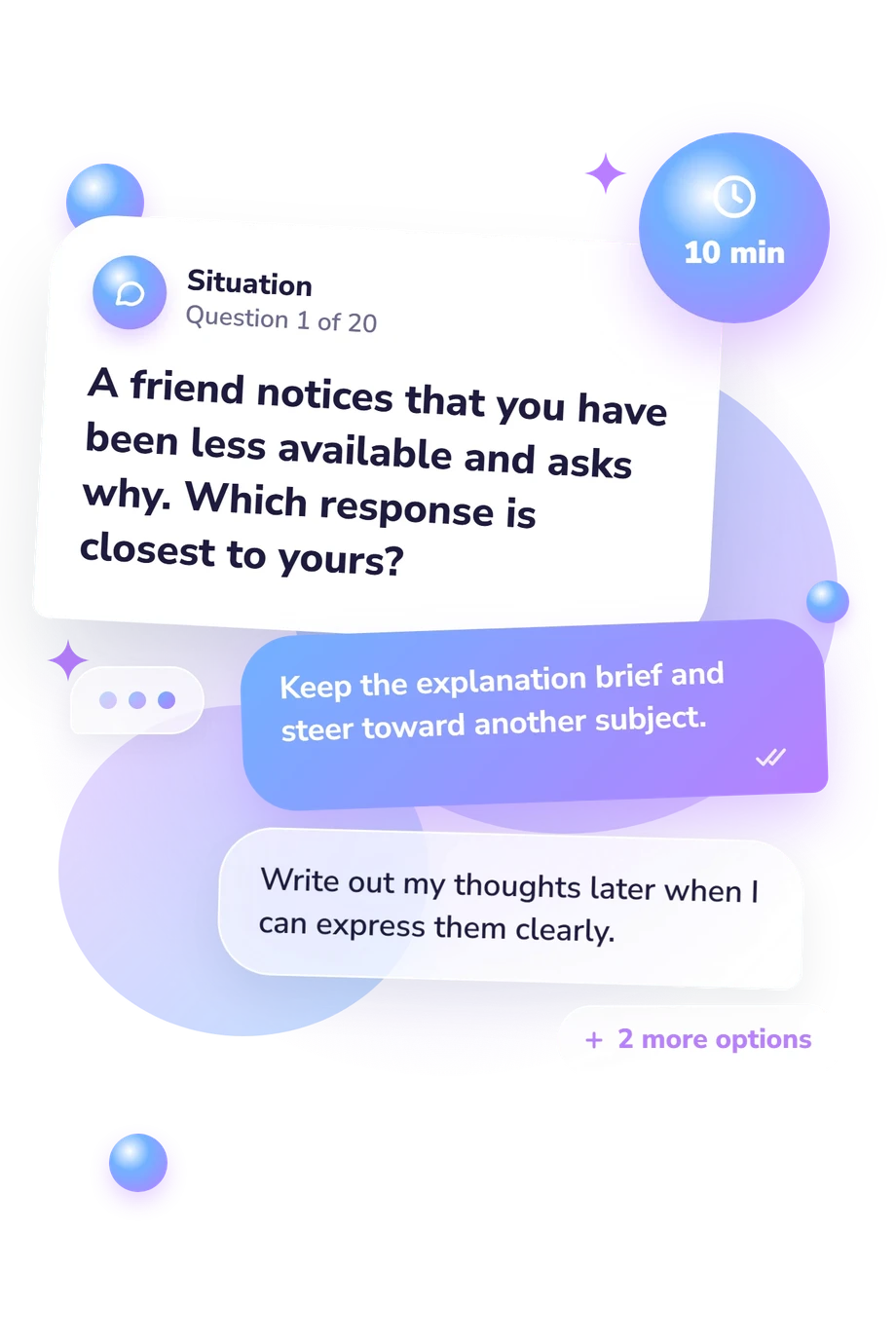
Everyday situations pair with four possible reactions. The choices contrast containment, support, inward reflection, experimentation, hope, and firm boundaries, so respondents select the closest current tendency. Tarot knowledge is unnecessary; the symbolic reading follows the comparisons.
The outcome displays a score for each scale and compares current affinities. It turns the what tarot card are you quiz question into a comparison among several symbolic tendencies. The highest displayed score indicates the strongest affinity, while scores within one point form a blend.
Nichols and Jungian works provide interpretive background for cards as archetypal images. Semetsky discusses tarot symbolism in relation to projective techniques; that context does not establish that this questionnaire uses a projective method. Jung’s archetype theory and the collaborative work of Jung, von Franz, Henderson, Jacobi, and Jaffe support recurring symbolic patterns. The questionnaire is conceptually consistent with these works, not presented as an adaptation.
The displayed bands are descriptive affinity bands; mood, context, and self-awareness can influence self-report responses.
- Nichols, Sallie. Jung and Tarot: An Archetypal Journey. New York: Samuel Weiser, 1980.
- Semetsky, Inna. "Tarot as a projective technique." Spirituality and Health International, 7(4), 187-197, 2006. 10.1002/shi.252
- Jung, Carl Gustav. The Archetypes and the Collective Unconscious. 2nd ed. Vol. 9, Part 1 of The Collected Works of C. G. Jung. Princeton, NJ: Princeton University Press, 1968.
- Jung, Carl Gustav, Marie-Louise von Franz, Joseph L. Henderson, Jolande Jacobi, and Aniela Jaffe. Man and His Symbols. Garden City, NY: Doubleday, 1964.
Updated: