
What Am I Quiz
How the Scales are Structured
Who Usually Takes This Test?
See How You Compare
Below is a preview of how scores are typically distributed across each scale.
Example Questions From the Test
- I uncovered possibilities I had not considered before
- I strengthened cooperation between people
- I turned a confusing goal into a workable plan
- I produced a tangible result that is ready to use
- Generate more possibilities before the group commits
- Check which version of the idea matters most to everyone
- Sketch a rough sequence of actions the group could test
- Define the deliverable, responsibilities, and first deadline
- Return to a favorite activity and enjoy knowing what to expect
- Add one fresh element to a comfortable routine
- Visit an unfamiliar place that has been recommended to me
- Choose something entirely new and decide the details as I go
What Am I Quiz - Description and methodology of the test
People who want a structured way to consider their everyday choices and roles may find the What Am I Quiz useful. It is intended for curious people deciding whether a self-discovery quiz can help them examine recurring tendencies without treating the result as a fixed identity. The assessment suits those who prefer guided questions before reflecting on their own patterns.
What This Assessment Explores
Instead of forcing one overall type, the result shows how four affinities may coexist. For readers deciding whether this preference profile suits them, a preference profile quiz is most useful when it offers language for recurring preferences rather than a judgment of ability, popularity, or worth.
The four result dimensions are:
- Builder (0-12) measures satisfaction from turning ideas into practical steps; bands are Possibility Led (0-4), Situational Builder (5-8), and Strong Builder Fit (9-12).
- Connector (0-12) measures orientation toward belonging and inclusion; bands are Independent Style (0-4), Responsive Connector (5-8), and Strong Connector Fit (9-12).
- Explorer (0-12) measures energy drawn from discovery and novelty; bands are Grounded Preference (0-4), Selective Explorer (5-8), and Strong Explorer Fit (9-12).
- Guide (0-12) measures affinity for clarifying patterns, values, and direction; bands are Experience Focused (0-4), Emerging Guide (5-8), and Strong Guide Fit (9-12).
Methodology and Evidence Base
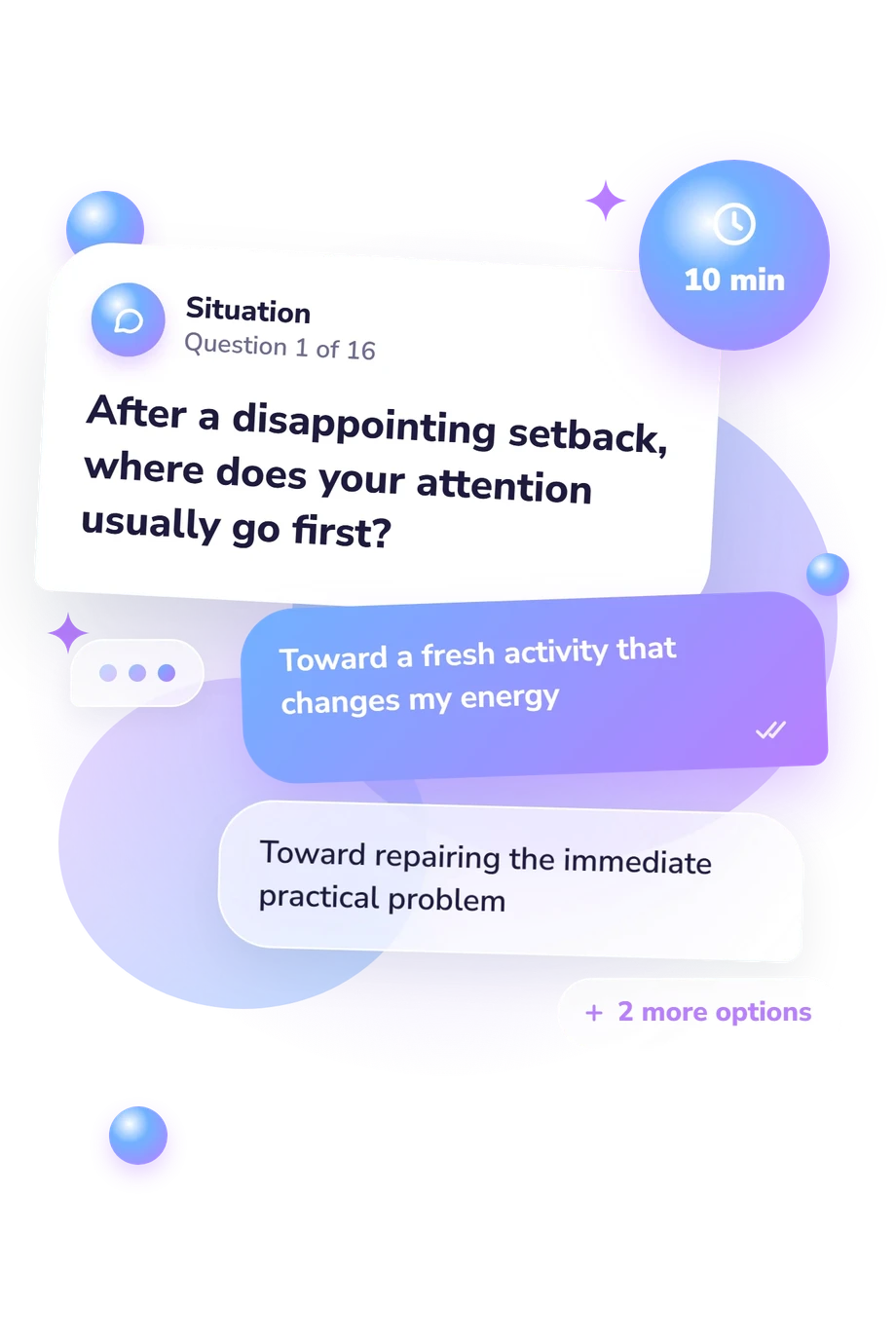
Each item presents a situation with four response options covering setbacks, group tension, unfamiliar experiences, practical problems, and open-ended projects. Selecting the most natural response creates a pattern across four directions; the result screen reports four affinity scores rather than a winning type.
The self-report format permits a limited conceptual comparison with the Fisher Temperament Inventory (Fisher et al., 2015). Novelty seeking and practical organization overlap broadly with its Explorer and Builder ideas, but Connector and Guide are not equivalents of its other dimensions, and the labels and structure differ. Brown, Acevedo, and Fisher (2013) and Fisher, Rich, Island, and Marchalik (2010) report findings; the 2010 paper examines only two temperament dimensions. Those publications neither authored nor validated this online questionnaire.
The displayed bands are internal categories of this questionnaire, and the online instrument has no established standardization or population norms. Responses depend on self-perception and current context, so mood and circumstances can influence the outcome. As a reflective preference questionnaire, it is most useful when compared with repeated real-life patterns and revisited as priorities change.
- Fisher, H. E., Island, H. D., Rich, J., Marchalik, D., & Brown, L. L. (2015). Four broad temperament dimensions: description, convergent validation correlations, and comparison with the Big Five. Frontiers in Psychology, 6, 1098. 10.3389/fpsyg.2015.01098
- Brown, L. L., Acevedo, B. P., & Fisher, H. E. (2013). Neural correlates of four broad temperament dimensions: testing predictions for a novel construct of personality. PLOS ONE, 8(11), e78734. 10.1371/journal.pone.0078734
- Fisher, H. E., Rich, J., Island, H. D., & Marchalik, D. (2010). The second to fourth digit ratio: a measure of two hormonally-based temperament dimensions. Personality and Individual Differences, 49(7), 773-777. 10.1016/j.paid.2010.06.027
Updated: