
FNAF Character Quiz
How the Scales are Structured
Who Usually Takes This Test?
See How You Compare
Below is a preview of how scores are typically distributed across each scale.
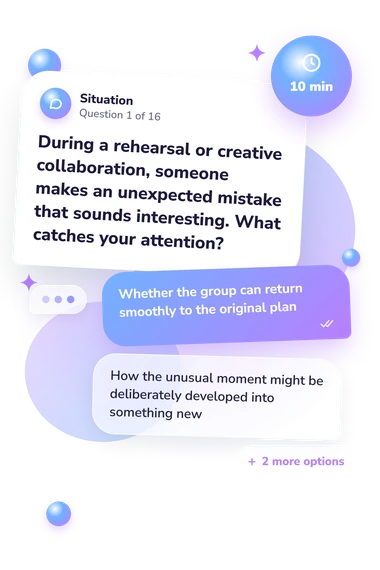
Example Questions From the Test
- Decline unless I can first resolve most of the uncertainty
- Ask one or two essential questions, then decide quickly
- Take the chance and trust myself to adjust along the way
- Wait to see what people I trust choose before committing
- Suggest a small trial so the group can learn from a real result
- Keep discussing until the team reaches broad agreement
- Try a workable approach immediately and report what happens
- Step back and let the designated leader choose the next move
- A fun distraction and an upbeat change of atmosphere
- A favorite snack or comfortable activity we can quietly share
- Plenty of room to decompress alone while I remain available
- Calm company without trying to shift their mood
FNAF Character Quiz - Description and methodology of the test
Fans of Five Nights at Freddy’s who enjoy playful personality exercises may find the FNAF Character Quiz a useful prompt for noticing how they approach everyday choices. It is suited to readers curious about their habits in creative collaboration, social situations, and group decisions, without treating a fictional comparison as a fixed identity. People interested in a What FNAF Character Are You Quiz can use the profile for light self-reflection.
What This Assessment Explores
Everyday choices are translated into four FNAF-inspired archetypes covering creative experimentation, social warmth, independent action, and visible coordination. The result describes a current affinity, not a permanent identity.
The result answers the question behind a Which FNAF Character Are You Quiz by showing which affinity feels most familiar without making it permanent.
These four displayed scales define the result:
- Bonnie Affinity (0-12) reflects creative focus through Practical Explorer (0-4), Curious Maker (5-8), or Dedicated Creator (9-12).
- Chica Affinity (0-12) reflects social warmth through Selective Socializer (0-4), Warm Companion (5-8), or Celebration Spark (9-12).
- Foxy Affinity (0-12) reflects independent action through Deliberate Navigator (0-4), Selective Adventurer (5-8), or Independent Charger (9-12).
- Freddy Fazbear Affinity (0-12) reflects coordination and responsibility through Supporting Presence (0-4), Flexible Coordinator (5-8), or Center-Stage Leader (9-12).
Methodology and Scientific Basis
Each item presents an everyday situation with four response choices. Scenarios cover creative mistakes, open-ended tasks, social contact, uncertainty, changing plans, and responsibility. Choosing the best-fitting option compares preferences across four dimensions.
Four internal totals are displayed. The highest is the strongest affinity, while any score within one point joins a blended result. These ranges belong to this questionnaire, not population norms.
Conceptually, the format is consistent with the Big Five Inventory-2 (Soto & John, 2017), but it is not an adaptation of that inventory. Character framing draws from Five Nights at Freddy’s (Cawthon, 2014).
For someone taking a What FNAF Character Am I Quiz, fictional labels make present preferences easier to discuss; they do not define a fixed identity.
These labels keep the exercise focused on present preferences.
The FNAF Quiz Who Are You format keeps attention on familiar choices and affinities.
Mood, context, self-awareness, and impression management can shift answers in this short self-report. Smith, McCarthy, and Anderson (2000) urge care with short-form measures. Descriptive bands show affinity patterns, not reference-group standing.
- Christopher J. Soto and Oliver P. John (2017). The next Big Five Inventory (BFI-2): Developing and assessing a hierarchical model with 15 facets to enhance bandwidth, fidelity, and predictive power. Journal of Personality and Social Psychology, 113(1), 117-143. 10.1037/pspp0000096
- Scott Cawthon (2014). Five Nights at Freddy's [video game]. ScottGames.
- Gregory T. Smith, David M. McCarthy, and K. G. Anderson (2000). On the sins of short-form development. Psychological Assessment, 12(1), 102-111. 10.1037/1040-3590.12.1.102