
Lab Safety Quiz
How the Scales are Structured
Who Usually Takes This Test?
See How You Compare
Below is a preview of how scores are typically distributed across each scale.
Example Questions From the Test
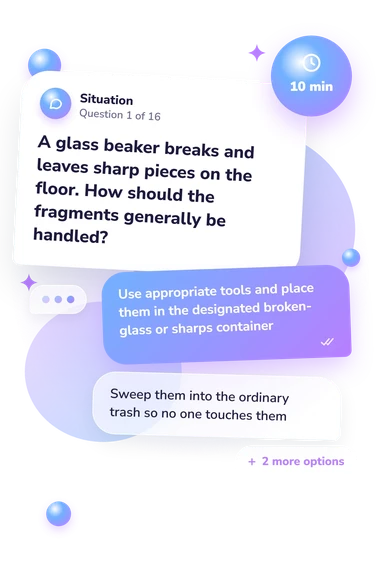
- Use appropriate tools and place them in the designated broken-glass or sharps container
- Sweep them into the ordinary trash so no one touches them
- Pick them up by hand while wearing standard disposable gloves
- Leave them in place until the laboratory’s routine cleaning period
- Wrap the damaged area with ordinary tape and use it at low power
- Position the cord where no one will touch it during operation
- Remove the instrument from use and report it for proper inspection or repair
- Use it only if the exposed section is not touching the bench
- Hold the lid down until the vibration decreases
- Increase the speed briefly to move through the unstable range
- Stop it according to procedure and check loading, balance, and equipment condition before reuse
- Let the run finish because stopping may disturb the samples
Lab Safety Quiz - Description and methodology of the test
Students, trainees, and anyone preparing to work around laboratory hazards can use this assessment to check whether everyday decisions match basic safety practice. The lab safety quiz focuses on recognizing unsafe conditions, choosing appropriate protective actions, and responding to incidents without relying on guesswork. As a laboratory safety quiz, it turns those situations into practical choices that can guide targeted review before hands-on work.
What This Assessment Explores
The items examine practical judgment around damaged equipment, chemical exposure, spills, alarms, waste, labeling, fume hoods, eye protection, heating, and pipetting. They suit learners and workers checking whether they can recognize hazards and choose a safer next step.
In practical terms, the chemistry quiz about lab safety connects hazards with controls, emergency actions, and local procedures. The result is educational feedback about knowledge to review, not chemistry ability.
The result uses one scale, Lab Safety Knowledge, scored 0-16, with displayed bands Foundation to build (0-6), Developing understanding (7-12), and Strong understanding (13-16). It brings together these themes:
- Hazard recognition shows whether unsafe conditions are noticed promptly.
- Protective practice reflects choices about equipment, clothing, gloves, hoods, and pipetting.
- Emergency response indicates how hazards, alarms, exposure, reporting, and assistance are prioritized.
- Chemical management covers labels, Safety Data Sheets, waste, and local handling rules.
Methodology and Evidence Base
Each item presents a laboratory scenario with four answer choices. Its multiple-choice design makes it a quiz with answers about lab safety: the respondent selects the safest or most appropriate action, testing recognition and response rather than written explanation.
Responses form one total; the displayed range should not be used to infer an unstated point value or weighting rule for individual options. Use the result to prioritize review of core rules and local procedures.
The content is conceptually consistent with laboratory safety-awareness dimensions examined by Wu, Yang, and Xu (2023) and chemical-safety education discussed by Sonawane, Patil, and Tigaa (2023). Its practical precautions also align with guidance from the American Chemical Society and the National Research Council. The questionnaire is not presented as a standardized adaptation of those publications; they support the topics and decisions tested.
Viewed in context, the science safety quiz is an online knowledge check influenced by attention, guessing, prior training, and local rules; the educational score is not certification or a guarantee of safe performance, and an actual incident requires the responsible person’s instructions and the laboratory emergency plan.
- Wu, Guixiang; Yang, Yanfei; Xu, Chenglin. (2023). Determination of University Students’ Laboratory Safety Awareness: A Cross-Sectional Study. Journal of Chemical Education, 100(9), 3402-3409. 10.1021/acs.jchemed.3c00305
- Sonawane, Swapnil L.; Patil, Vikas J.; Tigaa, Rodney A. (2023). Evaluating and Promoting Chemical Safety Awareness in the Chemical Sciences. Journal of Chemical Education, 100(2), 469-478. 10.1021/acs.jchemed.2c00102
- American Chemical Society, Committee on Chemical Safety. (2017). Safety in Academic Chemistry Laboratories: Best Practices for First- and Second-Year University Students, 8th edition. Washington, DC: American Chemical Society.
- National Research Council, Committee on Prudent Practices in the Laboratory. (2011). Prudent Practices in the Laboratory: Handling and Management of Chemical Hazards, Updated Version. Washington, DC: The National Academies Press. 10.17226/12654
Updated: