
Testosterone Quiz
How the Scales are Structured
Who Usually Takes This Test?
See How You Compare
Below is a preview of how scores are typically distributed across each scale.
Example Questions From the Test
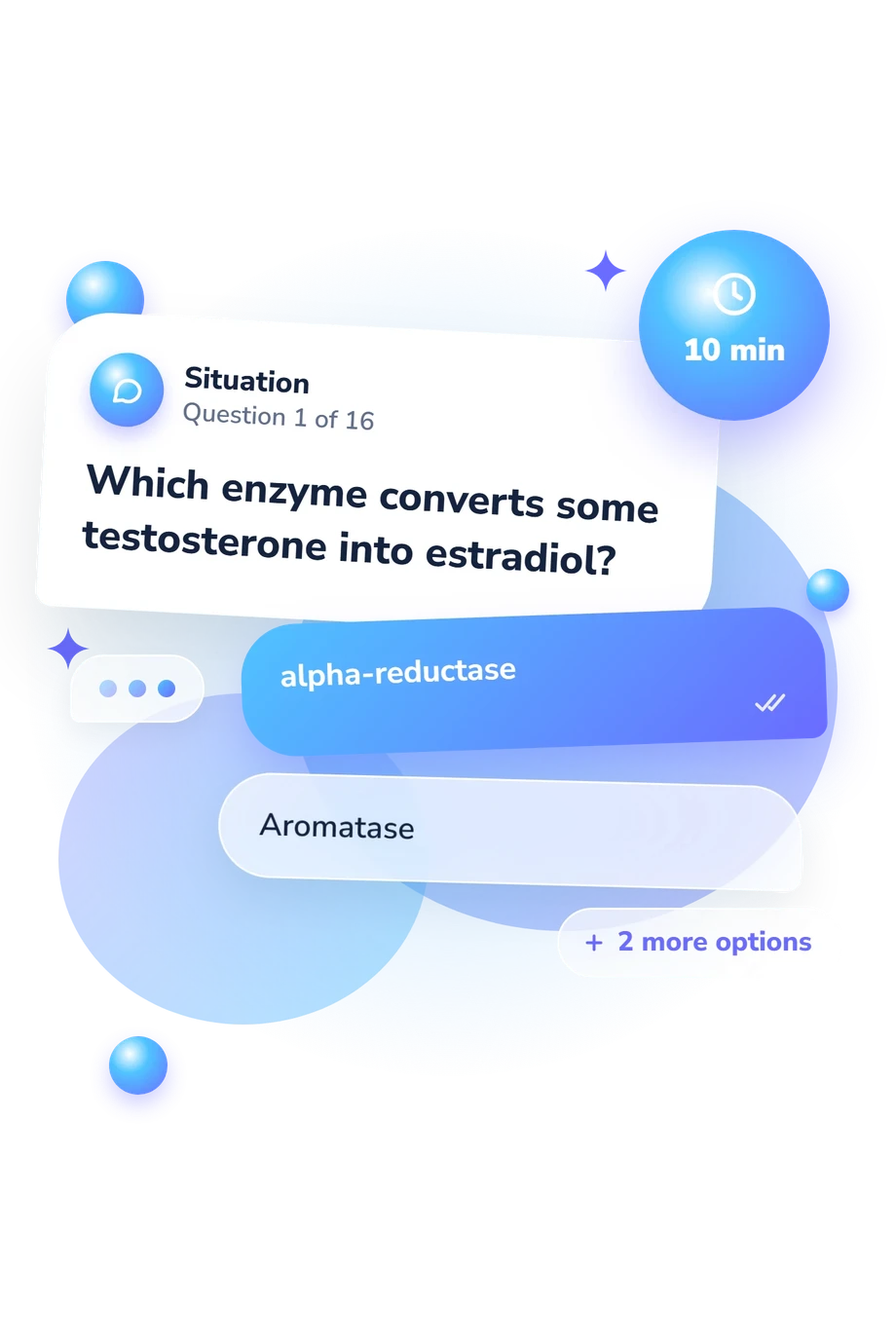
- alpha-reductase
- Aromatase
- Thyroid peroxidase
- Insulin
- Aromatase
- alpha-reductase
- Lactase
- Acetylcholinesterase
- Gonadotropin-releasing hormone (GnRH)
- Luteinizing hormone (LH)
- Follicle-stimulating hormone (FSH)
- Cortisol
Testosterone Quiz - Description and methodology of the test
Readers considering a quiz about low testosterone can use this assessment for focused self-reflection. The testosterone quiz is suited to people reviewing symptoms, laboratory terminology, fertility questions, or treatment claims before a conversation with a clinician. It gives an overall indication of knowledge and can focus further reading on these topics.
What This Assessment Explores
Fatigue and sexual changes have many explanations, so this assessment separates physiology from conclusions that require testing. People wondering whether they have low testosterone can use this assessment as a quiz built around the question: do I have low testosterone? It reviews how symptoms, laboratory terminology, and clinical context fit together.
The questions cover four broad areas:
- Biology and production: it covers enzymes, Leydig cells, pituitary signals, androgen action, and daily rhythms.
- Testing and interpretation: it covers timing, illness, sleep, SHBG, and clinical context.
- Fertility and treatment: it addresses sperm suppression, external testosterone, steroids, and fertility planning.
- Symptoms and safety: it separates possible associations from deficiency and highlights urgent warning signs.
The scale is Testosterone Knowledge, 0-16. Foundations to build is 0-6, Developing knowledge is 7-12, and Strong knowledge is 13-16. These bands summarize knowledge, not hormone measurements, medical severity, or diagnosis.
Methodology and Scientific Basis
Each item presents four answer choices and asks the respondent to select the statement that best fits established physiology or clinical interpretation. Together, the four-choice responses produce the displayed knowledge result, while the result bands summarize quiz knowledge.
As a testosterone level quiz, it tests understanding of measurement rather than a person's hormone concentration; its knowledge items do not form a validated symptom inventory.
The content is conceptually consistent with Bhasin et al. (2018), whose guidance addresses symptoms, repeated low measurements, testing conditions, fertility, and clinical context. It also aligns with Mulhall et al. (2018) and Handelsman (2020) on evaluation, androgen physiology, treatment, use, and misuse. It is not an adaptation of those publications.
The result bands are unvalidated summaries of quiz knowledge. Guessing, attention, and personal beliefs can affect performance. Persistent changes warrant clinical discussion; sudden intense headache with vision changes requires urgent medical help.
- Bhasin, Shalender, Juan P. Brito, Glenn R. Cunningham, Frances J. Hayes, Howard N. Hodis, Alvin M. Matsumoto, Peter J. Snyder, Ronald S. Swerdloff, Frederick C. Wu, and Maria A. Yialamas. (2018). Testosterone Therapy in Men With Hypogonadism: An Endocrine Society Clinical Practice Guideline. The Journal of Clinical Endocrinology & Metabolism, 103(5), 1715-1744. 10.1210/jc.2018-00229.
- Mulhall, John P., Landon W. Trost, Robert E. Brannigan, Emily G. Kurtz, J. Bruce Redmon, Kelly A. Chiles, Deborah J. Lightner, Martin M. Miner, M. Hassan Murad, Christian J. Nelson, Elizabeth A. Platz, Lakshmi V. Ramanathan, and Ronald W. Lewis. (2018). Evaluation and Management of Testosterone Deficiency: AUA Guideline. The Journal of Urology, 200(2), 423-432. 10.1016/j.juro.2018.03.115.
- Handelsman, David J. (2020). Androgen Physiology, Pharmacology, Use and Misuse. In: Feingold, Kenneth R., Richard A. Adler, S. Faisal Ahmed, et al., editors. Endotext [Internet]. South Dartmouth, MA:, Inc.; updated October 5, 2020.
Updated: