
UTI or Yeast Infection Quiz
How the Scales are Structured
Who Usually Takes This Test?
See How You Compare
Below is a preview of how scores are typically distributed across each scale.
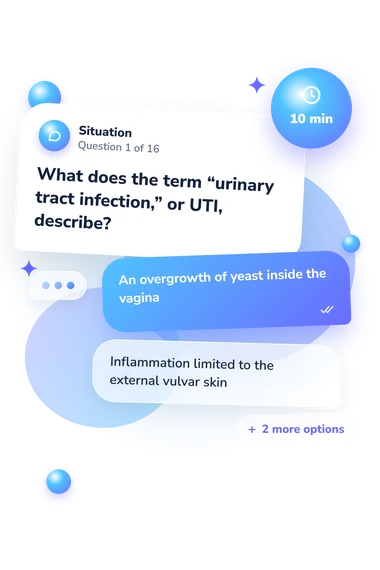
Example Questions From the Test
- An overgrowth of yeast inside the vagina
- Inflammation limited to the external vulvar skin
- Any infection transmitted through sexual contact
- An infection affecting part of the urinary system, such as the bladder, urethra, or kidneys
- Burning during urination
- A strong and frequent urge to urinate
- A noticeable change in vaginal discharge
- Pressure or discomfort in the lower abdomen
- Bacteria traveling from the urethra into the bladder
- A virus that infects the urinary tract
- An overgrowth of Candida yeast
- Mineral crystals forming in vaginal tissue
UTI or Yeast Infection Quiz - Description and methodology of the test
Readers who want a practical knowledge check about common urinary and vaginal conditions can use this assessment to examine what they know before deciding which health topics deserve closer attention. The uti or yeast infection quiz is intended for people who want to test their understanding of common distinctions and appropriate care-seeking decisions. Differences between a yeast infection and a UTI clarify why similar symptoms can point to different conditions.
What This Assessment Explores
These questions measure knowledge of how urinary and vaginal conditions differ, including symptom distinctions, testing limits, treatment principles, and care-seeking decisions. They distinguish urinary features such as burning, urgency, lower abdominal discomfort, and blood in urine from vulvar itching, irritation, and changed discharge, while recognizing that STIs and other conditions can resemble that pattern. Topics include antibiotics, hygiene, recurrence, pregnancy, testing, and warning signs.
People weighing UTI or yeast infection symptoms can use the result to identify knowledge areas that need review. The result reflects how clearly the respondent understands symptom distinctions, testing limits, treatment principles, and care-seeking decisions. The UTI or Yeast Infection Knowledge scale runs from 0 to 16 and appears in three bands:
- Foundations to build (0-6) indicates that basic distinctions and care decisions need review.
- Developing knowledge (7-12) indicates recognition of many patterns, with gaps remaining.
- Strong knowledge (13-16) indicates solid understanding of common distinctions and their limits.
Methodology and Scientific Basis
In this yeast infection vs uti quiz, each item presents a concept or scenario with answer choices, and the respondent selects the most accurate statement. It covers definitions, symptoms, testing, treatment, hygiene misconceptions, recurrence, pregnancy, and warning signs. The score summarizes these judgments; it is an unvalidated educational score, interpreted through displayed categories rather than a clinical cutoff.
Its evidence base is conceptually consistent with Komaroff's 1978 study of distinguishing urinary and vaginal infections. Hooton's 2012 work supports uncomplicated UTI presentation and evaluation. Workowski's 2021 STI guidance supports overlap and testing, while ACOG's 2023 guidance supports prompt assessment of urinary symptoms during pregnancy. This questionnaire is not adapted or validated by those publications.
The result highlights areas to review. Honest responses and context shape self-report, while symptoms can overlap with STIs, irritation, and other conditions. Pregnancy-related urinary symptoms or symptoms that persist or recur need prompt assessment; fever with flank or back pain, repeated vomiting, confusion, or severe illness warrants urgent help regardless of the score.
- Komaroff AL, Pass TM, McCue JD, Cohen AB, Hendricks TM, Friedland G. Management strategies for urinary and vaginal infections. Archives of Internal Medicine. 1978;138(7):1069-1073. 10.1001/archinte.138.7.1069
- Workowski KA, Bachmann LH, Chan PA, Johnston CM, Muzny CA, Park I, Reno H, Zenilman JM, Bolan GA. Sexually Transmitted Infections Treatment Guidelines, 2021. MMWR Recommendations and Reports. 2021;70(4):1-187. 10.15585/mmwr.rr7004a1
- Hooton TM. Uncomplicated Urinary Tract Infection. New England Journal of Medicine. 2012;366(11):1028-1037. 10.1056/NEJMcp1104429
- American College of Obstetricians and Gynecologists' Committee on Clinical Consensus-Obstetrics. Urinary Tract Infections in Pregnant Individuals. Obstetrics & Gynecology. 2023;142(2):435-445. 10.1097/AOG.0000000000005269
Updated: