
Ecological Footprint Quiz
How the Scales are Structured
Who Usually Takes This Test?
See How You Compare
Below is a preview of how scores are typically distributed across each scale.
Example Questions From the Test
- An estimate of the productive forest area needed to absorb relevant carbon dioxide emissions not otherwise absorbed
- The land physically occupied by power stations and fuel pipelines
- The area needed to store solid carbon-containing waste in landfills
- All environmental damage caused by every greenhouse gas and air pollutant
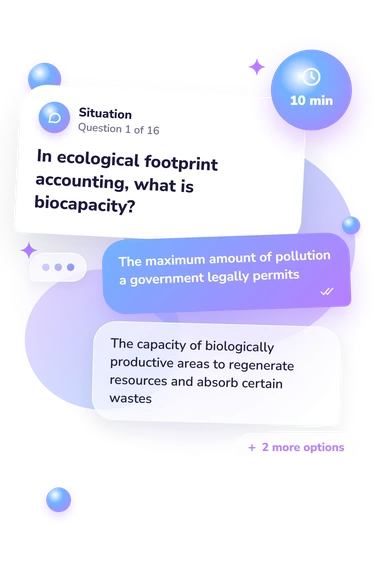
- The maximum amount of pollution a government legally permits
- The capacity of biologically productive areas to regenerate resources and absorb certain wastes
- The amount of nonrenewable material stored beneath an ecosystem
- The financial value of goods produced from land and water
- Cycling instead of driving
- Driving the same car after checking its tire pressure
- Buying fuel at a station closer to home
- Washing the car less frequently
Ecological Footprint Quiz - Description and methodology of the test
People who want to learn or check their understanding of ecological-footprint accounting can use this questionnaire as an ecological footprint assessment, examining the carbon component alongside several other topics. In the ecological footprint quiz, that component is one part of a broader account of resource demand. It is intended for anyone exploring how biocapacity, consumption, overshoot, and accounting limits shape environmental interpretation.
What This Assessment Explores
The questionnaire tests whether respondents can distinguish ecological-footprint concepts and apply them to decisions.
Items cover the carbon component, biocapacity, global hectares, consumption accounting, overshoot, food, transport, housing, product replacement, biodiversity limits, and differences from water footprints. As an eco footprint quiz, it connects scenarios with accounting boundaries.
Topics covered by the questions include:
- Accounting foundations explain how biocapacity and global hectares represent productive land and sea.
- Consumption and trade-offs show how imports, food, transport, energy, and replacement choices affect demand.
- Environmental boundaries distinguish ecological-footprint accounting from biodiversity status and water-footprint measures.
Together, these themes lead to one displayed Ecological Footprint Knowledge score (0-16): Foundations to build (0-6), Developing understanding (7-12), and Strong understanding (13-16). That overall score measures knowledge, not personal impact; a higher band indicates stronger command of tested concepts.
Methodology and Scientific Basis
Each item presents one prompt with four answer choices, making this a selected-response educational assessment. The respondent selects the option that best matches established ecological-footprint concepts. The result aggregates those selections into a knowledge score; it does not convert answers into tonnes of carbon or global hectares.
Conceptually, the questionnaire aligns with National Footprint Accounts (Borucke et al., 2013), whose framework explains productive area, biocapacity, consumption-based accounting, and global hectares. Global Footprint Network's 2009 standards support consistent terminology, while Wackernagel and Rees supply the broader ecological-footprint framework. The questionnaire is conceptually consistent with these works.
Together, these features make it an ecological footprint knowledge test with a focused educational scope. The displayed bands describe performance on this questionnaire rather than established population norms. Results can vary with prior familiarity, attention, question interpretation, and guessing. A lower band identifies concepts to revisit; a higher band indicates stronger understanding of the tested material.
- Borucke, M., Moore, D., Cranston, G., Gracey, K., Iha, K., Larson, J., Lazarus, E., Morales, J. C., Wackernagel, M., & Galli, A. (2013). Accounting for demand and supply of the biosphere's regenerative capacity: The National Footprint Accounts' underlying methodology and framework. Ecological Indicators, 24, 518-533. 10.1016/j.ecolind.2012.08.005
- Global Footprint Network. (2009). Ecological Footprint Standards 2009. Oakland, CA: Global Footprint Network.
- Wackernagel, M., & Rees, W. E. (1996). Our Ecological Footprint: Reducing Human Impact on the Earth. Gabriola Island, BC: New Society Publishers.