
MRI Quiz
How the Scales are Structured
Who Usually Takes This Test?
See How You Compare
Below is a preview of how scores are typically distributed across each scale.
Example Questions From the Test
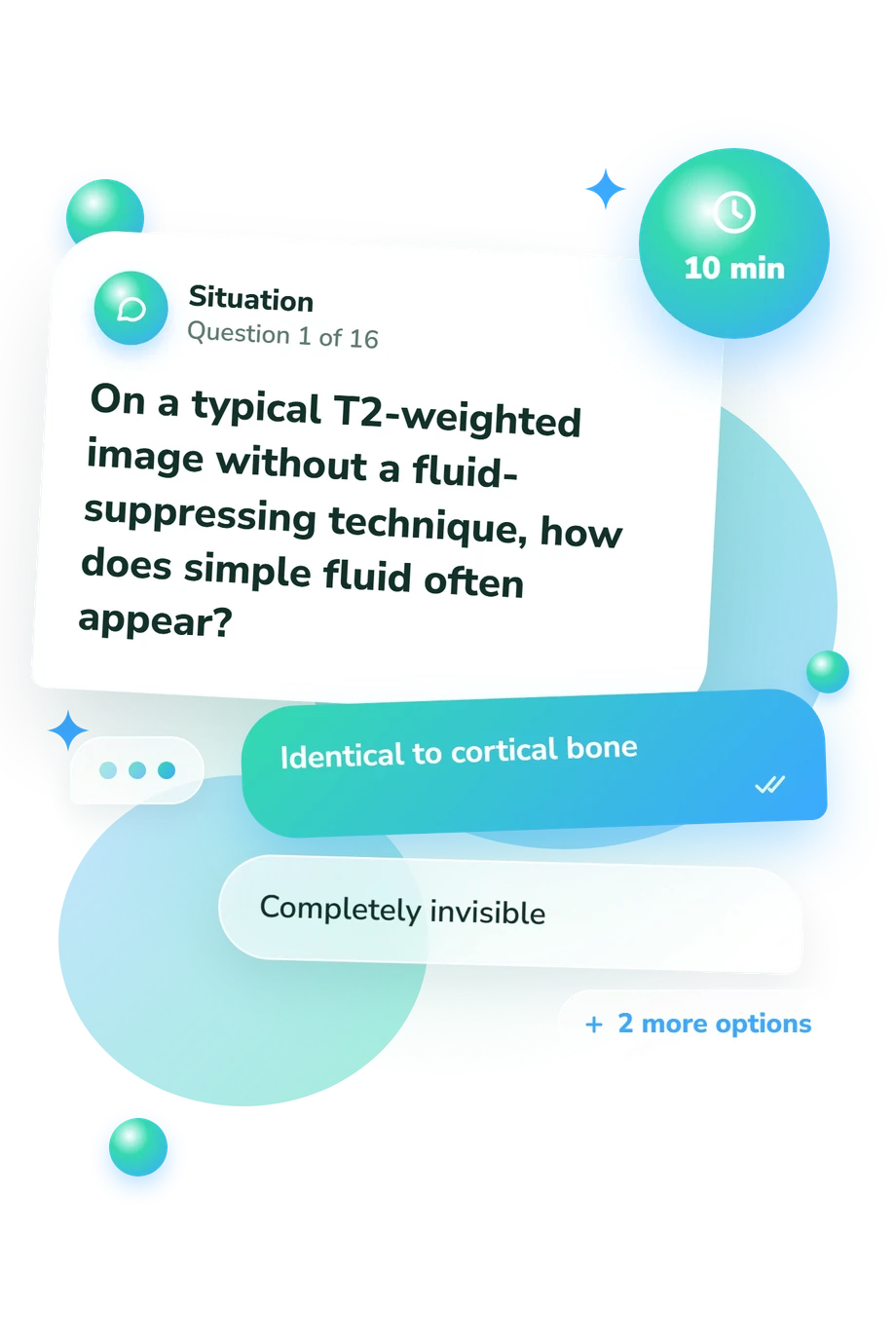
- Identical to cortical bone
- Completely invisible
- Relatively bright
- Always darker than air
- A folded cotton blanket
- A foam positioning cushion
- A plastic specimen cup
- An unsecured ferromagnetic oxygen cylinder
- Iodine-based contrast
- Gadolinium-based contrast
- Barium sulfate contrast
- Technetium-based tracer
MRI Quiz - Description and methodology of the test
People preparing for an MRI appointment, studying imaging basics, or supporting someone through screening can use this assessment to organize essential knowledge. The MRI Quiz helps readers identify areas to revisit before an appointment and frame practical questions for the imaging team. Its result can guide MRI preparation by showing which topics deserve further discussion.
What This Assessment Explores
These questions link MRI physics, image quality, and patient safety. They ask about signal production, fluid appearance, motion artifacts, scanner sounds, screening, implants, contrast, pregnancy, kidney disease, claustrophobia, injection concerns, and communication. The assessment combines facts with practical responses.
The main content areas are:
- MRI physics and image formation explain how magnetic fields, radiofrequency energy, tissue properties, gradients, and motion shape a scan.
- Screening and implant awareness show whether metal hazards, device conditions, documentation, and advance planning are recognized.
- Contrast and patient communication show whether the respondent recognizes when health history, symptoms, or concerns should be reported to imaging staff.
For someone taking an MRI knowledge test, the MRI Knowledge scale runs from 0-16: Foundations to Build (0-6) signals review needs; Developing Knowledge (7-12) shows many essentials with gaps; Strong Knowledge (13-16) reflects broad understanding of principles and precautions. These are educational bands, not medical clearance.
Methodology and Scientific Basis
Each item presents four answer choices. Some test foundations such as MRI signal production or artifact causes; others describe situations involving implants, contrast, screening, symptoms, or communication. One overall result is reported, but no item-weighting rule is stated, so readers should not infer identical contribution beyond the displayed scoring structure.
Viewed as an MRI safety quiz, the content is conceptually consistent with Muthalaly et al. (2018), especially its attention to cardiac-device type, scanning conditions, and advance planning. Plewes and Kucharczyk (2012) supports the physics themes. The American College of Radiology’s 2024 MR safety manual and 2025 contrast manual support safety, screening, and contrast domains. Together, these sources provide context for the safety and physics topics in questions about device conditions, scanning requirements, image formation, and contrast; they do not provide norms or validation for this online version.
Results can vary with self-report bias, current stress, attention, prior training, and self-awareness; recognizing a correct choice does not establish practical competence. Use the result to focus questions for imaging professionals when an implant, pregnancy, kidney disease, contrast, or claustrophobia is relevant.
- Muthalaly RG, Nerlekar N, Ge Y, Kwong RY, Nasis A. MRI in Patients with Cardiac Implantable Electronic Devices. Radiology. 2018;289(2):281-292. 10.1148/radiol.2018180285
- American College of Radiology. ACR Manual on MR Safety: 2024. American College of Radiology; 2024.
- Plewes DB, Kucharczyk W. Physics of MRI: A primer. Journal of Magnetic Resonance Imaging. 2012;35(5):1038-1054. 10.1002/jmri.23642
- American College of Radiology. ACR Manual on Contrast Media. Version 2025. American College of Radiology; 2025.
Updated: