
What Lipstick Suits Me Quiz
How the Scales are Structured
Who Usually Takes This Test?
See How You Compare
Below is a preview of how scores are typically distributed across each scale.
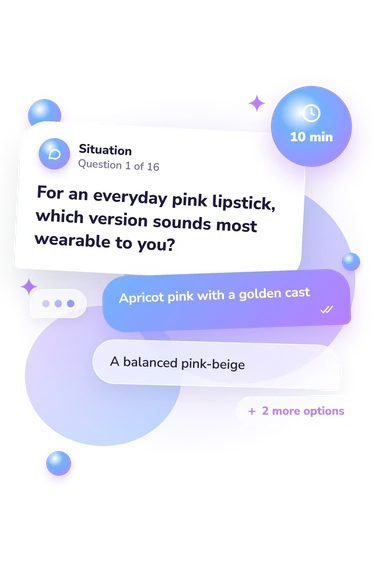
Example Questions From the Test
- Apricot pink with a golden cast
- A balanced pink-beige
- A muted cool rose
- A clearly blue-based pink or mauve
- A translucent beige-pink balm
- A medium muted rose
- A rich classic red
- An electric fuchsia or saturated vivid coral
- I would rather the stain fade peachy or warm brown
- It is fine if the tint is subtle and neutralized
- I enjoy it for certain outfits or seasons
- That fresh, cool tint is one of my favorite effects
What Lipstick Suits Me Quiz - Description and methodology of the test
For readers deciding whether the What Lipstick Suits Me Quiz fits their routine, this assessment offers a practical way to understand color preference rather than chase a universal “best” shade. Visitors wondering what lipstick color is best for them can use this specific quiz to decide whether its style profile matches their wardrobe and comfort zone. It suits anyone unsure which lipstick direction feels natural to wear.
What This Assessment Explores
The assessment maps preference across saturation, temperature, softness, and earthy warmth rather than naming one correct shade. This lip color quiz suits anyone choosing or comparing lipstick; its result describes styles to sample, not objective attractiveness or undertone.
The four result dimensions are:
- Bold & Vivid (0-12) measures style affinity for vivid or saturated lipstick, not objective attractiveness; Subtle Contrast 0-4; Occasion-Ready Boldness 5-8; Strong Vivid Affinity 9-12.
- Cool & Rosy (0-12) measures attraction to mauve, berry, blue-pink, and cool rose; Warmer Direction 0-4; Selective Rosiness 5-8; Strong Cool Affinity 9-12.
- Soft & Neutral (0-12) measures comfort with understated beige-pink, muted rose, cocoa, and rose-brown; More Defined Color 0-4; Flexible Neutrality 5-8; Strong Soft-Neutral Affinity 9-12.
- Warm & Earthy (0-12) measures preference for peach, coral, terracotta, cinnamon, caramel, and brick; Cooler Direction 0-4; Selective Warmth 5-8; Strong Warm Affinity 9-12.
Methodology and Scientific Basis
Each item presents four response options about shade family, contrast, temperature, finish, or lipstick's role in a look. Questions cover everyday wear, outfits, unfamiliar purchases, nude testing, photos, and reactions to brighter or warmer colors. Together, these choices make the lip quiz a self-report preference questionnaire that produces profile scores rather than one result.
The scoring is descriptive: answer patterns contribute to four profile directions, and each displayed band translates a direction into a practical style description. The approach is conceptually consistent with Tian et al. (2023), which studied lipstick-color preference under different lighting. Kobayashi (2005) provides context for warm-cool relationships between skin and lipstick, while Khanh and Bodrogi (2018) discuss naturalness, vividness, and makeup color quality under lighting. These sources support the framework’s relevance, not validation of this online questionnaire.
Because the lipstick quiz is a self-report preference questionnaire, its result is a style-preference profile. No norm group, reliability estimate, or standardized cutoff is stated for this questionnaire. Results can shift with mood, lighting, wardrobe, and color familiarity; daylight swatches and repeated wear provide a useful reality check.
- Tian B, Gong H, Chen Z, Yu X, Pointer MR, Yu J, Yu F, Liu Q. Assessment of color preference, purchase intention and sexual attractiveness of lipstick colors under multiple lighting conditions. Frontiers in Neuroscience. 2023;17:1280270. 10.3389/fnins.2023.1280270
- Kobayashi M. Studies on the Color Planning of Clothing-The warm-cool evaluation of the skin and lipstick color and their matching-. Journal of the Japan Research Association for Textile End-Uses. 2005;46(8):509-517. 10.11419/senshoshi1960.46.509
- Khanh TQ, Bodrogi P. Colour preference, naturalness, vividness and colour quality metrics, Part 3: Experiments with makeup products and analysis of the complete warm white dataset. Lighting Research & Technology. 2018;50(2):218-236. 10.1177/1477153516669558
Updated: