
Analog Clock Quiz
How the Scales are Structured
Who Usually Takes This Test?
See How You Compare
Below is a preview of how scores are typically distributed across each scale.
Example Questions From the Test
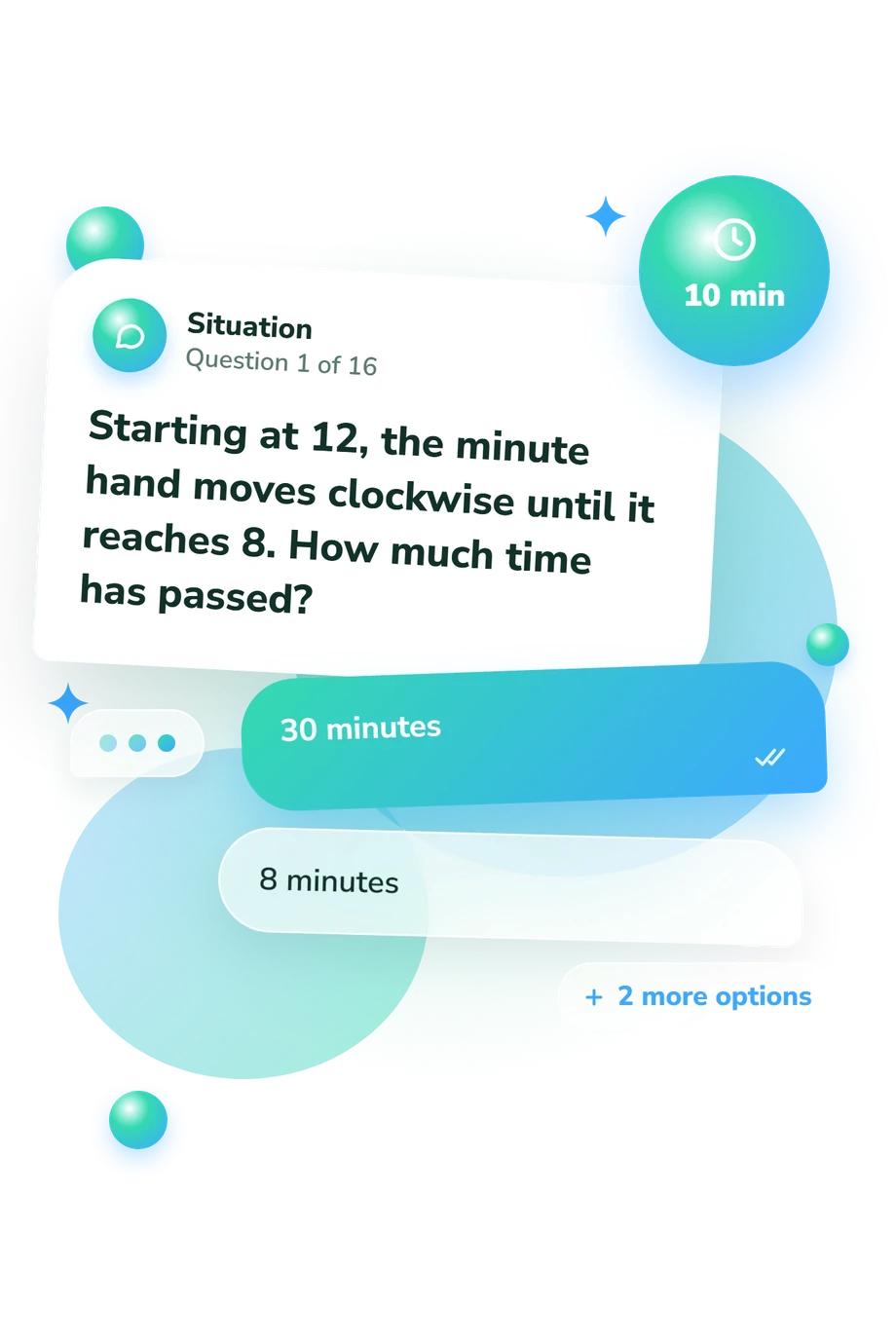
- 30 minutes
- 8 minutes
- 40 minutes
- 50 minutes
- 2:25
- 2:35
- 2:30
- 2:40
- 9 minutes
- 50 minutes
- 30 minutes
- 45 minutes
Analog Clock Quiz - Description and methodology of the test
Designed for anyone who wants to check time-reading skills, this analog clock quiz focuses on interpreting an analog face rather than memorising labels. It suits learners, parents, and adults refreshing everyday knowledge. The result from this clock quiz gives a view of clock knowledge, rather than separate scores for individual skills. Its questions reveal which areas deserve more practice. The emphasis is on useful everyday reasoning, not speed or competition.
What This Assessment Explores
The questions connect the two main hands with time expressions and everyday timing decisions. They cover hand roles, five-minute intervals, half-hours, quarter phrases, movement between numerals, elapsed time, clock error, and angles between hands. Together, these tasks combine visual interpretation, language, and practical calculation in this telling time quiz.
These are themes covered by the questions, rather than separately reported scores:
- Recognising hand roles shows whether you can identify hour and minute hands.
- Locating minute intervals shows how accurately numerals and hand positions translate into five-minute steps.
- Reading moving hour positions shows whether you notice the hour hand shifting between numerals.
- Applying time information shows how well you calculate durations, corrections, arrivals, and schedules.
The overall band indicates general clock knowledge, not separate scores for these themes. It can guide practice in areas such as hand placement or elapsed time.
Methodology and Scientific Basis
Each item presents a clock display, time phrase, or timing problem with four choices. An answer requires recognition, translation between representations, and applied reasoning. In this time quiz, answering independently keeps the result tied to the respondent's own interpretation.
Results use one scale, Analog Clock Knowledge, scored from 0-16. Its bands are Building the foundation (0-6), Developing time reader (7-12), and Strong clock knowledge (13-16). These labels describe increasing consistency in reading hand positions, time expressions, and practical timing problems; no points-per-answer formula should be inferred.
Earnest, Gonzales, and Plant (2018) support the hand-positioning theme, while Boulton-Lewis and colleagues address reading analogue and digital time. Van Bommel and Walla's 2025 review places these skills within early-mathematics teaching. These works provide contextual evidence for the topics, not validation of this questionnaire: it is not presented as an adaptation of them, and its result is educational, not a formal assessment.
Because this clock time quiz combines visual judgments with timing calculations, results may reflect attention, notation familiarity, or situational mistakes. Use it to identify practice priorities, not to infer a formal educational level.
- Earnest, Darrell, Alicia C. Gonzales, and Anna M. Plant. (2018). "Time as a Measure: Elementary Students Positioning the Hands of an Analog Clock." Journal of Numerical Cognition, 4(1), Article e5793. 10.5964/jnc.v4i1.94
- Boulton-Lewis, Gillian M., Lynn Wilss, and Sue Mutch. (1997). "Analysis of Primary School Children's Abilities and Strategies for Reading and Recording Time from Analogue and Digital Clocks." Mathematics Education Research Journal, 9(2), 136-151. 10.1007/BF03217308
- van Bommel, Jorryt, and Maria Walla. (2025). "Teaching and Learning of Time in Early Mathematics Education: A Systematic Literature Review." Education Sciences, 15(8), 1003. 10.3390/educsci15081003
Updated: