
Sig Fig Quiz
How the Scales are Structured
Who Usually Takes This Test?
See How You Compare
Below is a preview of how scores are typically distributed across each scale.
Example Questions From the Test
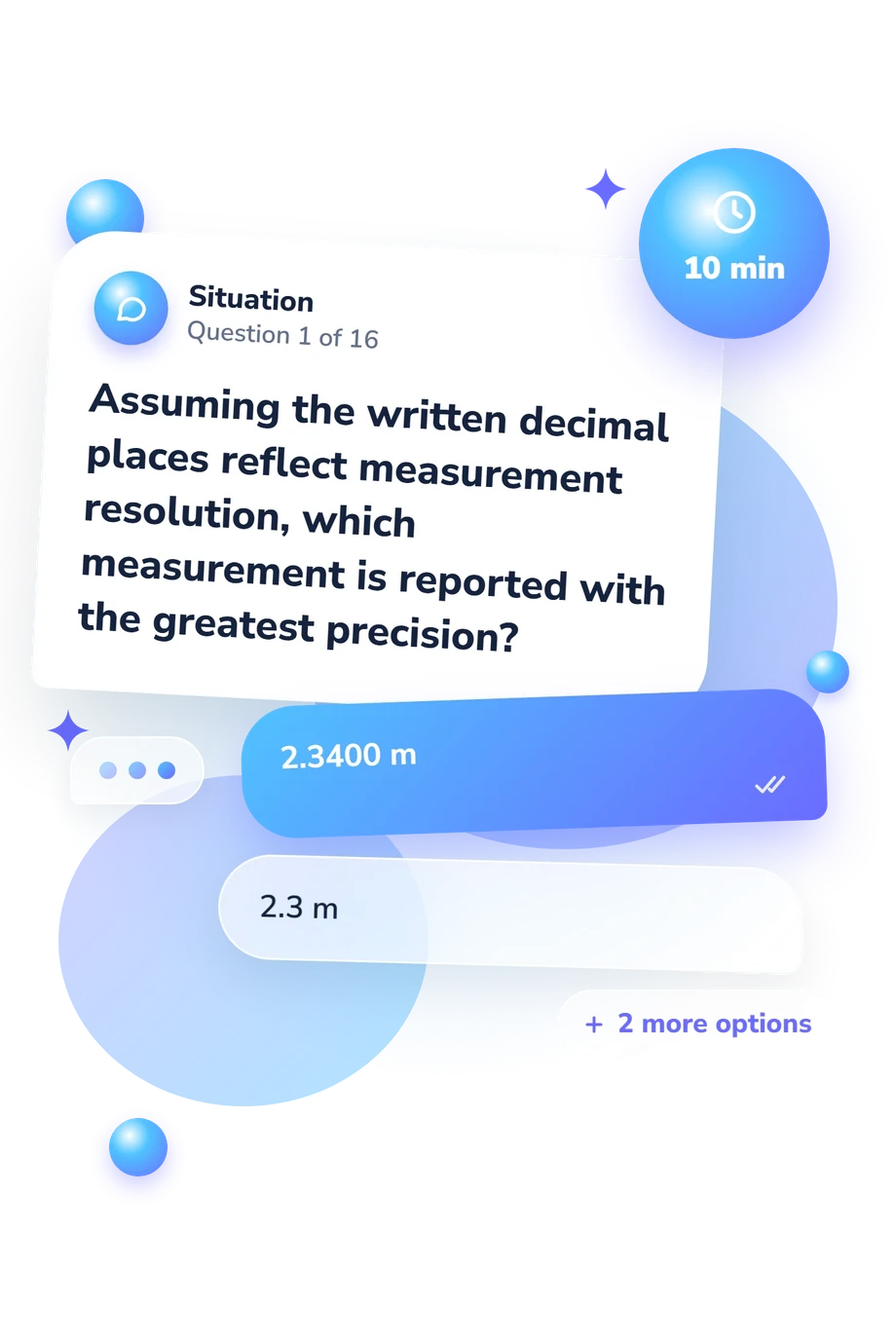
- 3400 m
- 3 m
- 340 m
- 2 m
- As a measured value with two significant figures
- As a measured value with one significant figure
- As an exact quantity that does not limit significant figures
- As a quantity with no significant figures
- 50 kg
- 5 kg
- 500 kg
- 8 kg
Sig Fig Quiz - Description and methodology of the test
Students learning measurement notation, reviewing chemistry calculations, or checking laboratory work can use this significant figures practice quiz when deciding whether their current understanding is ready for independent problem solving. The assessment helps learners choose between targeted review and further application practice. The Sig Fig Quiz offers a focused way to check that readiness and identify an appropriate next learning step.
What This Assessment Measures
This assessment examines conventions that determine the precision a recorded value communicates. Its items cover identifying significant figures, exact counted quantities, decimal-place rules for addition and subtraction, and significant-figure rules for multiplication, division, means, areas, and rounding. It suits learners reviewing measurement calculations.
Questions about calculation and notation make this a sig fig practice quiz that shows whether uncertainty comes from arithmetic or from deciding how many digits to report. The Significant Figures Knowledge scale runs from 0-16: Foundations to Review (0-6), Developing Knowledge (7-12), and Strong Knowledge (13-16). These bands describe increasing consistency with notation and measurement conventions.
The items cover four skill areas:
- Precision and resolution show how decimal places communicate detail.
- Exact quantities distinguish counts from precision-limiting measurements.
- Zeros and scientific notation show whether notation preserves figures.
- Operations and rounding show whether rules survive calculation.
Methodology and Scientific Basis
Each item offers four answer options, so the questionnaire is a significant figures quiz rather than a free-response calculation sheet. The respondent selects the report that follows the stated convention, sometimes by recognizing notation and sometimes by carrying rules through a calculation. Questions require reading decimal places, identifying zeros, distinguishing exact counts, or retaining guard digits before final rounding.
The questionnaire reports the displayed knowledge scale and its three descriptive bands; it does not present separate subscores. Graham's work is the closest conceptual reference for the arithmetic conventions tested here, and the questionnaire is consistent with that work but is not an adaptation of it. Pacer's treatment supports introductory examples and conventions, while measurement guidance by Ambler Thompson and Barry N. Taylor provides context for units, precision, and uncertainty.
Performance may vary with prior classroom conventions, notation familiarity, and attention during the attempt. The descriptive result bands are not population norms or validated course cutoffs, so the profile should guide further practice instead of standing for mastery in unfamiliar laboratory conditions.
- Graham, D. M. (1989). Significant figure rules for general arithmetic functions. Journal of Chemical Education, 66(7), 573-575. 10.1021/ed066p573
- Pacer, Richard A. (2000). How Can an Instructor Best Introduce the Topic of Significant Figures to Students Unfamiliar with the Concept? Journal of Chemical Education, 77(11), 1435. 10.1021/ed077p1435
- Thompson, Ambler, and Barry N. Taylor. (2008). Guide for the Use of the International System of Units (SI), NIST Special Publication 811, 2008 Edition. National Institute of Standards and Technology. 10.6028/NIST.SP.811e2008
- Taylor, Barry N., and Chris E. Kuyatt. (1994). Guidelines for Evaluating and Expressing the Uncertainty of NIST Measurement Results, 1994 Edition. NIST Technical Note 1297. National Institute of Standards and Technology. 10.6028/NIST.tn.1297
Updated: