
Anatomy and Physiology Quiz
How the Scales are Structured
Who Usually Takes This Test?
See How You Compare
Below is a preview of how scores are typically distributed across each scale.
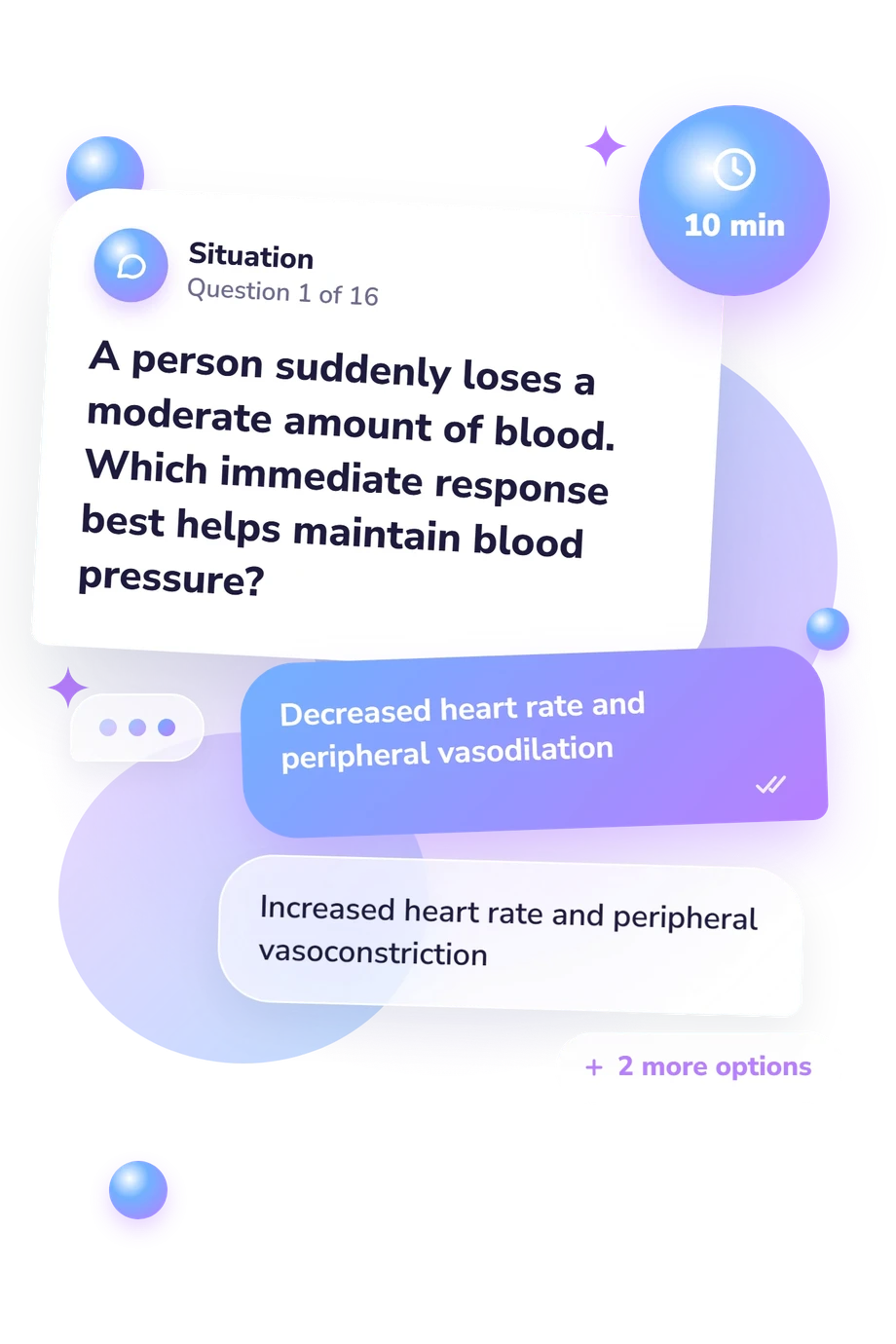
Example Questions From the Test
- Decreased heart rate and peripheral vasodilation
- Increased heart rate and peripheral vasoconstriction
- Increased urine production and reduced thirst
- Reduced breathing rate and relaxed arterioles
- Increased urine volume through lower duct permeability
- Greater glucose filtration at the glomerulus
- Reduced sodium reabsorption throughout the nephron
- Greater water reabsorption in the kidney collecting ducts
- Pancreatic beta cells
- Pancreatic alpha cells
- Thyroid follicular cells
- Adrenal medulla cells
Anatomy and Physiology Quiz - Description and methodology of the test
Students reviewing body systems, preparing for introductory coursework, or checking prerequisite knowledge can use this anatomy and physiology quiz to see how well they connect structure with function. It offers a focused learning snapshot rather than a clinical profile. As a quiz on human anatomy and physiology, it is especially useful for locating topics to revisit before more advanced study or laboratory work.
What This Assessment Measures
Questions cover homeostasis, hormones, immunity, renal and digestive function, neural pathways, movement, reproduction, respiration, circulation, bone, skin, and myelin. Linking each structure or process with its immediate function is central to this physiology quiz, with many items using brief applied situations.
The main themes are:
- Regulation shows how hormones and kidneys support internal stability.
- Neural and muscular function links reflexes, nerve roots, pathways, and movement.
- Respiration and circulation connect ventilation, gas exchange, blood flow, and acid-base balance.
- Tissue and organ structure matches cells and layers with specialized roles.
Results are reported as Anatomy and Physiology Knowledge: 0-16. The scale captures major structures, system roles, cause-and-effect relationships, and physiological reasoning. Foundation Building (0-6) marks essential review; Developing Knowledge (7-12) shows many essentials with some gaps; Strong Knowledge (13-16) reflects broad command of core material.
Methodology and Evidence Base
Each item presents four answer choices and one best response, combining direct knowledge checks with applied situations involving blood-pressure compensation, hormone release, nephron function, reflexes, gas exchange, circulation, and tissue structure. One point is awarded for each correct answer, so the score reflects selected responses rather than confidence or partial understanding.
The closest published comparison is Abrahams et al.'s Foundational Anatomy and Physiology Knowledge Assessment, which targets foundational knowledge in this subject area. Pienaar et al.'s Life Sciences Baseline Assessment addresses broader life-science knowledge, while Phys-MAPS illustrates programmatic physiology assessment across levels. These published tools provide conceptual context, not the source or validation of this online questionnaire.
As an introductory anatomy-and-physiology knowledge check, it can guide review, but it has no stated population norms, reliability estimates, or clinical cutoffs. Pais et al. shows why ambiguous stems or weak distractors may affect performance. Results can also reflect prior instruction, current attention, and the respondent’s interpretation of each item.
- Lunelle Pienaar, Robert Prince, and Amaal Abrahams. Development of a baseline assessment tool to establish students' foundational knowledge of life sciences at entry to university. African Journal of Health Professions Education. 2021;13(1):77-82. 10.7196/AJHPE.2021.v13i1.1226
- Amaal Abrahams, Lunelle Pienaar, Kishor Bugarith, Geney Gunston, and Elmi Badenhorst. A foundational knowledge assessment tool to predict academic performance of medical students in first-year anatomy and physiology. Advances in Physiology Education. 2022;46(4):598-605. 10.1152/advan.00017.2022
- Katharine Semsar, Sara Brownell, Brian A. Couch, Alison J. Crowe, Michelle K. Smith, Mindi M. Summers, Christian D. Wright, and Jennifer K. Knight. Phys-MAPS: a programmatic physiology assessment for introductory and advanced undergraduates. Advances in Physiology Education. 2019;43(1):15-27. 10.1152/advan.00128.2018
- João Pais, Artur Silva, Bruno Guimarães, Ana Povo, Elisabete Coelho, Fernanda Silva-Pereira, Isabel Lourinho, Maria Amélia Ferreira, and Milton Severo. Do item-writing flaws reduce examinations psychometric quality? BMC Research Notes. 2016;9(1):399. 10.1186/s13104-016-2202-4
Updated: