
Finish the Lyrics Quiz
How the Scales are Structured
Who Usually Takes This Test?
See How You Compare
Below is a preview of how scores are typically distributed across each scale.
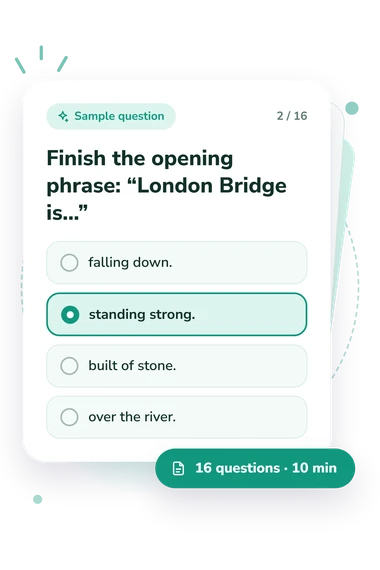
Example Questions From the Test
- And so say all of us.
- May good fortune come his way.
- Which nobody can deny.
- Let us sing it once again.
- falling down.
- standing strong.
- built of stone.
- over the river.
- Buy me some peanuts and Cracker Jack.
- Take me out to the old ball game.
- Let me root, root, root for the home team.
- For it’s one, two, three strikes, you’re out.
Finish the Lyrics Quiz - Description and methodology of the test
Readers who enjoy traditional songs, classroom singalongs, or casual music recall can use the Finish the Lyrics Quiz with Answers to compare their recall across a shared repertoire. It also lets people revisit remembered lines and check their continuations, pairing a song lyric quiz with answers that clarify the repertoire. The result shows which parts of the songbook feel secure and where version differences or unfamiliar songs may affect a choice.
What This Assessment Explores
This questionnaire examines expected continuations in traditional and public-domain songs. Prompts draw on opening lines, refrains, and verse sequences, testing verbal access and rejection of plausible alternatives. It suits readers curious about lyric memory at holidays, sporting events, school activities, or singalongs.
The selected questions create a focused profile of lyric knowledge within a music-lyrics quiz, rather than measuring general musical ability. A stronger result suggests dependable recall for this repertoire; a lower one may reflect unfamiliar songs, competing versions, or momentary difficulty.
The result is shown through the Finish the Lyrics Knowledge scale (0-16), with three reader-facing bands:
- Starting Verse (0-6) shows recognition of some standards but confusion between nearby lines or similar songs.
- Chorus Catcher (7-12) shows many familiar completions with less certainty around unfamiliar transitions.
- Lyric Finisher (13-16) shows strong knowledge and reliable rejection of near-miss continuations.
Methodology and Evidence Base
Each item uses a four-option multiple-choice format in this finish-the-lyrics quiz: the prompt requires selecting the familiar continuation from one expected line and three plausible near misses. The displayed result summarizes performance on this set, with no published norms or standardized clinical interpretation.
The quiz's focus is conceptually consistent with research by Hyman and Rubin on durable access to familiar verbal material. Work by Peynircioğlu, Rabinovitz, and Thompson treats titles, lyrics, and melodies as related memory cues, while research by Peretz, Radeau, and Arguin examines interactions between tune and lyric recognition. Together, these findings provide context for the memory rationale, but this online questionnaire is not presented as an adaptation of their instruments.
Its fixed 16-item repertoire offers a bounded snapshot of recognition for selected songs. Scores may vary with exposure, cultural familiarity, preferred song versions, attention, and response to competing alternatives. The descriptive bands concern this repertoire and do not establish broader memory or cognitive ability.
- Hyman, Ira E., Jr., and David C. Rubin. (1990). Memorabeatlia: A naturalistic study of long-term memory. Memory & Cognition, 18(2), 205-214. 10.3758/BF03197096
- Peynircioğlu, Zehra F., Brian E. Rabinovitz, and Jennifer L. W. Thompson. (2008). Memory and metamemory for songs: The relative effectiveness of titles, lyrics, and melodies as cues for each other. Psychology of Music, 36(1), 47-61. 10.1177/0305735607079722
- Peretz, Isabelle, Monique Radeau, and Martin Arguin. (2004). Two-way interactions between music and language: Evidence from priming recognition of tune and lyrics in familiar songs. Memory & Cognition, 32(1), 142-152. 10.3758/BF03195827