
Which Pony Are You Quiz
How the Scales are Structured
Who Usually Takes This Test?
See How You Compare
Below is a preview of how scores are typically distributed across each scale.
Example Questions From the Test
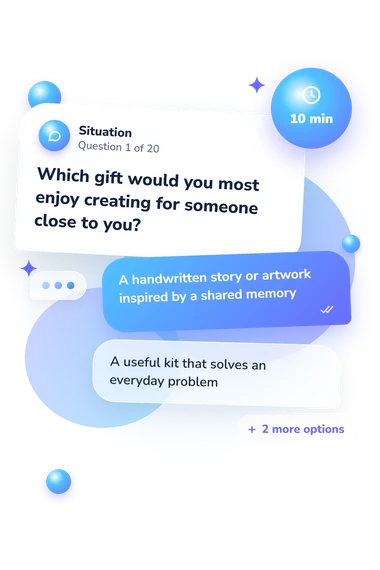
- A handwritten story or artwork inspired by a shared memory
- A useful kit that solves an everyday problem
- Tickets for an exciting experience together
- A cheerful group surprise involving several friends
- Suggest a simple, fair routine and take a dependable share
- Challenge everyone to finish the work as quickly as possible
- Look for a tool or system that could make the chores easier
- Turn the cleanup into a social activity with music and jokes
- Inventor who improves everyday tools and systems
- Scout who leads expeditions into unfamiliar country
- Host who fills community events with laughter and energy
- Keeper who makes sure neighbors have support and supplies
Which Pony Are You Quiz - Description and methodology of the test
For anyone curious about how they respond in group situations, make choices under pressure, or balance initiative with reflection, the Which Pony Are You Quiz offers a playful framework for self-observation. It suits readers who want to understand their role in shared activities and the tendencies guiding everyday decisions. Readers can use it as a What My Little Pony Am I Quiz, treating the result as a practical prompt rather than a fixed identity.
What This Assessment Explores
The questionnaire reads everyday choices as signs of preferred ways to relate, act, notice, and create. Although its framing may resemble a quiz asking which MLP character you are, it matches responses with five original pony-style profiles rather than established franchise characters.
These are the five result dimensions:
- Clover Hearth (0-12) reflects dependable care and patient cooperation.
- Emberstride (0-12) reflects adventurous initiative and decisive energy.
- Jubilee Bell (0-12) reflects playful sociability and shared energy.
- Prism Ponder (0-12) reflects inventive curiosity and careful observation.
- Velvet Quill (0-12) reflects reflective imagination and emotional nuance.
Each score is shown as Different Spark (0-4), Shared Streak (5-8), or Strong Match (9-12). Here, the MLP quiz asks what pony style you are closest to: the highest of the five scores indicates your strongest affinity, and scores within one point form a blended result.
Methodology and Scientific Basis
Items cover social, creative, practical, and uncertain situations and offer four response options. You choose the response that feels most like your action. The questionnaire produces five 0-12 affinity scores: the highest indicates your strongest affinity, while scores within one point create a blended result.
The approach is conceptually consistent with the broad character-strength framework associated with the VIA-IS and developed by Peterson and Seligman, but those works do not validate this questionnaire or establish its five custom scales. The questionnaire is neither an adaptation nor a standardized administration of the VIA-IS.
The fictional profiles use friendship-centered language associated with My Little Pony. Snider’s guidebook provides franchise context, not psychological evidence. For someone approaching this questionnaire as a What MLP Character Am I Quiz, the outcome prompts reflection on five custom profiles rather than identification with a canonical character.
Interpret the outcome as a snapshot of self-perception. Mood, relationships, situational priorities, and willingness to answer candidly can influence choices. The bands are descriptive categories rather than population norms or clinical thresholds, so the result is most informative as a personal reflection on response tendencies.
- Park, Nansook, Christopher Peterson, and Martin E. P. Seligman. “Strengths of Character and Well-Being.” Journal of Social and Clinical Psychology 23, no. 5 (2004): 603-619. 10.1521/jscp.23.5.603.50748
- Peterson, Christopher, and Martin E. P. Seligman. Character Strengths and Virtues: A Handbook and Classification. Washington, DC, and New York: American Psychological Association and Oxford University Press, 2004.
- Snider, Brandon T. My Little Pony: The Elements of Harmony: Friendship Is Magic: The Official Guidebook. New York: Little, Brown Books for Young Readers, 2013.