
Medical Quiz
How the Scales are Structured
Who Usually Takes This Test?
See How You Compare
Below is a preview of how scores are typically distributed across each scale.
Example Questions From the Test
- Gallbladder
- Spleen
- Pancreas
- Thyroid gland
- Carotid arteries
- Pulmonary veins
- Coronary arteries
- Venae cavae
- Producing antibodies against infections
- Carrying oxygen through the bloodstream
- Digesting fats absorbed from food
- Forming the body's major blood clots
Medical Quiz - Description and methodology of the test
People who want to check their grasp of everyday health information can use this assessment as a structured learning exercise. A medical knowledge quiz can suit learners, curious adults, and anyone revising basic concepts. The medical quiz organizes knowledge about body systems, prevention, medicines, first aid, and urgent responses, then turns performance into a broad educational profile rather than a judgment about personal health.
What This Assessment Measures
This questionnaire examines practical health literacy, while its medical-knowledge questions focus on sound explanations and actions across body systems, prevention, medicines, first aid, and urgent warning signs. It is intended for readers who want to review general health knowledge for learning, revision, or curiosity.
Results appear on one educational scale. Medical Knowledge (0-16) summarizes recognition of foundational concepts and applied situations, with Foundation to build (0-6), Developing knowledge (7-12), and Strong foundation (13-16). These bands describe answers to this questionnaire, not clinical ability or personal health status.
The main topic groups are:
- Body systems cover insulin, circulation, kidneys, and oxygen transport.
- Prevention and infection cover vaccination, handwashing, antibiotics, and blood-pressure awareness.
- Medicines and first aid cover interactions, glucose, rehydration, and minor burns.
- Urgent responses cover anaphylaxis and possible stroke.
Methodology and Evidence Base
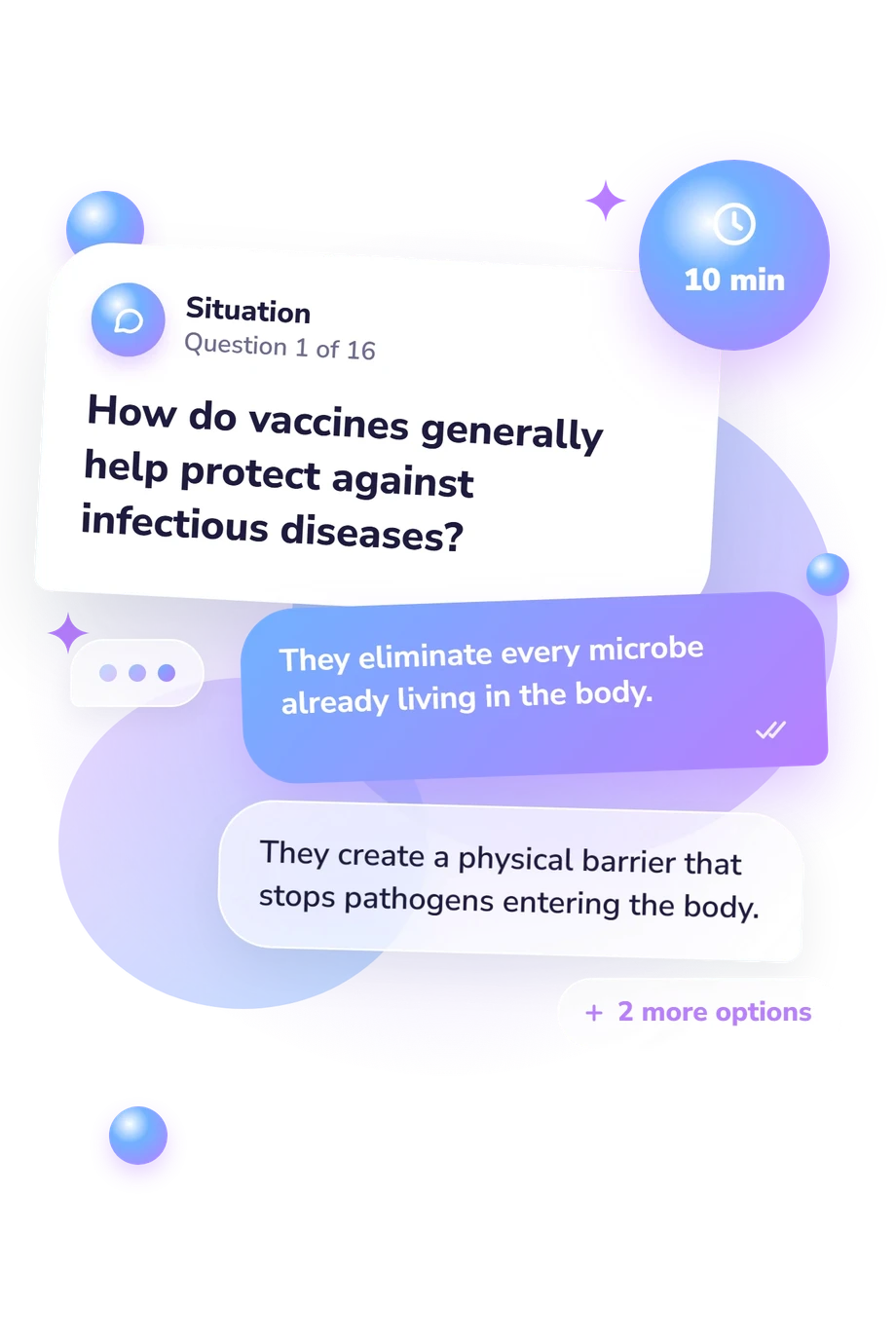
Each item presents a short health scenario or factual question with four answer choices. The respondent selects the best-supported response, making this a self-report, knowledge-based format that reflects recognition of concepts and appropriate actions rather than confidence alone. The scoring display converts selected responses into a 0-16 summary, and interpretation is categorical rather than diagnostic.
Its evidence base is conceptual. The structure is consistent with J-HKT (Tokuda et al., 2010), and it also aligns with later health-knowledge work by Gellert et al. (2016) and Richardson and Bélanger (2020). This questionnaire is not presented as an adaptation of those instruments, and those studies do not validate this exact online version.
For general readers, this doctor quiz focuses on health knowledge rather than practitioner competence. It is not a standardized clinical instrument: population norms, reliability estimates, and diagnostic validity should not be inferred from the score. Used as a health quiz for fun, it can identify topics worth reviewing, while answers may be influenced by memory, wording, and current context.
- Tokuda Y, Okubo T, Yanai H, Doba N, Paasche-Orlow MK. Development and Validation of a 15-Item Japanese Health Knowledge Test. Journal of Epidemiology. 2010;20(4):319-328. 10.2188/jea.JE20090096.
- Gellert P, Detel S, Ernsting C, Oedekoven M, Kuhlmey A. Development and psychometric properties of a health knowledge test on six chronic conditions. Patient Education and Counseling. 2016;99(12):2034-2042. 10.1016/j.pec.2016.07.035.
- Richardson LJ, Bélanger JJ. COVID-19 Knowledge Test: An Assessment Tool for Health Educators During the COVID-19 Pandemic. Frontiers in Public Health. 2020;8:580204. 10.3389/fpubh.2020.580204.
Updated: