
Was I Sexually Assaulted Quiz
How the Scales are Structured
Who Usually Takes This Test?
See How You Compare
Below is a preview of how scores are typically distributed across each scale.
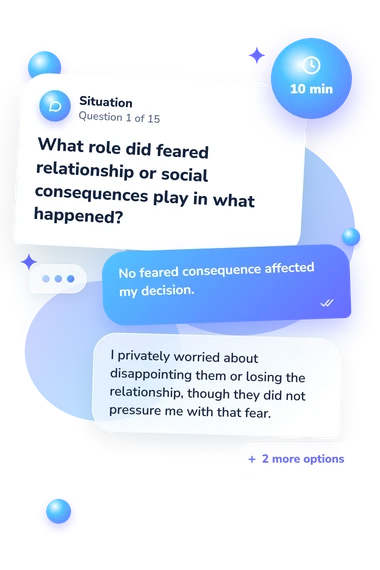
Example Questions From the Test
- No feared consequence affected my decision.
- I privately worried about disappointing them or losing the relationship, though they did not pressure me with that fear.
- Prior patterns of anger or rejection made me expect conflict if I refused, although no consequence was stated then.
- They stated or implied a threat such as breakup, humiliation, outing, rumors, punishment, or retaliation if I did not comply.
- I experienced no unwanted pain, injury, or physical aftereffects.
- There was brief discomfort, and the contact stopped or changed as soon as it became apparent.
- Pain or discomfort continued because it was not recognized or checked, but I had no known injury.
- I was injured, struck, choked, bleeding, or left needing or considering medical care.
- There was no relevant power imbalance, or it was handled without leverage or pressure.
- The difference made speaking up harder, although the person did not use it as leverage.
- They hinted that approval, access, opportunity, housing, care, or another benefit depended on cooperation.
- They used authority or dependency to obtain sexual contact that I did not freely choose.
Was I Sexually Assaulted Quiz - Description and methodology of the test
People who are unsure how to understand a sexual experience can use the Was I Sexually Assaulted Quiz to sort difficult details and show which responses may need closer review, without choosing a label immediately. This sexual assault quiz is intended for anyone reflecting on an experience that feels confusing, pressured, or hard to classify. The questions can clarify patterns that may deserve attention, support, or a safer next step.
What This Assessment Explores
Questions group pressure, boundaries, safety, and support responses; this sexual consent questionnaire flags what needs attention.
The result has three dimensions:
- Coercion, Control & Care Failures (0-15) reflects pressure, power imbalance, threats, exploitation, grooming, and care or support failures; access barriers may raise concern without proving deliberate neglect; bands: No scored item (0), Concern present (1-2), Action warranted (3-15).
- Consent & Sexual Boundaries (0-15) reflects uncertainty, discomfort, ignored conditions, or contact after consent was unclear or withdrawn; bands: No scored item (0), Concern present (1-2), Action warranted (3-15).
- Physical Force & Immediate Safety (0-15) covers restraint, injury, restricted movement, physical pressure, or substance concerns; bands: No scored item (0-0), Concern present (1-2), Action warranted (3-15).
No scored item means only that no item scored in a dimension; it does not rule out harm or establish consent. Concern matters independently.
Methodology and Evidence Base
Each item describes a concrete situation and offers four ordered responses, moving from freely chosen contact or no concern toward pressure, impairment, boundary violation, or danger. The respondent chooses the closest description, making this a structured self-report tool. Answers are combined within relevant dimensions; displayed ranges do not show how many points each option contributes.
The closest conceptual reference is the Sexual Experiences Survey Victimization Version (Koss et al., 2024), alongside SES revision work by Koss and colleagues (2007) and the original national study (Koss et al., 1987). This questionnaire is conceptually consistent with those frameworks but is not a reproduction or validated adaptation. Its consent perspective also corresponds with the Sexual Consent Scale-Revised developed by Humphreys and Brousseau (2010).
The consent self-assessment is not presented as a normed instrument. Its bands are unvalidated reflective summaries rather than legal, clinical, or severity cutoffs, and self-report may be shaped by memory, distress, self-awareness, fear, or minimization. A red-flag response matters even when the total is low; immediate danger or severe injury requires urgent help.
- Koss, Mary P., RaeAnn Anderson, Zoë D. Peterson, Heather Littleton, Antonia Abbey, Robin Kowalski, Martie Thompson, Sasha Canan, Jacquelyn White, Heather McCauley, Lindsay Orchowski, Lisa Fedina, Elise Lopez, and Christopher Allen. (2024). The Revised Sexual Experiences Survey Victimization Version (SES-V): Conceptualization, Modifications, Items and Scoring. The Journal of Sex Research, 61(6), 839-867. 10.1080/00224499.2024.2358407
- Koss, Mary P., Antonia Abbey, Rebecca Campbell, Sarah Cook, Jeanette Norris, Maria Testa, Sarah Ullman, Carolyn West, and Jacquelyn White. (2007). Revising the SES: A Collaborative Process to Improve Assessment of Sexual Aggression and Victimization. Psychology of Women Quarterly, 31(4), 357-370. 10.1111/j.1471-6402.2007.00385.x
- Koss, Mary P., Christine A. Gidycz, and Nadine Wisniewski. (1987). The Scope of Rape: Incidence and Prevalence of Sexual Aggression and Victimization in a National Sample of Higher Education Students. Journal of Consulting and Clinical Psychology, 55(2), 162-170. 10.1037/0022-006X.55.2.162
- Humphreys, Terry P., and Mélanie M. Brousseau. (2010). The Sexual Consent Scale-Revised: Development, Reliability, and Preliminary Validity. The Journal of Sex Research, 47(5), 420-428. 10.1080/00224490903151358
Updated: