
Golf Ball Fitting Quiz
How the Scales are Structured
Who Usually Takes This Test?
See How You Compare
Below is a preview of how scores are typically distributed across each scale.
Example Questions From the Test
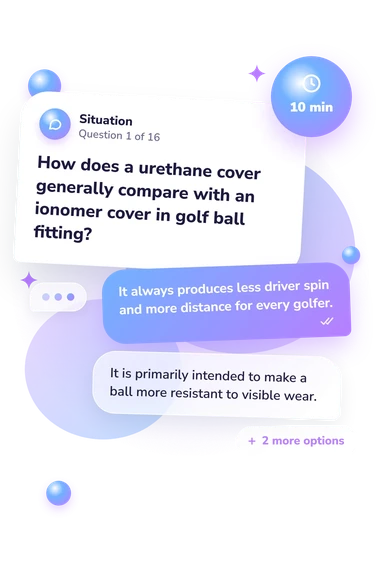
- It always produces less driver spin and more distance for every golfer.
- It is primarily intended to make a ball more resistant to visible wear.
- It generally offers more greenside spin potential, although the ball's full construction still matters.
- It determines compression without affecting short-game performance.
- Distance claims apply only to putting and short chips.
- Actual distance depends on the golfer's launch, speed, spin, strike, and conditions, while other shots also matter.
- A longer ball is always less accurate, regardless of the golfer.
- All balls produce exactly the same distance when hit with a driver.
- Use driver carry distance as the only deciding factor.
- Choose the highest compression available because faster swings always require it.
- Ignore compression and select whichever ball has the firmest cover.
- Test complete ball performance, because swing speed and compression alone do not determine the best fit.
Golf Ball Fitting Quiz - Description and methodology of the test
Golfers who want to compare balls more intelligently can use this assessment to connect construction, launch conditions, and shot demands instead of relying on marketing claims. The golf ball fitting quiz is intended for players, coaches, and equipment-curious readers who want to test practical fitting judgment. Its questions focus on practical fitting judgment, making this a what golf ball should i use quiz for comparing different situations.
What This Assessment Explores
Questions cover cover materials, compression, driver spin, wedge predictability, putting feel, temperature, durability, cost, and repeatable testing. Taken together, this golf ball quiz tests whether the respondent can weigh interacting factors, improving practice comparisons and equipment conversations rather than promoting one decisive specification.
Four practical areas organize the assessment:
- Construction and materials connect ball design with flight and short-game behavior.
- Comparison methods use repeated shots, consistent conditions, and relevant measurements.
- Shot priorities balance driver, iron, wedge, chip, and putting performance.
- Practical fit considers feel, temperature, durability, cost, and consistent play.
The displayed result for this golf ball selector quiz is Golf Ball Fitting Knowledge (0-16): Foundations to build (0-6), Developing fitter (7-12), or Strong fitting knowledge (13-16). The bands move from basic recognition to applied trade-offs and a well-rounded view across the bag.
Methodology and Scientific Basis
Each item presents a fitting scenario with four answer choices. The strongest option reflects evidence across shots and conditions, so the questionnaire tests applied judgment rather than recall of isolated specifications. The result condenses responses to the scenarios into one knowledge indicator.
The framework is conceptually consistent with nFlight fitting software (Wood & Swartz, 2010), which compares measurable ball performance across clubs and shot types; this questionnaire is not its adaptation. Allen et al. (2012) supports attention to temperature because cold conditions can alter feel and distance.
The questionnaire also supports golf ball selection by valuing repeatability; Bishop et al. (2023) reported reliability evidence for launch-monitor metrics in controlled indoor testing. Repeated comparisons therefore matter more than a single longest shot.
The bands are descriptive indicators for this questionnaire, not population norms or a personal launch profile, so a golfer should use the result to guide individual ball testing; it works as a best golf ball for me quiz only in the limited sense of helping decide which ball suits them rather than serving as a fitted equipment recommendation.
- Wood, Paul, and Greg Swartz. 2010. "Accounting for ball performance differences in golf club fitting." Procedia Engineering 2(2): 3441-3442. 10.1016/j.proeng.2010.04.177
- Allen, Tom, Adam Bowley, Paul Wood, Erik Henrikson, Eric Morales, and David James. 2012. "Effect of temperature on golf ball dynamics." Procedia Engineering 34: 634-639. 10.1016/j.proeng.2012.04.108
- Bishop, Chris, Jack Wells, Alex Ehlert, Anthony Turner, Daniel Coughlan, Noah Sachs, and Andrew Murray. 2023. "Trackman 4: Within and between-session reliability and inter-relationships of launch monitor metrics during indoor testing in high-level golfers." Journal of Sports Sciences 41(23): 2138-2143. 10.1080/02640414.2024.2314864