
What Food Am I Quiz
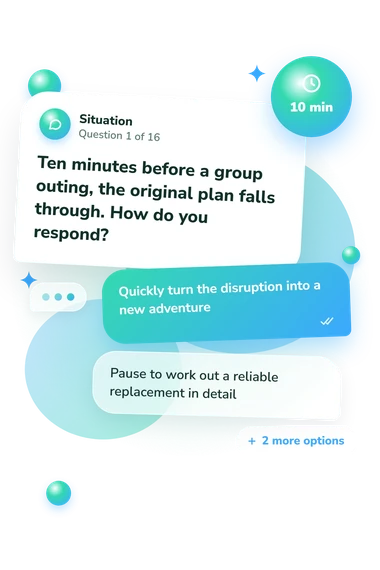
How the Scales are Structured
Who Usually Takes This Test?
See How You Compare
Below is a preview of how scores are typically distributed across each scale.
Example Questions From the Test
- Learning the technique and seeing how its parts fit together
- Having an easy activity we can enjoy with a larger group
- Making something comforting to keep or give away
- Experimenting freely and producing something unexpectedly bold
- Layer bright colors, contrasting textures, and playful surprises
- Use a restrained theme with carefully coordinated details
- Arrange flexible seating that makes mingling easy
- Create soft lighting and a cozy corner where people can unwind
- A quiet place, something warm, and room to talk at their own pace
- A fun group distraction that might shift the mood
- A fresh activity that gets both of us out of the house
- A focused conversation about the details whenever they are ready
What Food Am I Quiz - Description and methodology of the test
For readers who want a playful way to reflect on how they handle people, comfort, novelty, and detail, the What Food Am I Quiz turns everyday choices into a food-inspired profile of tendencies. It functions as a what food are you quiz, making it suitable for anyone who enjoys self-reflection and wants a clear, accessible picture of the style behind familiar decisions.
What This Assessment Explores
Food here is a metaphor, not a measure of nutrition or dietary health. Scenarios cover changed plans, guests, support, unfamiliar places, detail, comfort, connection, precision, and surprise. The comparison therefore serves as a which food are you quiz, linking each choice to behavioral tendencies rather than literal food identity.
The four dimensions are:
- Pizza Match (0-12) reflects inclusive sociability, easygoing flexibility, and enthusiasm for familiar fun: Selective Slice (0-4), Flexible Favorite (5-8), or Pizza Spirit (9-12).
- Soup Match (0-12) reflects restorative warmth, patient support, and meaningful steadiness: Brisk Current (0-4), Warm Balance (5-8), or Soup Spirit (9-12).
- Sushi Match (0-12) reflects deliberate curiosity, appreciation of detail, and composed choices: Broad Brush (0-4), Thoughtful Taster (5-8), or Sushi Spirit (9-12).
- Tacos Match (0-12) reflects expressive energy, improvisation, and an appetite for vivid or unexpected experiences: Steady Flavor (0-4), Adventurous Mix (5-8), or Taco Spirit (9-12).
Methodology and Scientific Basis
Each item presents a familiar situation with four response options. Choosing the most natural response creates a self-report pattern across social coordination, support, exploration, order, and novelty. The questionnaire serves as a what food would I be quiz, producing four displayed match scores and their result bands.
The questionnaire does not state how individual responses are weighted. The bands organize these tendencies; they do not establish a single fixed food type.
Keller and Siegrist (2015) offer the closest conceptual context, linking personality with eating styles and food choices. Golestanbagh et al. (2021) connect personality traits with dietary and taste preferences, while Goldberg’s (1990) Big-Five framework provides broader context about individual differences. These sources help explain the food metaphor; this questionnaire is a separate online self-report rather than an adaptation of those instruments or studies.
Framed as a what kind of food am I quiz, the questionnaire makes abstract tendencies memorable. Mood, memory, interpretation, and self-presentation can affect self-report results, so the profile is most useful for reflection.
- Keller, Carmen, and Michael Siegrist. “Does personality influence eating styles and food choices? Direct and indirect effects.” Appetite 84 (2015): 128-138. 10.1016/j.appet.2014.10.003
- Golestanbagh, Najmeh, M. Miraghajani, Reza Amani, Michael E. Symonds, Sorour Neamatpour, and Mohammad Hosein Haghighizadeh. “Association of Personality Traits with Dietary Habits and Food/Taste Preferences.” International Journal of Preventive Medicine 12, no. 1 (2021): 92. 10.4103/ijpvm.IJPVM_19_19
- Goldberg, Lewis R. “An alternative ‘description of personality’: The Big-Five factor structure.” Journal of Personality and Social Psychology 59, no. 6 (1990): 1216-1229. 10.1037/0022-3514.59.6.1216