
Hilarious Quiz Questions
How the Scales are Structured
Who Usually Takes This Test?
See How You Compare
Below is a preview of how scores are typically distributed across each scale.
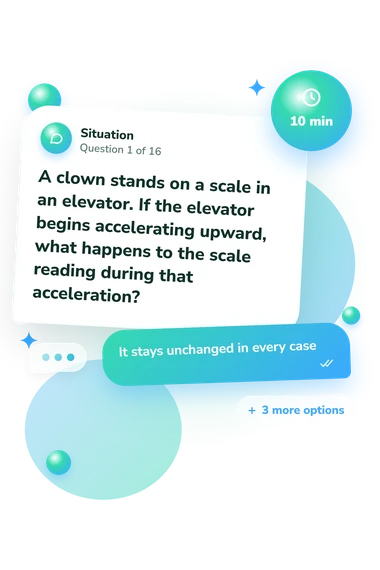
Example Questions From the Test
- Three
- Two
- One
- Four
- Roosters lay eggs only when no hens are present
- Roosters lay only unfertilized eggs
- Roosters normally begin laying after their first year
- Roosters are adult male chickens and do not produce eggs
- An oven and a workplace
- Bread mixture and money
- Flour and free time
- A recipe and a salary slip
Hilarious Quiz Questions - Description and methodology of the test
For readers who enjoy learning through absurd scenarios, this assessment offers a compact way to see how varied knowledge works in one playful challenge. Here, hilarious quiz questions and answers combine science, language, probability, logic, and everyday facts in a playful format. The displayed band gives the challenge a simple endpoint, while the varied prompts make funny quiz questions approachable for anyone who wants to test several familiar topics.
What This Assessment Measures
This questionnaire measures knowledge handling rather than comedic talent. Its scenarios ask you to identify facts, interpret language, apply basic science, and draw conclusions from short premises. The result suits anyone wanting an entertaining snapshot of these abilities, rather than a personality or emotional profile.
The questions cluster around three practical areas:
- Science and nature reasoning shows how you recognize explanations involving motion, biology, sound, baking, and astronomy.
- Language and humor understanding shows whether you identify wordplay, figurative devices, and double meanings.
- Logic and quantitative reasoning shows how you handle probability, counting, deduction, and simple calculations.
In group play, this set offers hilarious family quiz questions; users may notice strengths. Hilarious Quiz Questions Knowledge runs from 0-16: Comic Warm-Up (0-6), Punchline Detective (7-12), and Wit Whiz (13-16). These bands summarize this set as entertainment-focused knowledge, not a validated intelligence assessment.
Methodology and Evidence Base
Each item uses multiple-choice format with one best answer among distractors. Prompts cover factual recognition, short calculations, logical inference, and wordplay. In this format, funny quiz questions and answers test knowledge and reasoning, not a person's ability to be funny.
The questionnaire displays a score from 0-16 and places it in one of the listed descriptive bands. Context, guessing, attention, education, and language familiarity can affect performance, as can how readily a participant understands the joke.
Conceptually, the knowledge emphasis is consistent with the General Knowledge Test construct (Irwing et al., 2001), which treats general knowledge as related semantic-memory components; this questionnaire is not an adaptation. Feingold and Mazzella (1991) distinguish verbal humor ability from broader cognitive performance, so comic framing is not scored. Gierl et al. (2017) explain how plausible distractors make multiple-choice alternatives useful for separating a sound answer from a tempting one.
Used for conversation, this set of funny quiz questions with answers gives groups a ready-made round for comparing choices, while the result remains a momentary knowledge snapshot.
- Paul Irwing, Tommy Cammock, and Richard Lynn (2001). Some evidence for the existence of a general factor of semantic memory and its components. Personality and Individual Differences, 30(5), 857-871. 10.1016/S0191-8869(00)00078-7
- Alan Feingold and Robert Mazzella (1991). Psychometric intelligence and verbal humor ability. Personality and Individual Differences, 12(5), 427-435. 10.1016/0191-8869(91)90060-O
- Mark J. Gierl, Okan Bulut, Qi Guo, and Xinxin Zhang (2017). Developing, analyzing, and using distractors for multiple-choice tests in education: A comprehensive review. Review of Educational Research, 87(6), 1082-1116. 10.3102/0034654317726529