
Birth Control Quiz
How the Scales are Structured
Who Usually Takes This Test?
See How You Compare
Below is a preview of how scores are typically distributed across each scale.
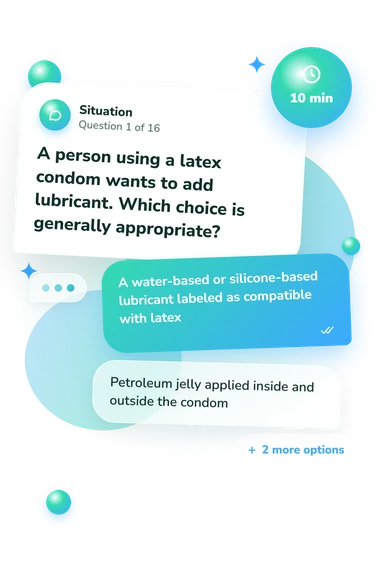
Example Questions From the Test
- It provides reliable protection against sexually transmitted infections
- It is intended to be irreversible, so the possibility of future regret should be discussed carefully
- It is designed to wear off automatically after several years
- It guarantees that reversal will restore fertility later
- Hormonal implants
- Combined contraceptive pills
- External or internal condoms
- Copper intrauterine devices
- Only after the next menstrual period has been missed
- After waiting a week to see whether pregnancy symptoms appear
- As soon as possible, because available options are time-sensitive
- Only if a home pregnancy test is already positive
Birth Control Quiz - Description and methodology of the test
For readers who feel unsure about contraception terminology or basic principles, this birth control quiz offers a structured knowledge check. Someone considering a quiz about which birth control is best for me may find the exercise useful when organizing personal concerns and deciding what information to review first. It suits anyone seeking a clearer starting point before making choices.
What This Assessment Explores
At its core, the questionnaire examines contraceptive knowledge rather than preferences or eligibility. It suits readers who want to spot gaps before discussing options with a clinician or pharmacist. The result shows how consistently the respondent recognizes established contraception facts.
Items address correct use, method differences, missed pills, vomiting, unprotected sex, late periods, emergency contraception, and STI protection. They distinguish hormonal and non-hormonal options, temporary and permanent approaches. For a reader using this quiz to ask what birth control is best for me, the result still cannot establish suitability, which depends on personal factors beyond knowledge.
The displayed scale is Birth Control Knowledge (0-16), with these bands:
- Foundations to build (0-6) means several principles may be unfamiliar and need review.
- Developing knowledge (7-12) means many essentials are understood, but method-specific instructions may need checking.
- Strong knowledge (13-16) means broad understanding, but it cannot identify the best birth control for me or determine suitability.
Methodology and Evidence Base
Each item presents a short situation or factual question with four answer choices. The respondent selects the option that best matches established contraceptive guidance. The outcome is a knowledge score rather than a preference profile: this is not a quiz for choosing the best birth control for me; it summarizes performance across topics without recommending a method or estimating pregnancy risk in a particular encounter.
Conceptually, the content is consistent with Contraceptive Knowledge Assessment, a published research tool for contraceptive knowledge. This questionnaire is neither that instrument nor a validated adaptation. A review of oral-contraceptive knowledge measures notes limits in item coverage, wording, recall, and context.
That instrument supports conceptual relevance but does not validate this questionnaire; the displayed bands are educational, not validated clinical cutoffs. A reader using this quiz while wondering which IUD is right for me can use the score to prepare questions, while method choice may depend on health history, preferences, side effects, interactions, timing, and STI-protection needs.
Self-report also makes attention, interpretation, prior experience, and current circumstances relevant. For time-sensitive concerns, method instructions and professional advice take priority.
- Meagan Campol Haynes, Nessa Ryan, Mona Saleh, Abigail Ford Winkel, Veronica Ades. Contraceptive Knowledge Assessment: validity and reliability of a novel contraceptive research tool. Contraception. 2017;95(2):190-197. 10.1016/j.contraception.2016.09.002
- Kelli Stidham Hall, Paula M. Castaño, Patricia W. Stone, Carolyn Westhoff. Measuring Oral Contraceptive Knowledge: A Review of Research Findings and Limitations. Patient Education and Counseling. 2010;81(3):388-394. 10.1016/j.pec.2010.10.016