
Scapula Labeling Quiz
How the Scales are Structured
Who Usually Takes This Test?
See How You Compare
Below is a preview of how scores are typically distributed across each scale.
Example Questions From the Test
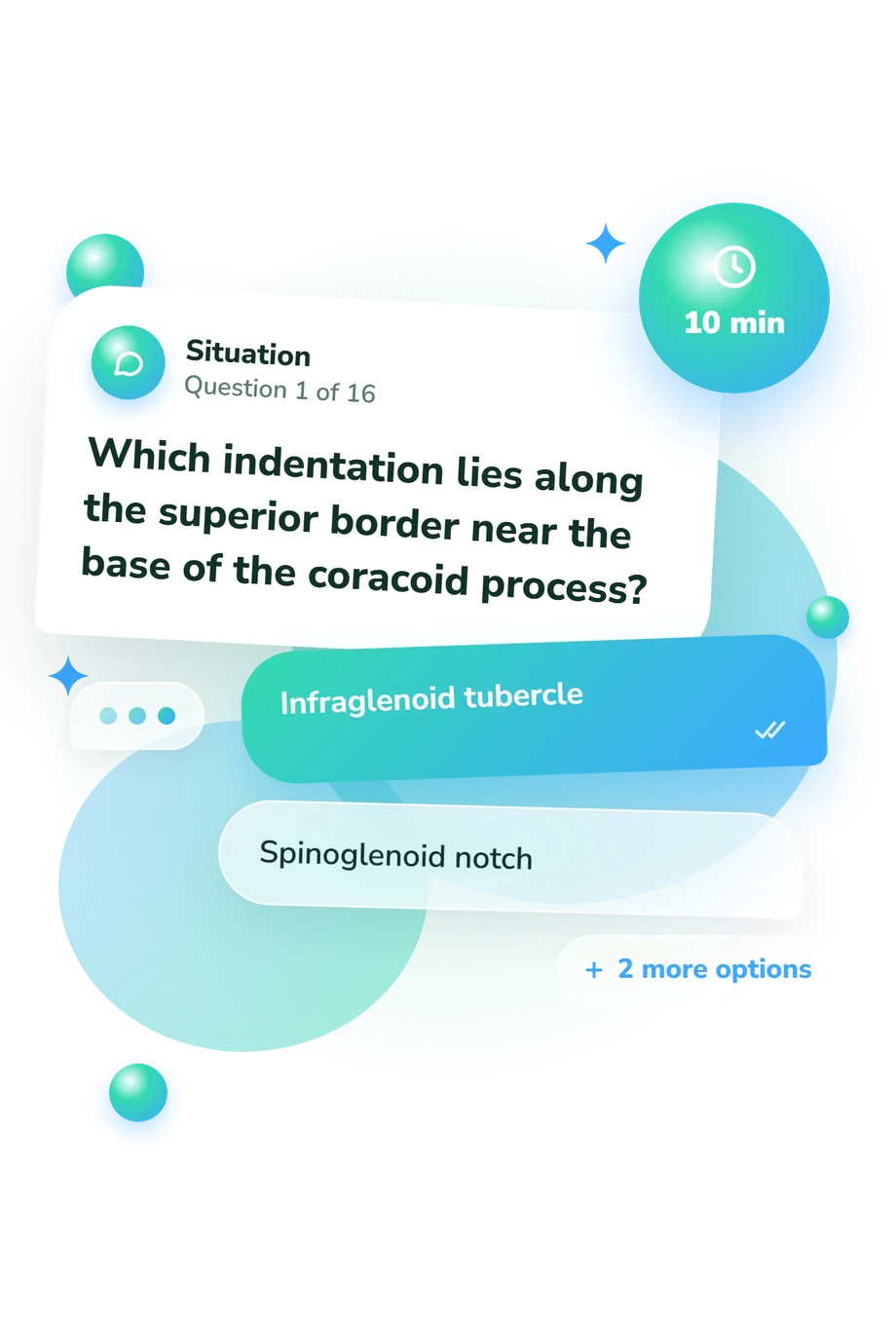
- Infraglenoid tubercle
- Spinoglenoid notch
- Glenoid cavity
- Suprascapular notch
- Acromion
- Coracoid process
- Glenoid cavity
- Supraglenoid tubercle
- Infraspinous fossa
- Subscapular fossa
- Supraspinous fossa
- Glenoid cavity
Scapula Labeling Quiz - Description and methodology of the test
Students, trainees, and anatomy learners who want to check their grasp of the shoulder blade can use the scapula labeling quiz as a focused retrieval exercise. It suits revision after reading, lecture study, or practical preparation, especially when nearby landmarks are easy to confuse. In this scapula quiz, the result shows whether your general landmark knowledge is developing or strong.
What This Assessment Explores
The questions assess recognition of the scapula’s borders, angles, fossae, spine, processes, tubercles, glenoid region, and neck. They suit learners reviewing regional anatomy, not people measuring pain, movement, or shoulder function. In this scapula anatomy quiz, each prompt asks whether a structure matches its position, surface, attachment area, or articulation.
These are the main groups covered by the questions:
- Borders and angles test orientation around the scapula’s margins.
- Fossae and the spine distinguish its broad anterior and posterior surfaces.
- Processes and tubercles identify projections and attachment landmarks.
- Articular regions cover the glenoid cavity, neck, and acromioclavicular connection.
The result appears as Scapula Knowledge (0-16). Foundations to Review (0-6) indicates that basic orientation needs revision; Developing Knowledge (7-12) indicates many recognized landmarks with some structures still to compare; Strong Knowledge (13-16) indicates command of markings, spatial relationships, and terminology.
Methodology and Evidence Base
Each item presents a short anatomical prompt with four answer choices. Some identify a landmark from its location; others use surface orientation, neighboring structures, or an attachment relationship. The format combines terminology recall with positional reasoning. When taking this scapula bone quiz, the learner selects the term that best matches the described feature.
The questionnaire reports a total score without item weighting or normative conversion. It should be read as a snapshot of performance on these recognition tasks, not as a complete measure of anatomical competence.
Its content is conceptually consistent with the Miniato scapular-anatomy study and uses terminology aligned with texts by Drake, Vogl, and Mitchell, Dalley and Agur, plus the terminology work of Adds and colleagues. It is not presented as an adaptation or validation of any one source.
A strong result can still reflect memorization, wording familiarity, or ease with visualizing one view. Standard anatomical terms make the labels precise, but they do not provide norms for comparing scores across respondents. A scapula landmarks quiz can support recall while leaving practical identification skills to be assessed separately.
- Miniato MA, Mudreac A, Borger J. Anatomy, Thorax, Scapula. In: StatPearls [Internet]. Treasure Island (FL): StatPearls Publishing; 2023 Jan-. Updated July 24, 2023. PMID 30855903.
- Drake RL, Vogl AW, Mitchell AWM. Gray's Anatomy for Students. 5th ed. Elsevier; 2023. ISBN 9780323934237.
- Dalley AF II, Agur AMR. Moore's Clinically Oriented Anatomy. 9th ed. Philadelphia: Wolters Kluwer; 2023. ISBN 9781975209544.
- Adds PJ, Longhurst GJ, Brassett C, Clancy J, Sulaiman S, Ashwood N, Hamilton DL. Terminologia Anatomica 2nd edition: perspectives from anatomy educators in the United Kingdom. Anatomical Science International. 2024;99(4):366-377. 10.1007/s12565-024-00784-4.
Updated: