
Shark Quiz
How the Scales are Structured
Who Usually Takes This Test?
See How You Compare
Below is a preview of how scores are typically distributed across each scale.
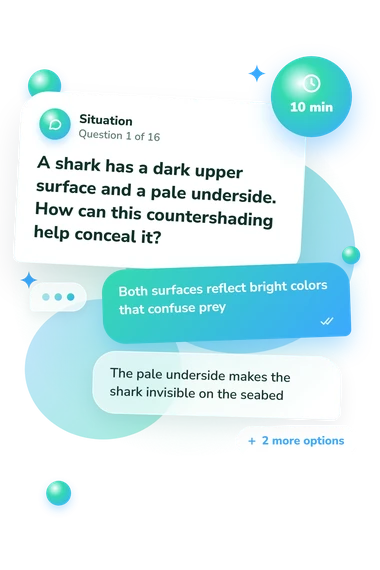
Example Questions From the Test
- Overlapping bony scales
- Hardened mucus plates
- Flexible shell fragments
- Dermal denticles
- Great white shark
- Basking shark
- Whale shark
- Tiger shark
- It lives only in salt water and has a streamlined body
- It breathes through gills and has a cartilaginous skeleton
- It swims with fins and travels long distances
- It is very large and feeds on small organisms
Shark Quiz - Description and methodology of the test
Designed for curious learners, this assessment helps you check knowledge, spot misconceptions, and decide what to review next. The shark quiz suits readers seeking a focused gauge of understanding. Its result summarizes how accurately you recognize structures, explain biological processes, and apply knowledge to realistic situations. Questions using visible features and biological clues turn one part of the assessment into a shark identification quiz, while the result covers broader knowledge.
What This Assessment Explores
Questions link anatomy with function, distinguishing sharks from rays and dolphins. Presented as a shark id quiz, it examines breathing, reproduction, sensory systems, movement, salt balance, feeding, and ecological roles. It asks you to use evidence rather than rely on a silhouette or fact.
These questions cover thematic groups, not separate scales:
- Anatomy and identification show how physical structures support recognition.
- Species and diversity distinguish sharks by form, feeding, and habitat.
- Behavior and physiology connect body systems with survival.
- Evolution and ecology place sharks in deep time and food webs.
- Observation and safety apply knowledge during coastal encounters.
Shark Knowledge: 0-16. Emerging Knowledge (0-6) reflects partial recognition; Developing Knowledge (7-12) shows core understanding with details to sharpen; Strong Knowledge (13-16) indicates broad command of shark biology, diversity, and ecology. These bands describe learning, not professional certification.
Methodology and Evidence Base
Each item presents a question with four answer choices. As a shark species quiz, it tests more than names by asking whether a structure, behavior, or environmental effect fits the evidence. The approach is comparative and applied: you identify structures, classify animals, explain mechanisms, and predict food-web effects. The score counts correct answers and groups performance into the displayed bands.
Questions about identification, anatomy, diversity, and natural history correspond to topics discussed by Ebert and colleagues in their shark reference work. Treatment of physiology, reproduction, sensory systems, and ecology is conceptually consistent with the work of Carrier and colleagues, while the food-web item reflects the kind of apex-predator effect examined by Myers and colleagues. The questionnaire is conceptually consistent with these sources, not an adaptation or validation of one published instrument.
The questionnaire has no stated standardization as a standalone instrument; interpret the result as performance on the sampled questions, recognizing that prior knowledge, guessing, wording, and topic coverage can affect it. Use the score to target further learning and self-checking.
- Ebert, David A., and Sarah L. Fowler. Sharks of the World: A Complete Guide. With illustrations by Marc Dando. Princeton University Press, 2021. 10.2307/j.ctv1574pqp.
- Carrier, Jeffrey C., John A. Musick, and Michael R. Heithaus, eds. Biology of Sharks and Their Relatives, Second Edition. CRC Press, 2012. 10.1201/b11867.
- Myers, Ransom A., Julia K. Baum, Travis D. Shepherd, Sean P. Powers, and Charles H. Peterson. Cascading effects of the loss of apex predatory sharks from a coastal ocean. Science 315, no. 5820 (2007): 1846-1850. 10.1126/science.1138657.