
Who Am I Compatible With Quiz
How the Scales are Structured
Who Usually Takes This Test?
See How You Compare
Below is a preview of how scores are typically distributed across each scale.
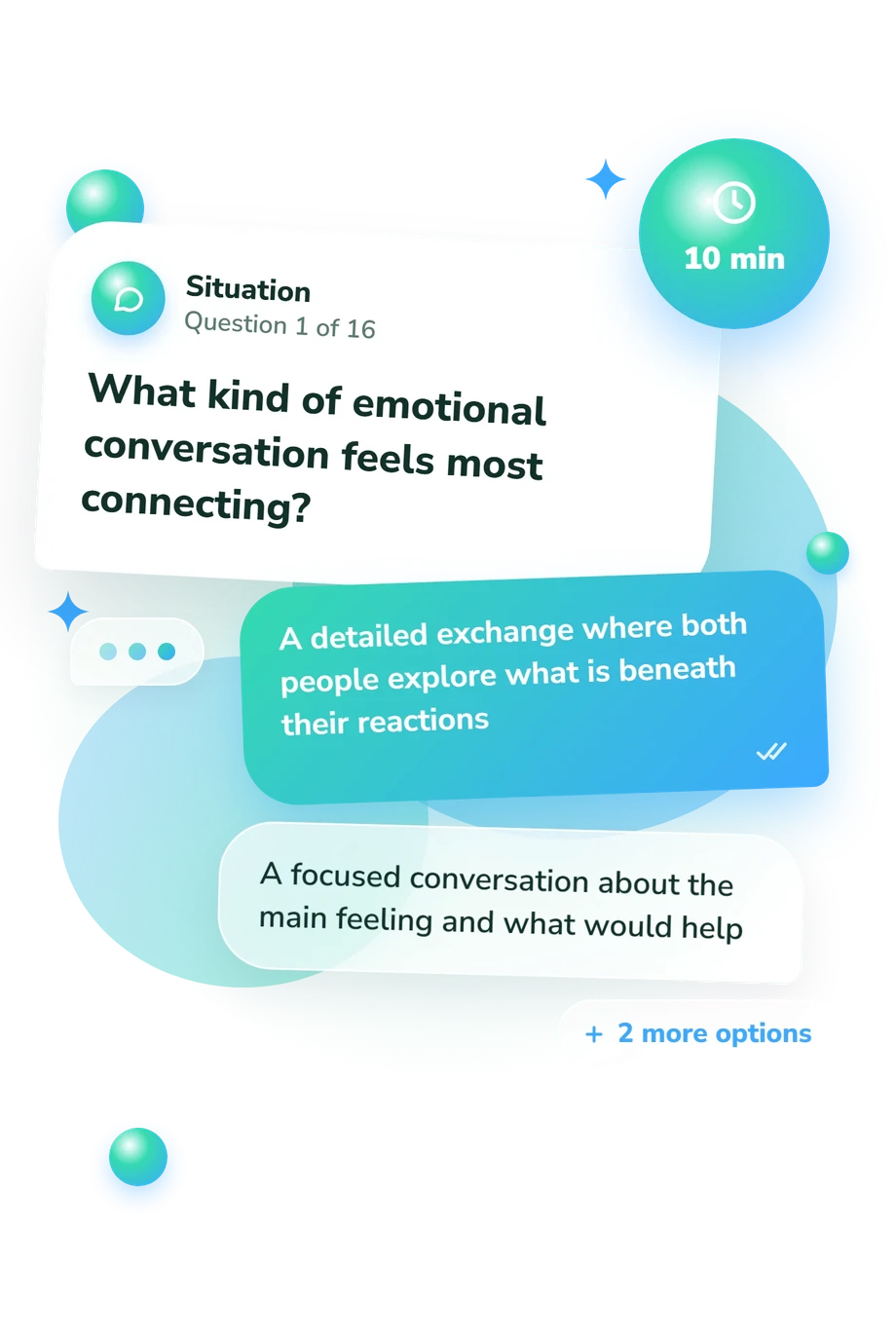
Example Questions From the Test
- Trying a place or activity neither of us has experienced
- Returning to a familiar favorite we know we enjoy
- Keeping the day separate so each of us can recharge
- Choosing something new after comparing plans and details
- Giving me uninterrupted space unless I reach out first
- Suggesting an unplanned outing to shift my mood
- Inviting me to talk through everything in detail
- Checking in gently and helping with one practical task
- Mostly spontaneous plans decided in the moment
- Separate schedules with occasional plans together
- A loose shared plan that can change when needed
- Dependable plans and routines we can usually count on
Who Am I Compatible With Quiz - Description and methodology of the test
People who want to understand which relationship habits and partner qualities feel most natural to them can use the Who Am I Compatible With Quiz as a structured reflection. It suits readers comparing communication, autonomy, steadiness, curiosity, and responses to change, functioning as an online partner compatibility test. Rather than naming a destined match, this quiz addresses who you may be most compatible with by describing a relationship rhythm.
What This Assessment Explores
Rather than measuring one personality trait, this assessment maps four relationship preferences. Its situations cover emotional conversation, affection, changing plans, separate interests, support, conflict follow-up, and shared decisions. The result is useful as a relationship compatibility quiz for comparing needs, but it describes a preferred rhythm, not long-term success.
These are the dimensions shown in the result:
- Curious Explorer (0-12) measures attraction to novelty and shared discovery: Different rhythm (0-4), Selective explorer (5-8), or Strong affinity (9-12).
- Independent Equal (0-12) measures preferred autonomy and coordination: Together-oriented (0-4), Flexible autonomy (5-8), or Strong affinity (9-12).
- Steady Supporter (0-12) measures preference for reliable care and follow-through: Different rhythm (0-4), Conditional fit (5-8), or Strong affinity (9-12).
- Thoughtful Communicator (0-12) measures comfort with emotional discussion and close listening: Different rhythm (0-4), Balanced dialogue (5-8), or Strong affinity (9-12).
Methodology and Scientific Basis
Each item presents a relationship situation with four possible responses. Choosing the most natural option lets the questionnaire compare patterns across dimensions; responses are combined into separate scale scores and displayed within the stated bands. The questionnaire does not specify how individual answers are weighted; do not reverse-engineer the displayed ranges into points per answer.
Its framework is conceptually consistent with the Ideal Standards Model (Fletcher et al., 1999), which treats partner and relationship ideals as standards for judging fit. Campbell et al. (2001) add that ideals can vary in flexibility, while Crasta et al. (2021) describe a related responsiveness measure offering context, not validation of this questionnaire. This questionnaire is not an adaptation of those instruments.
When considering a Who Am I Most Compatible With Quiz, interpretation should remain modest: the questionnaire captures stated preferences, not observed behavior between partners. Its displayed bands are descriptive categories and do not establish population norms or clinical thresholds. Mood, relationship history, self-awareness, and self-presentation can influence answers, so treat the profile as a prompt for reflection, not a fixed verdict.
- Simpson, Jeffry A., Garth J. O. Fletcher, Geoff Thomas, and Louise Giles. "Ideals in intimate relationships." Journal of Personality and Social Psychology, 76(1), 72-89, 1999. 10.1037/0022-3514.76.1.72
- Crasta, Dev, Ronald D. Rogge, Michael R. Maniaci, and Harry T. Reis. "Toward an optimized measure of perceived partner responsiveness: Development and validation of the Perceived Responsiveness and Insensitivity Scale." Psychological Assessment, 33(4), 338-355, 2021. 10.1037/pas0000986
- Campbell, Lorne, Jeffry A. Simpson, Deborah A. Kashy, and Garth J. O. Fletcher. "Ideal Standards, the Self, and Flexibility of Ideals in Close Relationships." Personality and Social Psychology Bulletin, 27(4), 447-462, 2001. 10.1177/0146167201274006
Updated: