
What Looney Tunes Character Are You Quiz
How the Scales are Structured
Who Usually Takes This Test?
See How You Compare
Below is a preview of how scores are typically distributed across each scale.
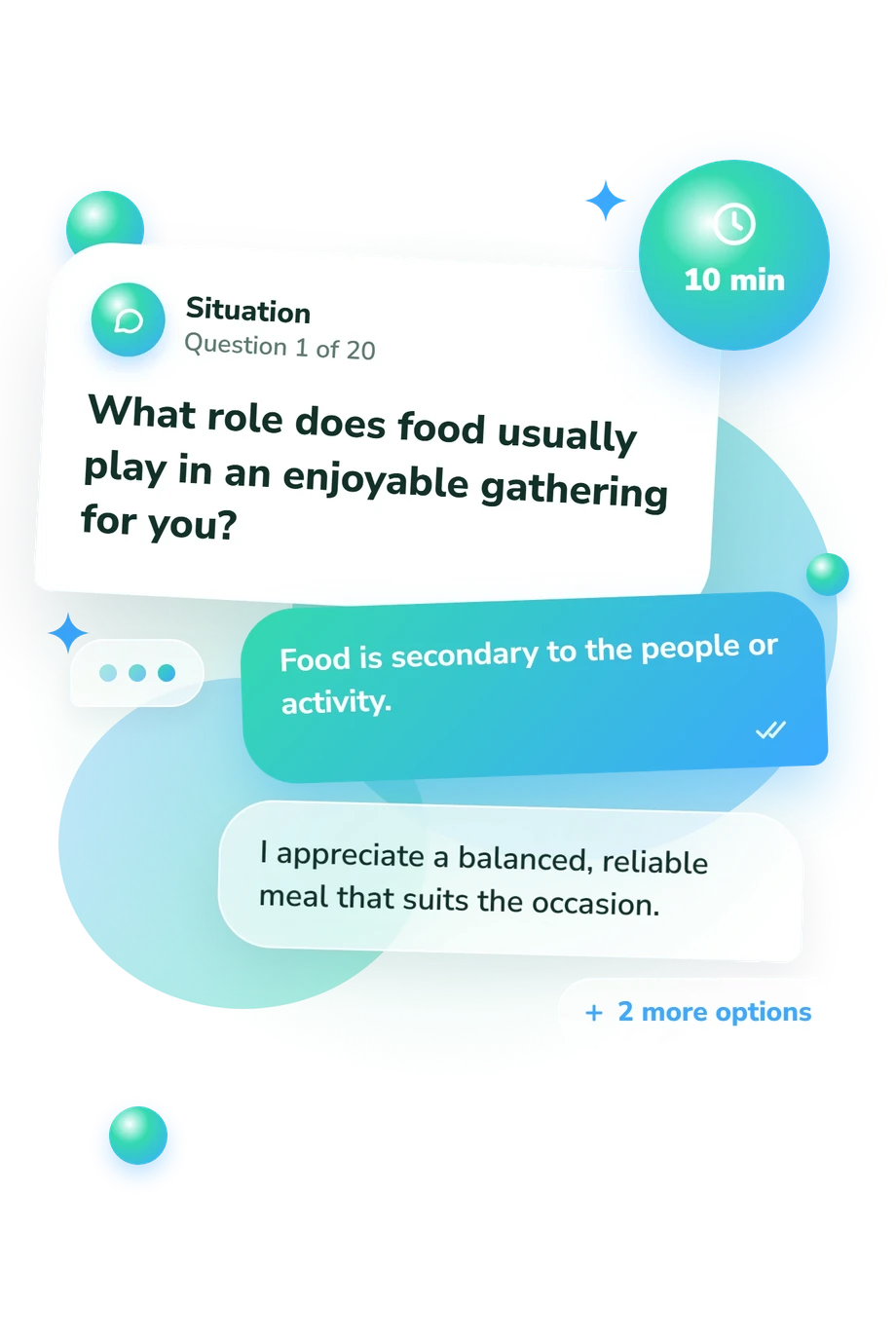
Example Questions From the Test
- Food is secondary to the people or activity.
- I appreciate a balanced, reliable meal that suits the occasion.
- Generous portions of favorite foods add significantly to the fun.
- The flavors, choices, and sheer feast-like excitement can become the main event.
- Decline because I would rather keep my original plan.
- Ask for the practical details before deciding.
- Take a moment to assess it, then probably join.
- Leap into the experience while the excitement is fresh.
- I generally prefer activities that do not involve comparison.
- The challenge gives me a reason to test my abilities.
- The tension and spectacle make the experience memorable.
- The possibility of proving that I deserve to be recognized.
What Looney Tunes Character Are You Quiz - Description and methodology of the test
Readers who enjoy using cartoon characters to notice everyday habits may find the What Looney Toon Character Are You Quiz a prompt for self-reflection. Anyone taking the What Looney Tunes Character Are You Quiz may appreciate a result organized around recognition, pressure, social uncertainty, movement, humor, and sudden changes. The result identifies a leading character affinity or blended tendencies, without treating one character as a complete description of the respondent.
What This Assessment Explores
Questions about food, rivalry, groups, frustration, humor, pace, recognition, and disrupted plans sample five character-linked response tendencies. For readers wondering which Looney Tunes character you are, the quiz profiles mean:
- Bugs Bunny Affinity (0-12) reflects wit and strategic improvisation: Different wavelength 0-4, Familiar spark 5-8, Clever operator 9-12.
- Daffy Duck Affinity (0-12) reflects ambition, desire for recognition, and theatrical self-expression: Offstage preference 0-4, Dramatic streak 5-8, Born headliner 9-12.
- Road Runner Affinity (0-12) reflects speed, autonomy, and efficiency: Unhurried route 0-4, Forward motion 5-8, Momentum master 9-12.
- Tasmanian Devil Affinity (0-12) reflects spontaneity and joyful intensity: Measured energy 0-4, Wild side 5-8, Full whirlwind 9-12.
- Tweety Affinity (0-12) reflects alert observation and strategic patience: Open-book style 0-4, Quiet awareness 5-8, Watchful strategist 9-12.
The highest score is the strongest affinity, while scores within one point create a blended result.
Methodology and Evidence Base
Methodologically, this is a self-report character-affinity exercise. Each scenario presents four response options, asking the respondent to choose a preferred way of acting rather than report a factual event. The answers produce five parallel affinity totals: the highest is the strongest match, while totals within one point form a blended result. This makes the Looney Tunes character test a comparative profile, not a fixed typology.
Sorting Hat Quiz research (Jakob et al., 2019) is the closest comparison because it examined character sorting alongside personality and human values. Crysel et al. (2015) provides a second comparison involving fictional character preferences and personality dimensions. Neither study validates this questionnaire; it is conceptually consistent with that work, not an adaptation of either instrument. A recognizable affinity can make a result feel personally meaningful, but Huang and Fung (2024) does not validate this questionnaire's scores.
The displayed bands are descriptive categories for this questionnaire rather than established population norms. Mood, current circumstances, self-awareness, and impression management can influence self-report, so close scores are best read as a snapshot of familiar tendencies.
- Lea Jakob, Eduardo Garcia-Garzon, Hannes Jarke, and Fabian Dablander (2019). The Science Behind the Magic? The Relation of the Harry Potter “Sorting Hat Quiz” to Personality and Human Values. Collabra: Psychology, 5(1), Article 31. 10.1525/collabra.240
- Laura C. Crysel, Corey L. Cook, Tatiana Orozco Schember, and Gregory D. Webster (2015). Harry Potter and the measures of personality: Extraverted Gryffindors, agreeable Hufflepuffs, clever Ravenclaws, and manipulative Slytherins. Personality and Individual Differences, 83, 174-179. 10.1016/j.paid.2015.04.016
- Kate Y. Huang and Helene H. Fung (2024). Measuring identification with narrative characters: the development and validation of a new scale. Current Psychology, 43, 24835-24849. 10.1007/s12144-024-06191-2
Updated: