
What Kind of Phone Do I Have Quiz
How the Scales are Structured
Who Usually Takes This Test?
See How You Compare
Below is a preview of how scores are typically distributed across each scale.
Example Questions From the Test
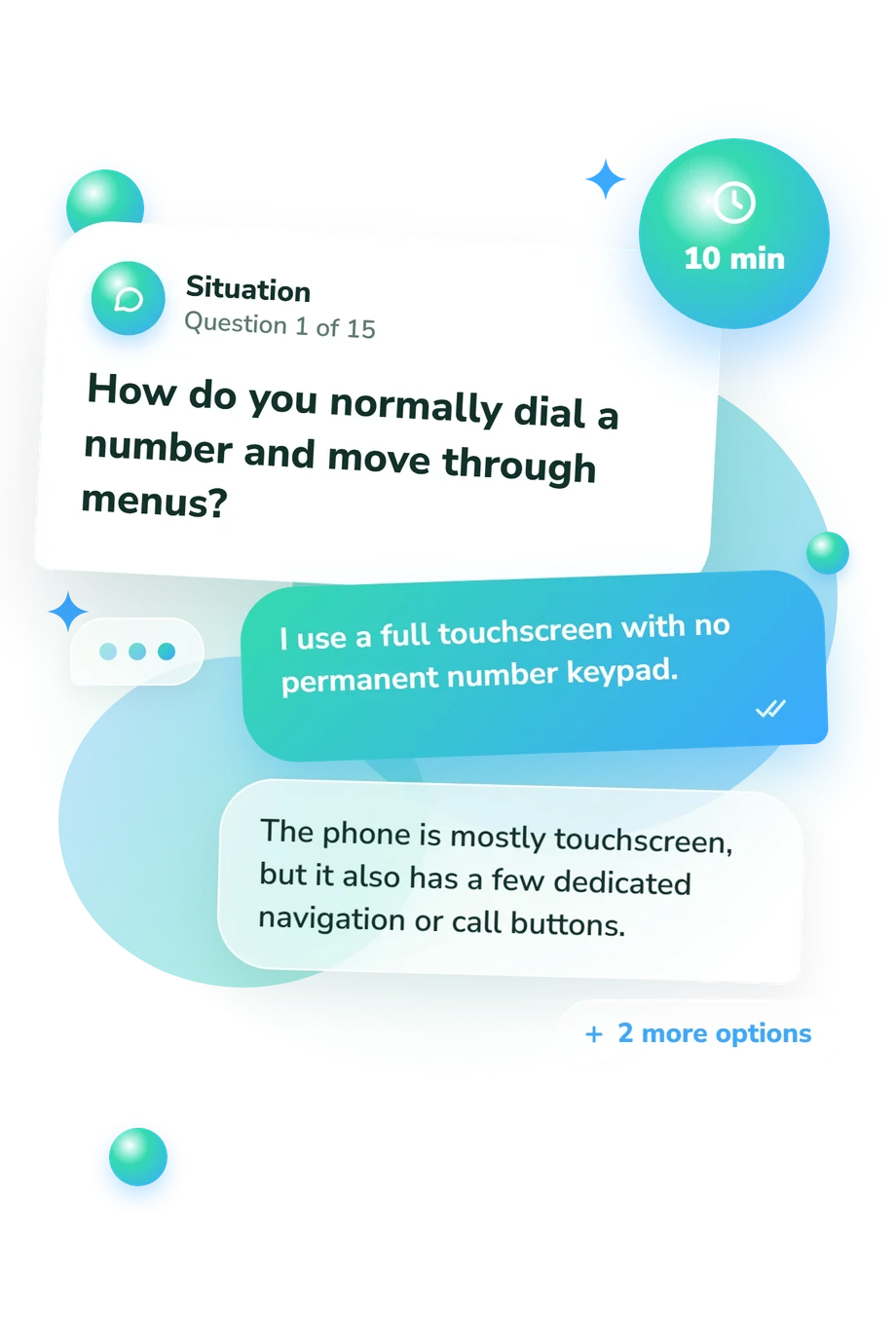
- I use a full touchscreen with no permanent number keypad.
- The phone is mostly touchscreen, but it also has a few dedicated navigation or call buttons.
- It has a compact screen and several physical controls, though numbers may also be entered on-screen.
- It has a permanent physical number keypad plus call, end, and navigation buttons.
- A Google account or a phone-maker account is the main account shown.
- My name appears with Apple Account, iCloud, Media & Purchases, or Find My options.
- My name appears, but I have not opened the account page to see which company provides it.
- The screen mentions iCloud or Apple services, although I am not signed in.
- It has General > About and identifies the device as an iPhone or shows an iOS version.
- It has About phone and displays an Android version.
- I can reach a settings menu, but I have not located an operating-system name.
- I have not checked the page, but the menus and wording look distinctly Apple-branded.
What Kind of Phone Do I Have Quiz - Description and methodology of the test
People needing support details can use this phone-category matching quiz to see whether clues fit Android, iPhone, or a basic/feature phone. The questions focus on clues a non-specialist can inspect without technical terminology. The What Kind of Phone Do I Have Quiz compares menus, accounts, app stores, and updates, while the exact model needs verification in the device information screen or on its label.
What This Assessment Explores
This self-report sorts familiar device clues into three broad phone categories. It suits anyone unsure of a handset’s operating system, manufacturer, or smartphone capability. Items cover menus, accounts, app stores, messaging, branding, and updates.
The result compares these three outcome scales:
- Android Smartphone (0-15) measures Android-specific settings, services, branding, and software. Its bands are Limited match 0-5; Possible match 6-10; Strong match 11-15.
- Apple iPhone (0-15) measures Apple-specific accounts, interface, app-store, messaging, and operating-system clues. Its bands are Limited match 0-5; Possible match 6-10; Strong match 11-15.
- Basic or Feature Phone (0-15) measures physical controls, simplified functions, limited apps, and feature-phone software. Its bands are Limited match 0-5; Possible match 6-10; Strong match 11-15.
When someone is unsure what phone they have, the result compares the category scores and identifies the strongest category affinity. Confirm the exact model in Settings, packaging, or a label.
Methodology and Scientific Basis
Each item describes a device situation and offers four response options, from software or hardware evidence to uncertainty. Groups cover navigation, accounts, device-information screens, updates, app stores, messaging, branding, setup, and everyday capability.
Responses become comparative category scores. This is a structured online self-report, not a standardized technical audit. Readers compare displayed outcomes rather than infer points for individual options. The questionnaire produces a phone category match: the highest score is the strongest affinity, while a near tie is a blended profile.
Here, the questionnaire uses device details reported by the respondent. Vine et al. (2026) addresses limits of such reports; Gerpott et al. (2013) distinguishes advanced handset groups and web-enabled users; Wenz et al. (2025) separates reported use from observed digital behavior. These studies do not validate its category scores, and the questionnaire is not presented as their instrument's adaptation.
Self-report can be affected by memory, access to settings, and familiarity with the device. Use the result as a lead, then identify your phone through Settings > About or the equivalent information screen.
- Vine, Jim, Jonathan Burton, Mick P. Couper, and Annette Jäckle (2026). “Paradata Versus Self-Reports for the Collection of Technical Data About Smartphones: Trade-Offs Between Completeness and Accuracy of Data on Smartphone Operating System Versions.” Journal of Survey Statistics and Methodology, advance online publication, article smag023. 10.1093/jssam/smag023
- Gerpott, Torsten J., Sandra Thomas, and Michael Weichert (2013). “Characteristics and mobile Internet use intensity of consumers with different types of advanced handsets: An exploratory empirical study of iPhone, Android and other web-enabled mobile users in Germany.” Telecommunications Policy, 37(4), 357-371. 10.1016/j.telpol.2012.04.009
- Wenz, Alexander, Florian Keusch, and Ruben L. Bach (2025). “Measuring Smartphone Use: Survey Versus Digital Behavioral Data.” Social Science Computer Review, 43(5), 1030-1049. 10.1177/08944393231224540
Updated: