
Water Pollution Quiz
How the Scales are Structured
Who Usually Takes This Test?
See How You Compare
Below is a preview of how scores are typically distributed across each scale.
Example Questions From the Test
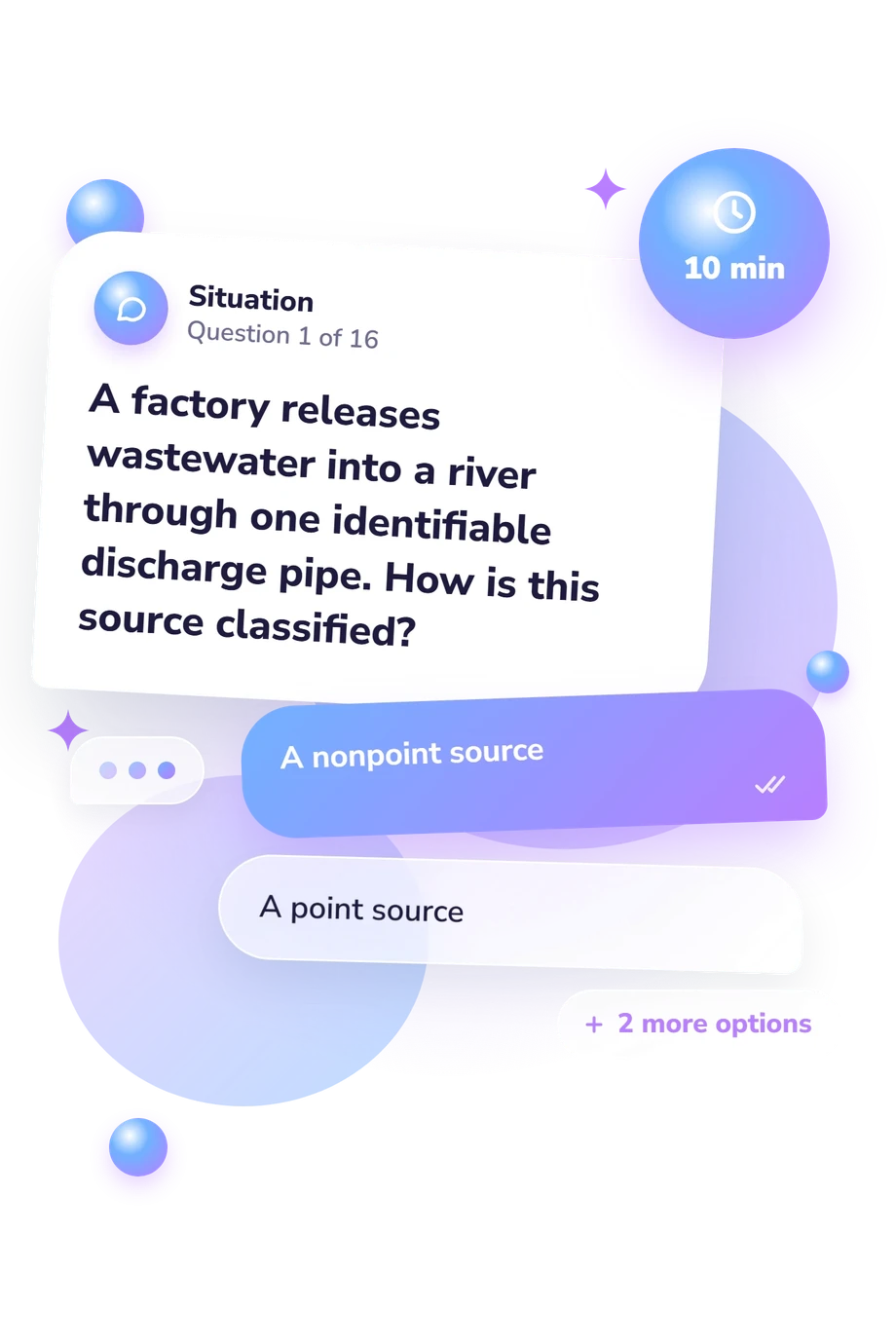
- A nonpoint source
- A point source
- Atmospheric deposition
- Natural background pollution
- Collect one sample far downstream during a single season
- Measure air temperature without testing the water
- Sample only the wastewater before it enters the stream
- Compare repeated samples upstream and downstream of the outlet
- Replacing soil with an impervious surface
- Maintaining a vegetated buffer strip beside the stream
- Clearing plants from the stream bank
- Applying fertilizer immediately before heavy rain
Water Pollution Quiz - Description and methodology of the test
People who want to check their understanding of aquatic contamination can use a quiz on water pollution as a focused learning exercise. It suits students, environmentally engaged readers, and anyone reviewing water-quality concepts before exploring a local issue. Its water pollution questions and answer choices cover sources, monitoring, chemical and biological effects, and prevention. The result places overall performance in an educational band that can guide general review.
What This Assessment Explores
This assessment checks whether a respondent can identify pollution pathways, interpret monitoring evidence, and connect environmental changes with effects on aquatic life. Its scenarios address discharge pipes, field and stormwater runoff, leaking tanks, mine drainage, pathogens, microplastics, thermal pollution, and nutrient-driven algal blooms.
Readers using this water pollution test can treat it as a structured check of practical environmental knowledge, not a measure of personal attitudes or field performance. The result uses the Water Pollution Knowledge scale (0-16) and three bands:
- Foundational (0-6) indicates emerging recognition of pollution concepts and a need to review movement, effects, and controls.
- Developing (7-12) indicates understanding of major sources and effects, with applied monitoring and prevention to strengthen.
- Strong (13-16) indicates broad skill in identifying pollutants, interpreting scenarios, and linking controls with outcomes.
This educational result describes performance on sampled topics, not professional certification.
Methodology and Scientific Basis
Each item presents a short environmental scenario with four answer choices. Tasks cover source classification, sampling comparisons, BOD, food-web concentration, treatment limits, land use, nutrient inputs, and other water-quality outcomes. The format is an applied knowledge check rather than a questionnaire about feelings or habits.
The questionnaire reports one total from performance across the selected items. This water pollution assessment turns that total into descriptive educational feedback through the displayed bands.
The emphasis is conceptually consistent with the 2021 study by Sholahuddin and colleagues, which connects environmental knowledge with scientific literacy and application; this questionnaire is not an adaptation of that instrument.
Water-specific literacy research, including the WELLS study reported by Irvin and colleagues in 2019, and environmental-health measurement work by Lichtveld and colleagues in 2019, supports separating knowledge from broader attitudes and behaviors. Terminology, scenario wording, familiarity with current coursework, and limited scenario coverage can affect performance; a high score cannot demonstrate field competence.
- Sholahuddin, Arif, Eko Susilowati, Binar Kurnia Prahani, and Erman Erman. Using a Cognitive Style-Based Learning Strategy to Improve Students’ Environmental Knowledge and Scientific Literacy. International Journal of Instruction, 2021;14(4):791-808. 10.29333/iji.2021.14445a
- Irvin, Veronica L., Diana Rohlman, Amelia Vaughan, Rebecca Amantia, Claire Berlin, and Molly L. Kile. Development and Validation of an Environmental Health Literacy Assessment Screening Tool for Domestic Well Owners: The Water Environmental Literacy Level Scale (WELLS). International Journal of Environmental Research and Public Health, 2019;16(5):881. 10.3390/ijerph16050881
- Lichtveld, Maureen Y., Hannah H. Covert, Mya Sherman, Arti Shankar, Jeffrey K. Wickliffe, and Cecilia S. Alcala. Advancing Environmental Health Literacy: Validated Scales of General Environmental Health and Environmental Media-Specific Knowledge, Attitudes and Behaviors. International Journal of Environmental Research and Public Health, 2019;16(21):4157. 10.3390/ijerph16214157
Updated: