
Waste Management Quiz
How the Scales are Structured
Who Usually Takes This Test?
See How You Compare
Below is a preview of how scores are typically distributed across each scale.
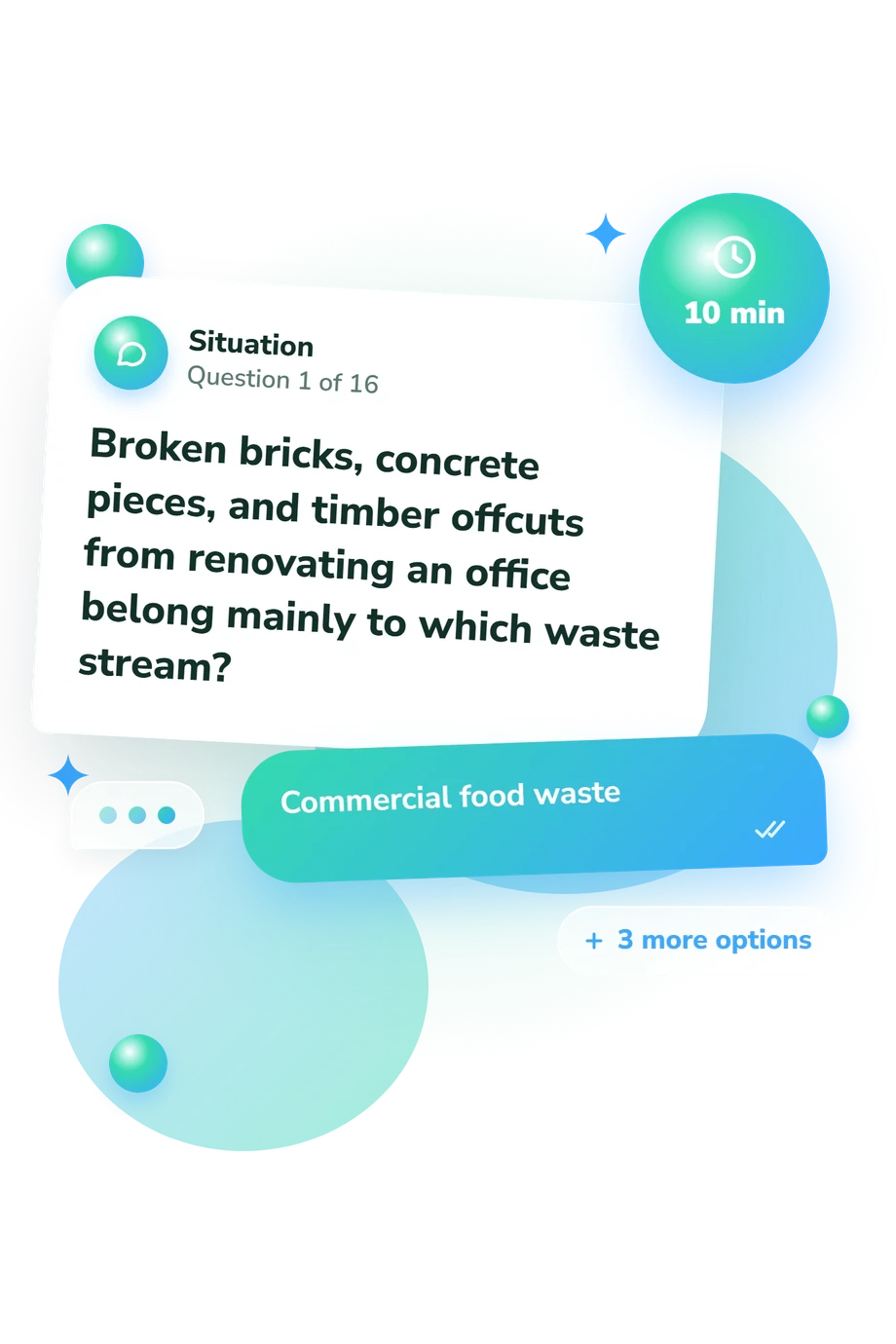
Example Questions From the Test
- Commercial food waste
- Household hazardous waste
- Agricultural waste
- Construction and demolition waste
- Residential or household waste
- Industrial waste
- Agricultural waste
- Construction and demolition waste
- To extract raw metal ore from the ground
- To sort and prepare collected recyclable materials for processing
- To manufacture every collected item into a new product on site
- To treat sewage before discharge
Waste Management Quiz - Description and methodology of the test
People who want a practical check of their waste-handling knowledge can use this waste management quiz to examine how they classify materials, choose collection routes, and apply prevention principles. It suits learners, household decision-makers, and anyone reviewing everyday environmental practices. Across the waste-management questions, the emphasis stays on practical decisions rather than abstract opinions. The result shows which concepts deserve further attention.
What This Assessment Explores
The items cover four knowledge areas:
- Identifying waste sources helps you distinguish household, industrial, agricultural, and construction streams.
- Choosing handling routes shows when electronics, batteries, paint thinner, and other hazardous materials need separate services.
- Applying prevention principles covers reuse, recycling, composting, source segregation, and materials recovery.
- Using environmental concepts tests your grasp of the waste hierarchy, circular design, landfill methane, and waste audits.
Together, these situations ask you to classify materials, select safer routes, and recognize preferred actions. As a waste management knowledge test, it measures understanding rather than personal character or commitment.
One catalogue scale, Waste Management Knowledge (0-16), is reported in three bands: Foundations to build (0-6), Developing knowledge (7-12), and Strong knowledge (13-16). The bands show consistency in identifying sources and applying management principles, while local acceptance and disposal rules may still require checking.
Methodology and Scientific Basis
Each item presents a concrete scenario followed by four answer choices. The respondent selects the most appropriate classification, treatment route, prevention measure, or operational step, so the format tests recognition of established waste-management practices rather than agreement with attitude statements.
The questionnaire is conceptually consistent with the SWM Knowledge and Attitudes Questionnaire (Dung et al., 2017), a nearby knowledge-oriented reference for solid-waste topics; this online form is not an adaptation of that instrument. Source separation also connects with Chen et al. (2017)'s study, while U.S. Environmental Protection Agency guidance supports the treatment of hierarchy, audits, recovery, and disposal principles.
The questionnaire does not state how many points each answer contributes or whether themes receive different weights. Its result therefore supports structured self-review, not comparison with a published norm. A free quiz on waste management can highlight gaps to revisit, yet performance may depend on prior instruction and familiarity with local collection rules. No published reliability, norms, or validity estimates are established for this exact online version.
- Dung, Mohammed Dauda, Mangut Mankilik, and Bernadette Ebele Ozoji. "Assessment of College Students' Knowledge and Attitudes Towards Solid Waste Management in North Central Zone of Nigeria." Science Education International 28, no. 2 (2017): 141-146. 10.33828/sei.v28.i2.7
- Chen, Haibin, Yan Yang, Wei Jiang, Mengjie Song, Ying Wang, and Tiantian Xiang. "Source separation of municipal solid waste: The effects of different separation methods and citizens' inclination-case study of Changsha, China." Journal of the Air & Waste Management Association 67, no. 2 (2017): 182-195. 10.1080/10962247.2016.1222317
- U.S. Environmental Protection Agency. Decision-Makers' Guide to Solid Waste Management, Volume II. EPA 530-R-95-023, 1995.
Updated: