
Engineering Quiz
How the Scales are Structured
Who Usually Takes This Test?
See How You Compare
Below is a preview of how scores are typically distributed across each scale.
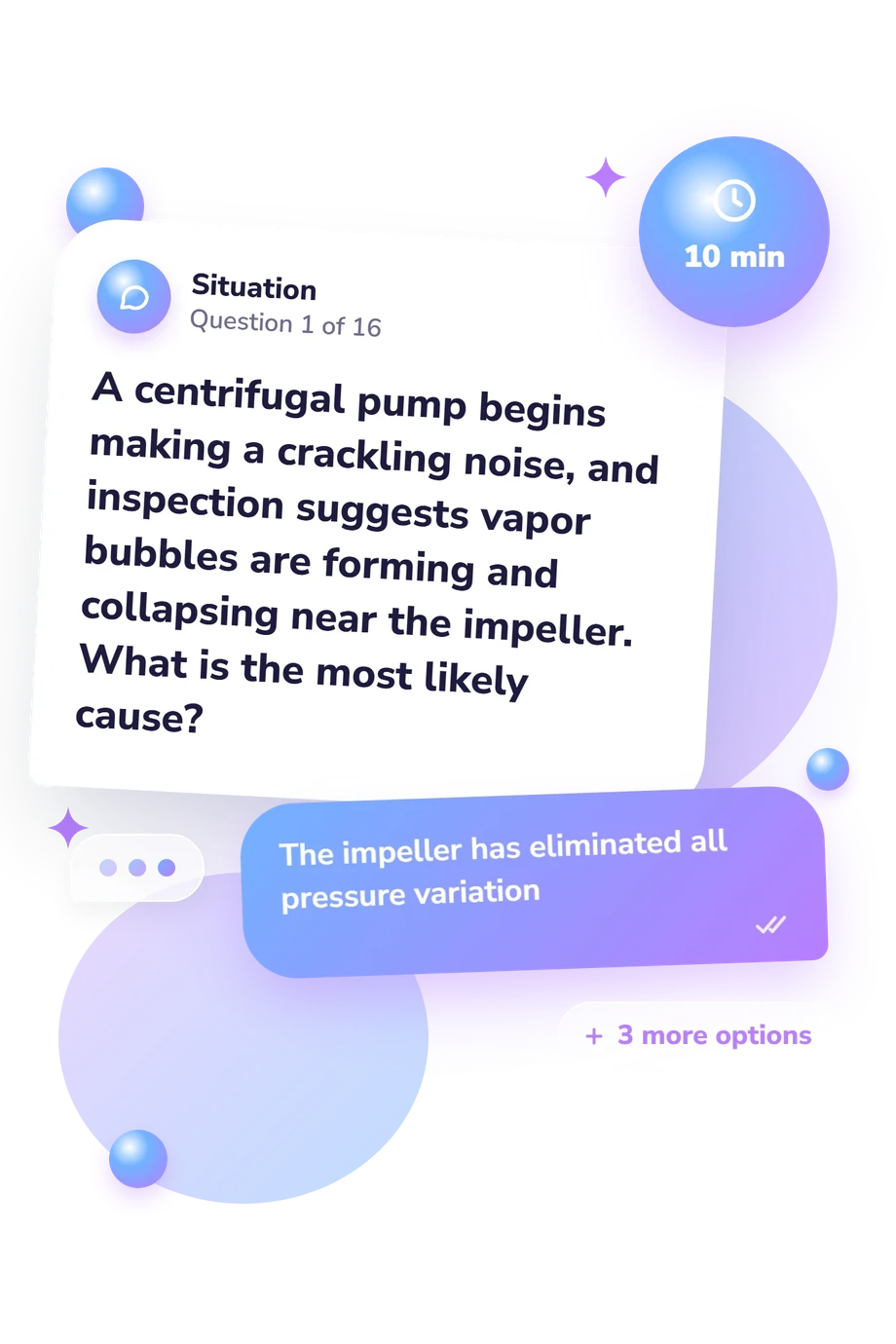
Example Questions From the Test
- Velocity and static pressure both increase
- Velocity and static pressure both decrease
- Velocity decreases while static pressure increases
- Velocity increases while static pressure decreases
- 9 Ω
- 5 Ω
- 2 Ω
- 5 Ω
- At the neutral axis
- At the outermost fibers, farthest from the neutral axis
- Uniformly throughout the cross-section
- Only at the centroid, regardless of loading
Engineering Quiz - Description and methodology of the test
People considering engineering study or work can use this engineering quiz to examine how they handle foundational technical ideas rather than to predict a specific profession. As an engineering career quiz, it suits learners, career explorers, and curious readers who want a structured starting point. The result can show whether core concepts feel secure and where targeted review may make future coursework more manageable.
What This Assessment Explores
This assessment samples engineering reasoning: interpreting physical relationships, selecting principles, and translating situations into technical answers. Readers treating it as a what type of engineering should i do quiz receive a foundation check, not a recommendation about a discipline.
The topics span areas. They ask whether you can recognize changing quantities, apply equations, and distinguish related concepts. Engineering Knowledge is an overall result, not a professional qualification or discipline-specific assessment: 0-16, with Foundations to strengthen (0-6), Developing command (7-12), and Strong command (13-16).
The themes show what the score can mean:
- Mechanics and materials show how you handle loads, stress, strain, and fatigue.
- Fluids and thermal principles show how you connect pressure, flow, energy, and resistance.
- Circuits and control test relationships in electrical networks and feedback systems.
- Measurement and design fundamentals reveal your grasp of accuracy, fits, dimensions, and safety factors.
Methodology and Evidence Base
Each item presents a scenario with four answer choices. You select the principle that best explains it, so the format tests applied conceptual understanding rather than extended calculation or design execution. Scoring condenses performance into the displayed result.
The approach is conceptually consistent with the FE Mechanical Exam Specifications (NCEES, 2020), which group foundational knowledge across mechanics, materials, fluids, thermal systems, measurements, and controls. It is not an adaptation of that examination. Strimel and colleagues’ taxonomy supports reading it as a cross-topic sample.
Readers using it as a should i be an engineer quiz can treat the outcome as a reflection point: a stronger band suggests firmer fundamentals, while a lower band highlights topics to review. It does not establish readiness for university study, licensure, or a specialization.
Jorion and colleagues’ framework stresses that assessment claims need evidence beyond content coverage. This questionnaire has no supplied norm group, reliability estimate, or professional standardization; results may reflect study, guessing, attention, and item wording. Used as a what type of engineer should i be quiz, it should be paired with exploration of interests and preparation.
- National Council of Examiners for Engineering and Surveying (NCEES). Fundamentals of Engineering (FE) Mechanical CBT Exam Specifications: Effective Beginning with the July 2020 Examinations. NCEES, 2020.
- Strimel, Greg, Tanner Huffman, Michael Grubbs, Eunhye Kim, and Jamie Gurganus. "Establishing a Content Taxonomy for the Coherent Study of Engineering in P-12 Schools." Journal of Pre-College Engineering Education Research, vol. 10, no. 1, Article 4, 2020. 10.7771/2157-9288.1232
- Jorion, Natalie, Brian D. Gane, Katie James, Lianne Schroeder, Louis V. DiBello, and James W. Pellegrino. "An Analytic Framework for Evaluating the Validity of Concept Inventory Claims." Journal of Engineering Education, vol. 104, no. 4, pp. 454-496, 2015. 10.1002/jee.20104
Updated: