
Time Management Quiz
How the Scales are Structured
Who Usually Takes This Test?
See How You Compare
Below is a preview of how scores are typically distributed across each scale.
Example Questions From the Test
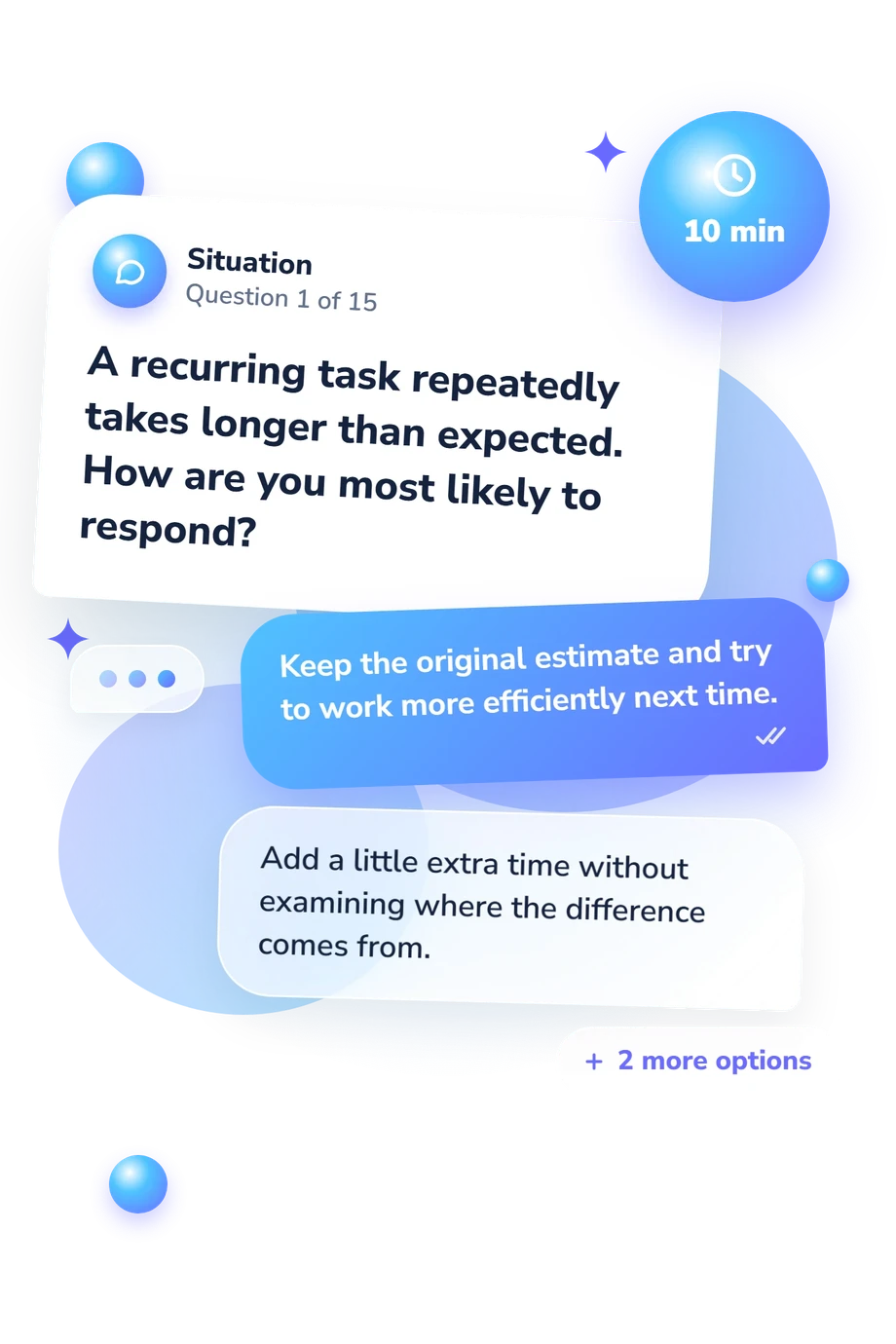
- Keep the original estimate and try to work more efficiently next time.
- Add a little extra time without examining where the difference comes from.
- Compare estimates with actual duration, identify the cause, and update future plans.
- Increase the estimate based on the most recent occurrence.
- Wait until I feel enough pressure or motivation to tackle it.
- Complete a few easier tasks first to build momentum.
- Set a start time and define a small, concrete first step.
- Open the relevant materials and explore them until a direction becomes clear.
- I work in focused periods mainly when a deadline is close.
- I reserve focused time for important work and give each period a specific target.
- I set aside time to work but decide what to tackle after the period begins.
- I prefer to remain available and move among tasks as needs arise.
Time Management Quiz - Description and methodology of the test
People who want a clearer picture of how they handle competing demands can use the time management quiz to examine everyday choices rather than abstract productivity ideals. As a task planning assessment, it suits students, employees, and anyone organizing several responsibilities at once. The profile highlights patterns in attention, planning, and adjustment, giving you practical themes to reflect on rather than a single label.
What This Assessment Explores
The questionnaire examines how people start demanding work, protect attention, choose priorities, estimate effort, and adjust when plans change. Its situations fit study, employment, household duties, and mixed schedules.
As a time management skills quiz, it shows whether attention, planning, or adaptation is more or less consistent. These are the dimensions reported:
- Focus & Follow-Through (0-15) measures starting work, managing distractions, restarting, and finishing. Circumstance-led attention (0-5), Inconsistent follow-through (6-10), and Protected execution (11-15) are the displayed bands.
- Prioritization & Planning (0-15) measures identifying priorities, creating workable actions, and making trade-offs. Reactive planning (0-5), Developing structure (6-10), and Deliberate planning (11-15) are the displayed bands.
- Time Awareness & Adaptation (0-15) measures duration estimates, time awareness, and plan revision. Limited calibration (0-5), Emerging calibration (6-10), and Adaptive time awareness (11-15) are the displayed bands.
Methodology and Scientific Basis
Each item presents a familiar situation with several response choices. The options describe behavior rather than test knowledge, and responses are combined into the three dimensions. Because point values are not published, no unlisted scoring formula should be inferred.
The structure is conceptually consistent with the Time Management Behavior Scale (Macan et al., 1990), particularly its focus on planning behavior and perceived control over time. Britton and Tesser (1991) connect time-management practices with academic performance; Imura et al. (2016) add a measurement perspective involving time management and stress; Aeon et al. (2021) provide broader evidence about effectiveness. These sources support interpretation of the themes, but this questionnaire is not an adaptation or validated administration of those instruments.
Used as a time management self assessment quiz, the profile helps you compare habits with your schedule and select one change to test. Without published norms, reliability estimates, or a documented option-to-score conversion, its bands describe response patterns rather than population cutoffs; current pressures and self-awareness may influence results.
- Macan, Therese Hoff, Comila Shahani, Robert L. Dipboye, and Amanda P. Phillips. (1990). College Students' Time Management: Correlations With Academic Performance and Stress. Journal of Educational Psychology, 82(4), 760-768. 10.1037/0022-0663.82.4.760
- Imura, Tomoya, Masahiro Takamura, Yoshihiro Okazaki, and Satoko Tokunaga. (2016). Construction of the Time Management Scale and examination of the influence of time management on psychological stress response. Shinrigaku Kenkyu, 87(4), 374-383. 10.4992/jjpsy.87.15212
- Britton, Bruce K., and Abraham Tesser. (1991). Effects of Time-Management Practices on College Grades. Journal of Educational Psychology, 83(3), 405-410. 10.1037/0022-0663.83.3.405
- Aeon, Brad, Aïda Faber, and Alexandra Panaccio. (2021). Does time management work? A meta-analysis. PLOS ONE, 16(1), e0245066. 10.1371/journal.pone.0245066
Updated: