
TG TF Quiz
How the Scales are Structured
Who Usually Takes This Test?
See How You Compare
Below is a preview of how scores are typically distributed across each scale.
Example Questions From the Test
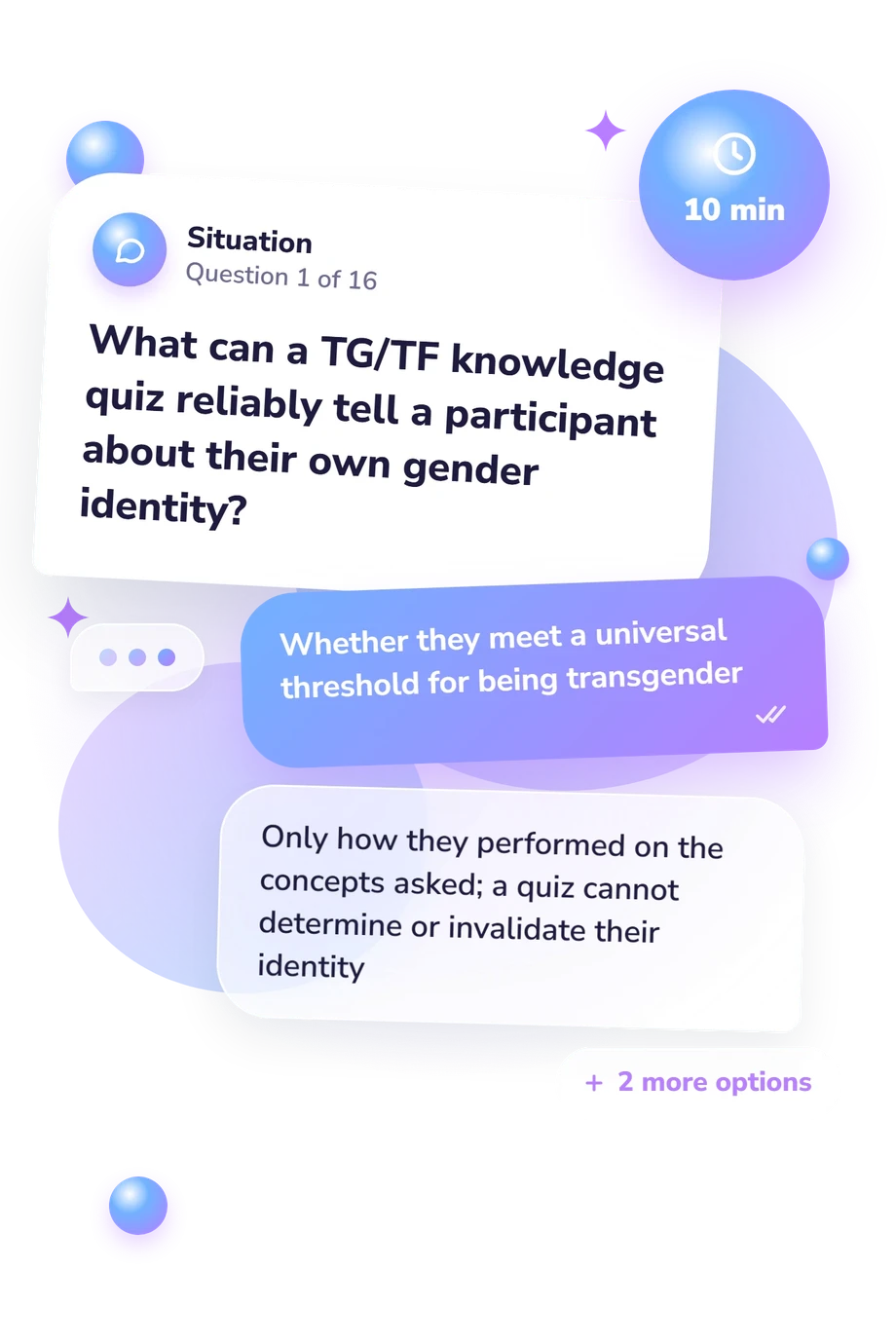
- Whether they meet a universal threshold for being transgender
- Only how they performed on the concepts asked; a quiz cannot determine or invalidate their identity
- Whether friends and family will accept their identity
- Which medical transition steps they should pursue
- Traditional femininity
- Transformation, referring to a character changing form, body, species, or other traits
- Trans-focused autobiography
- A formal clinical category for gender identity
- His clothing means that his gender identity must be changing
- Makeup makes his identity nonbinary regardless of how he identifies
- His gender expression can vary without changing his identity as a man
- Gender identity applies only when expression follows traditional expectations
TG TF Quiz - Description and methodology of the test
People who want to distinguish transgender terminology from transformation-fiction language can use this assessment to check their performance on the concepts and scenarios tested, including principles of respectful communication. The TG TF Quiz offers a focused knowledge check for readers exploring identity, expression, transition, privacy, and gender-affirming communication. Several TG transformation quiz questions in this assessment address how fictional change differs from lived identity.
What This Assessment Explores
This assessment examines knowledge that is often blurred in casual conversation and online fiction. Items distinguish gender identity from expression, define transgender, cisgender, nonbinary, deadnaming, and gender euphoria, and show that transition may involve social, legal, or medical steps without one required path.
Respectful conduct is another focus. A TG TF knowledge quiz result indicates how consistently the respondent handled the concepts represented here; it does not establish identity, intention, or personal experience.
The main themes are grouped as follows:
- Identity and expression are related, but outward presentation does not define someone’s gender.
- Transition and terminology show that social, legal, or medical steps have no single required route.
- Privacy and communication involve consent, names, pronouns, corrections, and inclusive forms.
- Transformation fiction and context separate fictional change from claims about real lives.
Methodology and Scientific Basis
Each item presents multiple-choice responses contrasting accurate distinctions with common misconceptions. Selecting the best answer tests recognition and application rather than emotional disclosure. The transformation fiction quiz items in this questionnaire treat fictional body change as narrative, not evidence about an author’s or reader’s gender.
The score uses TG/TF Knowledge (0-16): Foundation to build (0-6) calls for review of core distinctions; Developing knowledge (7-12) reflects substantial but incomplete understanding; Strong knowledge (13-16) reflects consistent command of the tested material. The labels describe performance; community language varies with context.
Its closest conceptual reference is the T-KAB Scale (Clark & Hughto, 2020), a published measure of transgender knowledge, attitudes, and beliefs. This questionnaire is conceptually consistent with that work, while its displayed bands are catalogue-defined performance levels for the tested knowledge. APA guidance and Coleman et al. (2022) address identity-expression distinctions, varied transition paths, and privacy-aware language.
Context and attention can affect performance, especially when distinguishing identity, expression, transition, privacy, and transformation-fiction language; use the score to identify learning needs and support reflection, not determine identity or diagnosis.
- Clark, K. A., & Hughto, J. M. W. (2020). Development and psychometric evaluation of the Transgender Knowledge, Attitudes, and Beliefs (T-KAB) Scale. Sexuality Research and Social Policy, 17(3), 353-363. 10.1007/s13178-019-00399-9
- American Psychological Association. (2015). Guidelines for psychological practice with transgender and gender nonconforming people. American Psychologist, 70(9), 832-864. 10.1037/a0039906
- Coleman, E., Radix, A. E., Bouman, W. P., et al. (2022). Standards of care for the health of transgender and gender diverse people, version 8. International Journal of Transgender Health, 23(Suppl. 1), S1-S259. 10.1080/26895269.2022.2100644
Updated: