
Speed Velocity and Acceleration Quiz
How the Scales are Structured
Who Usually Takes This Test?
See How You Compare
Below is a preview of how scores are typically distributed across each scale.
Example Questions From the Test
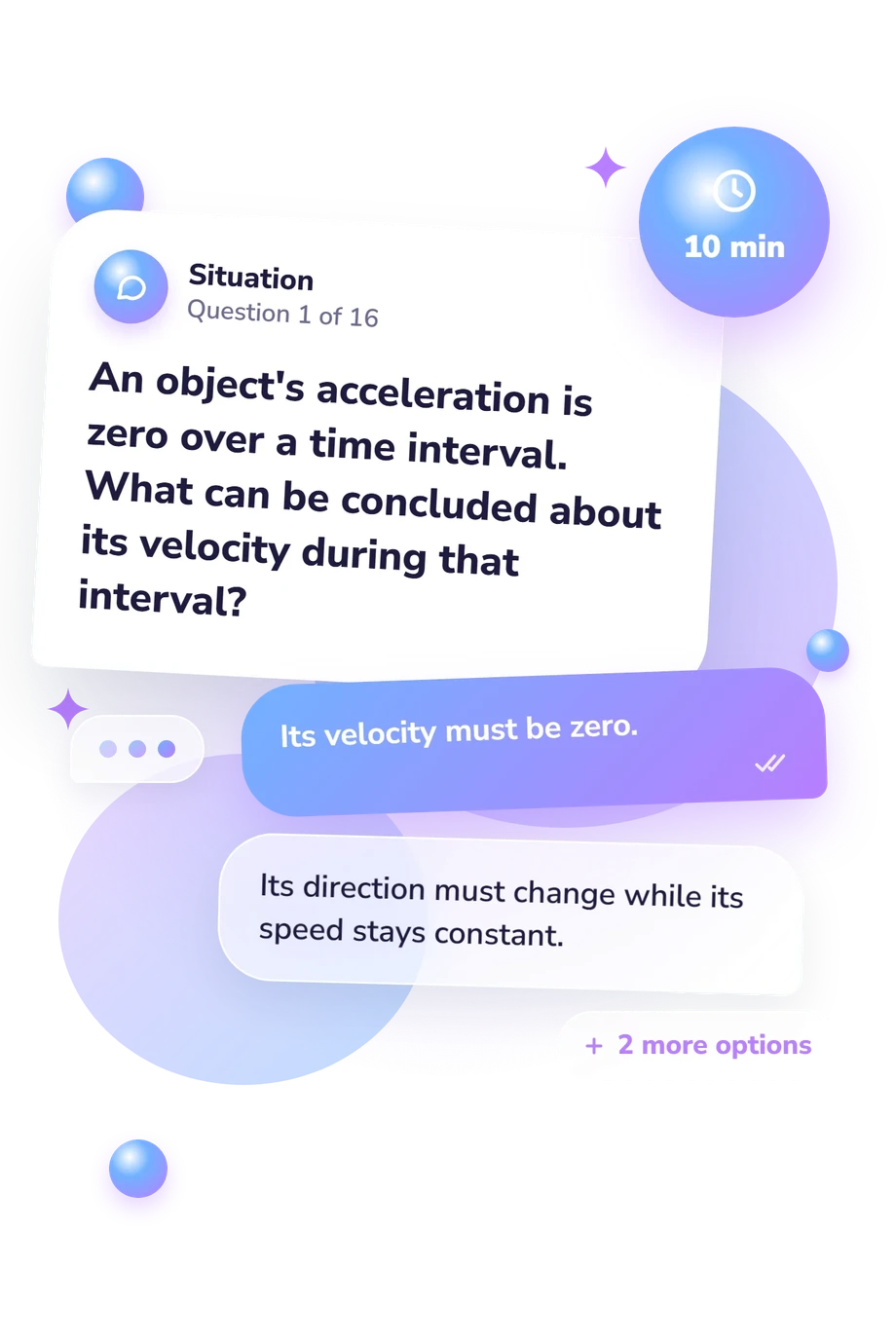
- Its velocity must be zero.
- Its direction must change while its speed stays constant.
- Its speed must decrease at a constant rate.
- Its velocity remains constant, though it may be zero or nonzero.
- The object is stationary and has constant acceleration.
- The object travels 8 meters in total.
- The object has constant velocity and zero acceleration.
- The object's velocity increases by 8 m/s each second.
- Average acceleration
- Final speed
- Displacement
- Total elapsed time
Speed Velocity and Acceleration Quiz - Description and methodology of the test
Students, teachers, and learners can use this assessment to check whether ideas about changing motion make sense. The Speed Velocity and Acceleration Quiz focuses on distinctions that cause errors, from direction and displacement to graph interpretation and unit conversion. It offers a way to identify which concepts you can apply consistently and which deserve another example. Questions in this speed and velocity quiz support problem-set review by linking definitions to direction, displacement, graphs, and unit conversion.
What This Assessment Explores
Motion is treated as several connected ideas rather than a single ability. The questions examine whether learners can separate scalar speed from directional velocity, relate acceleration to changing velocity, and apply those distinctions to trips, graphs, circular motion, and gravity. The velocity and acceleration quiz suits students revising introductory mechanics.
These thematic groups show what the result samples:
- Definitions show whether speed, velocity, and acceleration are kept conceptually distinct.
- Graphs and scenarios show whether displacement, direction, and changing motion are interpreted correctly.
- Calculations show whether formulas, SI units, and metric conversions are applied accurately.
The single reported scale, Speed, Velocity, and Acceleration Knowledge (0-16), summarizes these areas. Foundation Building (0-6) signals review needs; Developing Knowledge (7-12) reflects mostly secure ideas with some graph or directional practice needed; Strong Knowledge (13-16) indicates consistent application.
Methodology and Scientific Basis
Each item presents a physics question with four answer choices. The set moves between definition checks, reasoning, graph reading, calculation, and unit conversion. The questionnaire reports one total rather than dimension scores; the response options are used to place performance in bands, but no item-weighting rule is stated.
Conceptually, the content is consistent with the Kinematics Concept Test, a kinematics concept assessment, but the questionnaire is a knowledge check and is not a direct adaptation or restandardized edition of that instrument. OpenStax’s physics treatment supports the relationships among displacement, velocity, acceleration, and formulas, while NIST’s SI reference supports the unit conventions.
The result from this speed, velocity, and acceleration test is a focused knowledge check of the motion concepts covered. No standardization data, reliability coefficients, or norm-based interpretation are stated for this version, so the bands describe performance on this question set rather than standing relative to a reference population. Results can reflect prior practice, graph-reading skill, and familiarity with unit conversions; use missed topics to guide review rather than treating the total as a complete measure of physics ability.
- A. Lichtenberger, C. Wagner, S. I. Hofer, E. Stern, and A. Vaterlaus, “Validation and structural analysis of the kinematics concept test,” Physical Review Physics Education Research, 13(1), 010115 (2017). 10.1103/PhysRevPhysEducRes.13.010115
- Paul Peter Urone and Roger Hinrichs, College Physics 2e, OpenStax, Houston, Texas (2022). ISBN: 978-1-951693-60-2
- David B. Newell and Eite Tiesinga, The International System of Units (SI), 2019 Edition, NIST Special Publication 330, National Institute of Standards and Technology, Gaithersburg, Maryland (2019). 10.6028/NIST.SP.330-2019
Updated: