
Spanish Quiz
How the Scales are Structured
Who Usually Takes This Test?
See How You Compare
Below is a preview of how scores are typically distributed across each scale.
Example Questions From the Test
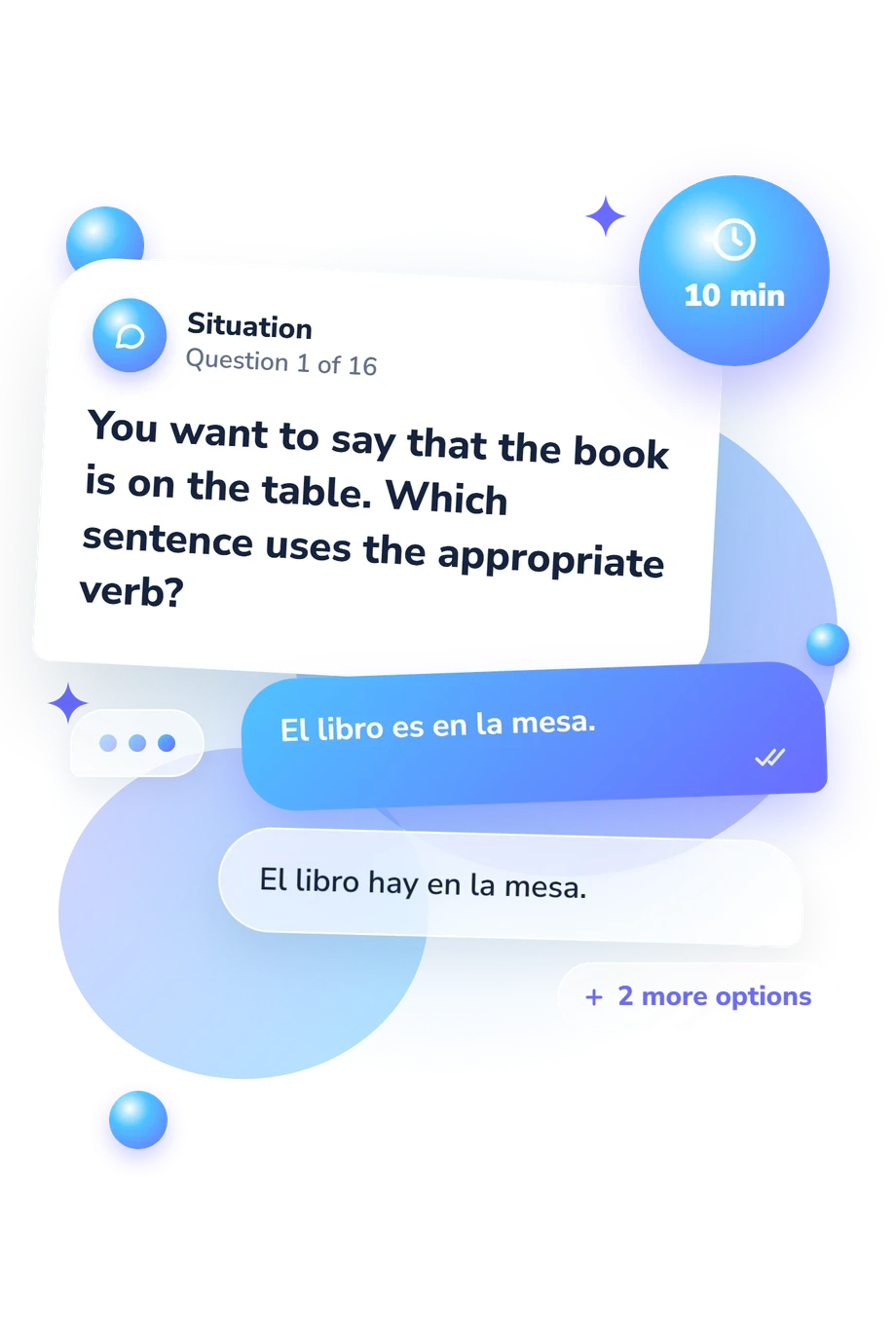
- El libro es en la mesa.
- El libro hay en la mesa.
- El libro está en la mesa.
- El libro tiene en la mesa.
- Pregnant
- Annoyed
- Confused
- Embarrassed
- Tengo agua, por favor.
- Quisiera agua, por favor.
- Busco el agua, por favor.
- Me gusta agua, por favor.
Spanish Quiz - Description and methodology of the test
For learners who want a quick sense of their practical Spanish ability, this Spanish quiz offers a focused starting point. It is especially useful for people choosing study materials, checking whether basic lessons have become usable, or deciding which areas deserve more attention. This quiz in Spanish makes that self-check concrete by linking individual answers to an overall knowledge level.
What This Assessment Explores
Rather than testing conversation fluency, the questionnaire samples recognition and controlled use of common Spanish. Its items cover vocabulary meaning, verb forms, agreement, pronouns, tense and mood, polite requests, location, time, and everyday phrases. Contexts such as cafés, travel, greetings, and routine descriptions show whether a rule can be applied rather than recalled in isolation.
Learners using this quiz for Spanish beginners can interpret the general band shown, while more experienced learners may use their individual answers to review particular areas. The assessment does not describe accent, listening comprehension, spontaneous speaking, writing, or interactional flexibility.
The result is reported on one scale:
- Spanish Knowledge: 0-16 measures how reliably the respondent handles the vocabulary, grammar, and practical usage represented here. Foundations to build covers 0-6, Developing knowledge covers 7-12, and Strong knowledge covers 13-16.
These bands describe performance on this set of tasks and help identify what to review next.
Methodology and Evidence Base
Each question is a four-option multiple-choice item with one answer that best fits the meaning, form, or context. The format combines vocabulary recognition with discrete grammar decisions involving verb forms, pronouns, agreement, prepositions, tense, and mood. The displayed result summarizes these item types without a separate score for every topic.
The Spanish Vocabulary and Grammar Test (VGT) offers a relevant comparison for these skills. This questionnaire is conceptually consistent with the VGT’s objective Spanish proficiency tasks, but it is not an adaptation of that instrument. Montrul’s DELE materials offer broader proficiency-testing context, while Duffield and White show how targeted Spanish grammar tasks can examine forms such as clitic placement.
Alongside Spanish 1 materials, it serves as a short instructional checkpoint during Spanish 1 quiz practice. The displayed interpretation organizes performance, but no population norms, reliability estimate, or diagnostic threshold should be inferred. Prior instruction, exposure to different varieties, attention, and guessing can affect performance, while this short sample cannot represent the full range of communicative ability. Use it to guide broader review of listening, speaking, reading, and writing.
- Luque, Alicia, Bryan Koronkiewicz, Bernard Issa, Mandy Faretta-Stutenberg, and Harriet Wood Bowden. "Ecological validity and inclusivity in heritage bilingualism research: Examining objective and subjective Spanish proficiency assessments and language experience factors." Frontiers in Language Sciences, 3, Article 1400587, 2025. 10.3389/flang.2024.1400587
- Montrul, Silvina. "DELE Proficiency Test." National Heritage Language Resource Center, University of California, Los Angeles, 2012.
- Duffield, Nigel, and Lydia White. "Assessing L2 knowledge of Spanish clitic placement: converging methodologies." Second Language Research, 15(2), 133-160, 1999. 10.1191/026765899668237583
Updated: