
Simile and Metaphor Quiz
How the Scales are Structured
Who Usually Takes This Test?
See How You Compare
Below is a preview of how scores are typically distributed across each scale.
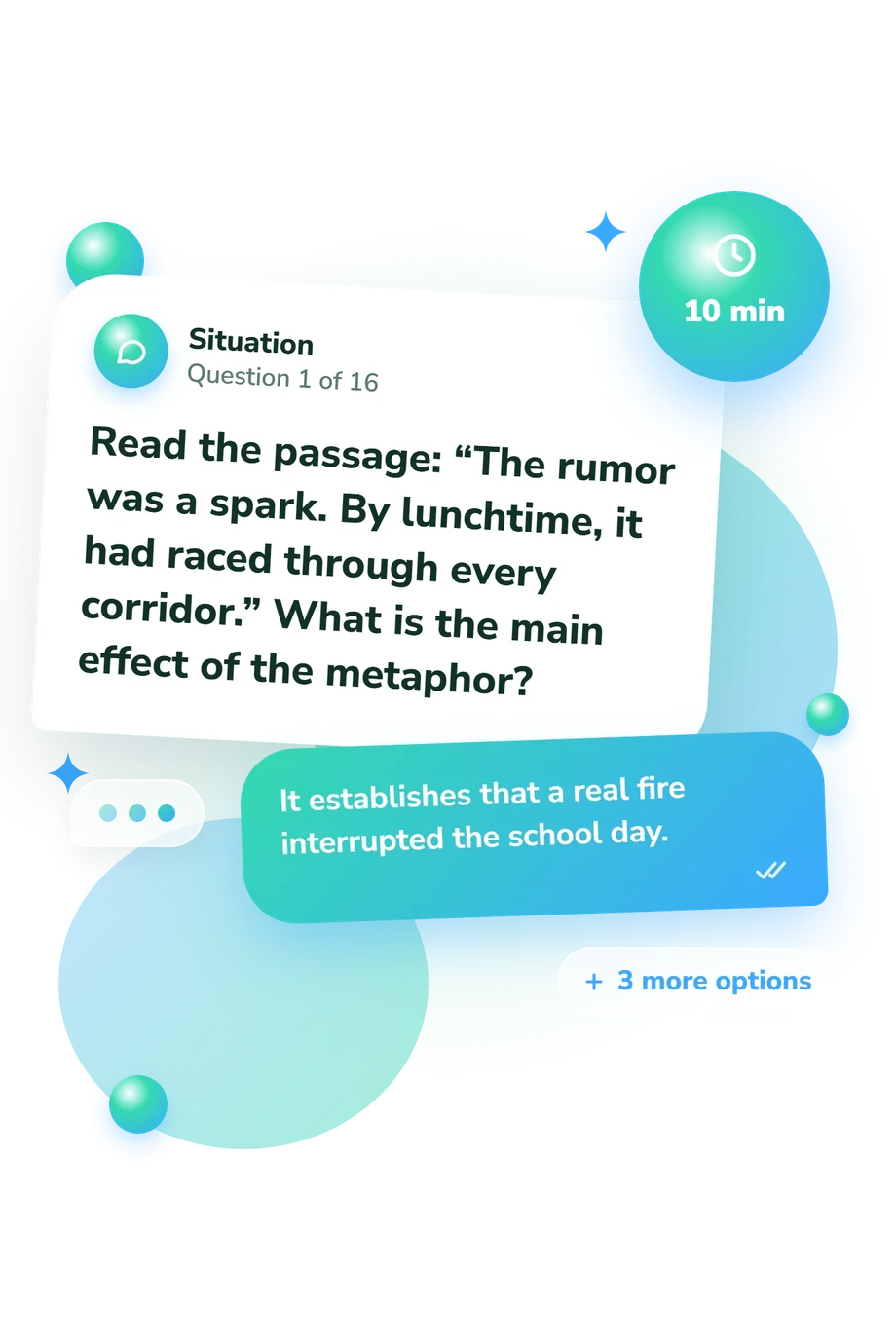
Example Questions From the Test
- The calm lake reflected the trees along its shore.
- The lake glittered like glass in the sunlight.
- The lake was a mirror beneath the morning sky.
- The lake wore a bright coat of afternoon sunlight.
- Curiosity can provide exact answers to every question.
- The student should use a physical compass while studying.
- Curiosity prevents a person from changing direction.
- Curiosity can help a person choose a direction for learning.
- The runner was a stream winding through the pack.
- The runner moved smoothly through the group ahead.
- The runner flowed through the pack like a stream around stones.
- The pack opened its arms and welcomed the runner.
Simile and Metaphor Quiz - Description and methodology of the test
Readers who want to strengthen their understanding of figurative language can use this assessment to choose areas for review and practice. As a simile and metaphor test, it suits learners, teachers, writers, and curious readers deciding whether they need clearer distinctions between direct comparisons, implied images, and coherent extended meanings. The simile and metaphor quiz presents a focused knowledge result that can guide study or writing practice.
What This Assessment Explores
These items examine whether a reader can identify similes and metaphors, explain meaning in context, and judge whether an image fits a purpose. They cover literal wording, implied comparisons, extended metaphors, and coherent revisions.
For this questionnaire, the simile vs metaphor quiz format emphasizes practical application: each answer depends on linking an image to the quality or effect it conveys, not merely recalling terminology.
The main result reflects four abilities:
- Recognizing similes shows whether like or as signals an explicit comparison.
- Recognizing metaphors shows whether direct or implied comparisons are understood.
- Interpreting context shows whether an image conveys its intended meaning.
- Tracking extended comparisons shows whether related details stay coherent.
Simile and Metaphor Knowledge runs from 0-16: Foundations to build (0-6), Developing knowledge (7-12), and Strong knowledge (13-16).
Methodology and Scientific Basis
Items use short examples and direct concept questions, with four answer choices covering identification, interpretation, comparison, definition, and revision. The respondent selects the option that best identifies a device, explains meaning, compares forms, defines a concept, or revises wording for a stated purpose. This combination tests recognition, interpretation, and application.
This questionnaire's combined metaphor-and-simile quiz format produces one displayed knowledge score; no separate weighting system, norm group, or diagnostic cutoff is specified. Read the band as performance on this learning-oriented set, not as general language ability.
Reynolds and Ortony examined metaphor comprehension, while Seidenberg and Bernstein studied comprehension of both similes and metaphors. Oka, Ohshima, and Kusumi developed an item set for simile interpretation, and Bowdle and Gentner proposed a theory of metaphor development and use. The questionnaire is conceptually consistent with these distinctions and theory, but it is not an adaptation of those instruments or studies, which do not validate this questionnaire.
Attention, prior teaching, and current context can affect performance. The result is best used as a focused snapshot for identifying topics for further study and practice.
- Reynolds, Ralph E., and Andrew Ortony. (1980). Some Issues in the Measurement of Children's Comprehension of Metaphorical Language. Child Development, 51(4), 1110-1119. 10.2307/1129551
- Seidenberg, Pearl L., and Deena K. Bernstein. (1986). The Comprehension of Similes and Metaphors by Learning Disabled and Nonlearning-Disabled Children. Language, Speech, and Hearing Services in Schools, 17(3), 219-229. 10.1044/0161-1461.1703.219
- Oka, Ryunosuke, Hiroaki Ohshima, and Takashi Kusumi. (2018). Development and validation of an item set of simile interpretations for metaphor research. The Japanese Journal of Psychology, 90(1), 53-62. 10.4992/jjpsy.90.17236
- Bowdle, Brian F., and Dedre Gentner. (2005). The Career of Metaphor. Psychological Review, 112(1), 193-216. 10.1037/0033-295X.112.1.193
Updated: