
Do I Have a Crush on a Fictional Character Quiz
How the Scales are Structured
Who Usually Takes This Test?
See How You Compare
Below is a preview of how scores are typically distributed across each scale.
Example Questions From the Test
- Hardly ever; my attention usually moves on with the story.
- Occasionally, especially after a memorable scene.
- Often for a while afterward, even when I am doing something else.
- Very often; thoughts of them keep resurfacing throughout my day.
- I appreciate what the moment contributes to the plot.
- I feel sympathy, much as I would for many characters.
- I feel unusually tender or protective toward them.
- I feel a deep personal ache or longing to comfort them.
- Watching how they react to ordinary modern life.
- Showing them places or activities I think they would enjoy.
- Spending private time together and getting to know each other.
- Discovering that they are romantically attracted to me too.
Do I Have a Crush on a Fictional Character Quiz - Description and methodology of the test
People wondering whether a fictional character has become more than a passing interest can use the Do I Have a Crush on a Fictional Character Quiz to examine that feeling. It helps fans reflect on attachment, fantasy, and balance in everyday life. Rather than classify obsession, this quiz examines the attention, mood, routines, expectations, and fantasy that the Am I Obsessed With a Fictional Character Quiz brings into focus.
What This Assessment Explores
The items in this fictional character crush quiz examine more than enjoyment: they cover anticipation, recurring thoughts, jealousy, imagined closeness, protectiveness, comparisons with real-world attraction, and the way interest can shape attention and mood. The profile shows whether this connection stays within story enjoyment or becomes emotionally vivid, imaginative, and influential in daily life.
The three displayed dimensions are:
- Emotional Attraction (0-15) measures emotional pull, excitement, longing, and affectionate attention; bands: Light Interest (0-5), Noticeable Attraction (6-10), Strong Emotional Pull (11-15).
- Everyday Influence and Balance (0-15) measures effects on time, mood, expectations, routines, and real-world comparisons; bands: Limited Influence (0-5), Meaningful Presence (6-10), Strong Everyday Influence (11-15).
- Romantic Imagination (0-15) measures imagined conversations, affection, mutual attraction, and alternate stories; bands: Story-Focused Imagination (0-5), Occasional Romantic Fantasy (6-10), Vivid Romantic Inner World (11-15).
Methodology and Evidence Base
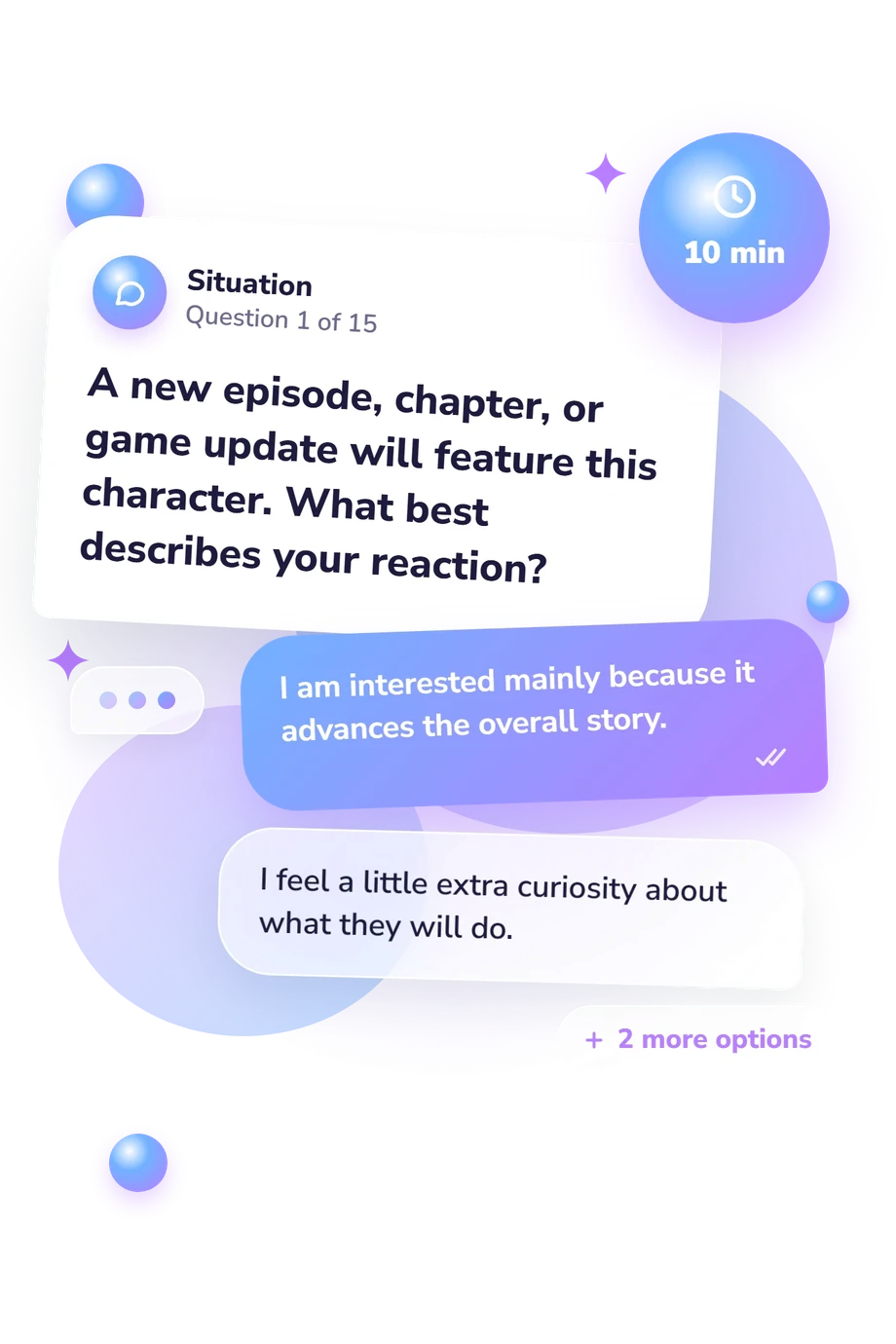
Each item in this fictional character attraction test presents a situation with four ordered response options, moving from little involvement to stronger emotional, imaginative, or everyday impact. Prompts cover new content, recurring thoughts, jealousy, bedtime fantasy, fandom spending, task interruption, and openness to real-world connection.
Scores are displayed separately for the three dimensions. Since item-to-point conversion is unspecified, the bands are reflective categories rather than population norms or clinical cutoffs.
The questionnaire is conceptually consistent with Karhulahti and Välisalo’s account of fictional-character attachment. It is likewise consistent with Liebers and Straub on fantasy and romantic parasocial involvement, and Tukachinsky on para-romantic love and para-friendships. Risco and Mills describe related scale development, but this questionnaire is not that scale or a validated adaptation.
Results should be read alongside current mood, self-awareness, and honest reporting: attraction may be strong while romantic fantasy stays limited; vivid fantasy may remain contained when everyday influence is low; and high everyday influence suggests effects on routines or expectations. Because this online questionnaire has no standardized diagnostic status, persistent disruption calls for broader assessment.
- Karhulahti, V.-M., & Välisalo, T. (2021). Fictosexuality, Fictoromance, and Fictophilia: A Qualitative Study of Love and Desire for Fictional Characters. Frontiers in Psychology, 11, 575427. 10.3389/fpsyg.2020.575427
- Liebers, N., & Straub, R. (2020). Fantastic relationships and where to find them: Fantasy and its impact on romantic parasocial phenomena with media characters. Poetics, 83, 101481. 10.1016/j.poetic.2020.101481
- Risco, S., & Mills, D. J. (2025). Development of the Relationship with Fictional Character Scale (RFCS): Differences Between Parasocial Relationship Profiles. OSF Preprints. 10.31234/osf.io/5bqjf_v1
- Tukachinsky, R. H. (2010). Para-romantic love and para-friendships: Development and assessment of a multiple-parasocial relationships scale. American Journal of Media Psychology, 3(1/2), 73-94.
Updated: